

The Pass-Through Problem
How 2026 Tariffs Are Concentrating Margin Compression at the One Layer of the Space Industrial Base That Can’t Absorb It

WHAT THIS MEANS
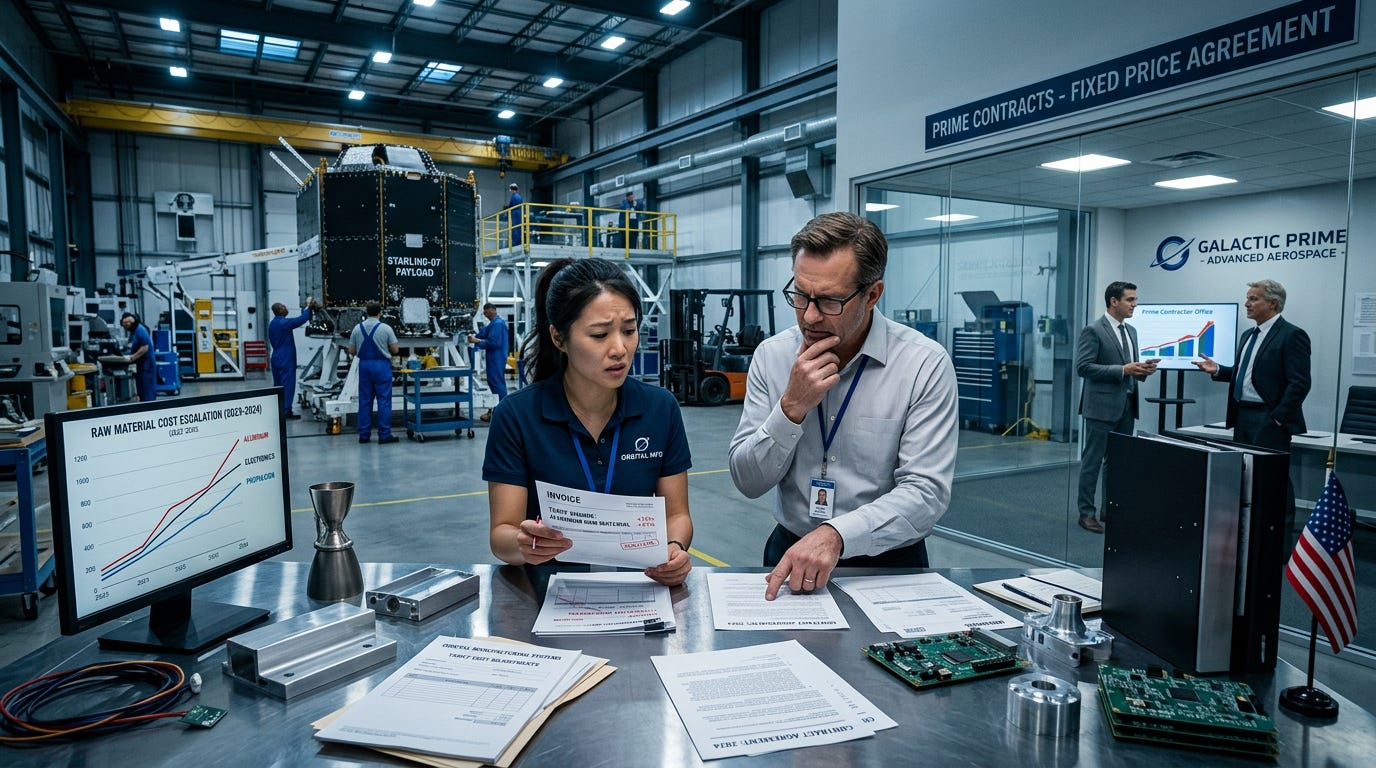
The 2026 tariff stack — 50% on aluminum articles, 25% on finished derivative assemblies, and 10–17% on GaN and SiC electronics — is not landing evenly across the space industrial base. Tier-1 primes on cost-plus and IDIQ contracts have Economic Price Adjustment (EPA) clauses that allow them to pass costs upstream. Most of their Tier-2 and Tier-3 subcontractors do not. The result is a structural margin squeeze concentrated at the mid-tier manufacturing layer — the $50M–$500M firms that build the satellite buses, power subsystems, and propulsion components that every major space program depends on. Supply-chain leaders and CFOs at these companies have a narrow window to pursue FAR 52.229-3(c) notifications, contract modification requests, and sourcing pivots before tariff absorption permanently erodes their operating position.
Somewhere in the United States right now, a mid-tier space manufacturer is staring at a purchase order for aluminum 7075 that costs 33% more than it did when they signed their government subcontract. Their gallium nitride (GaN) components are up somewhere between 12% and 17%. Their propulsion sub-assemblies are absorbing specialty metal surcharges that weren’t in anyone’s cost model eighteen months ago. And their prime contractor, the company they’re building parts for, is largely insulated from all of it.
That asymmetry is not an accident. It is the predictable result of how the space industrial base prices fixed-price government contracts, and it is about to matter enormously to program schedules, supplier finances, and the production ramps that the current defense and commercial procurement wave depends on.
The Signal That Arrived on April 6
On April 6, 2026, the Trump Administration restructured how Section 232 tariffs apply to derivative products containing steel, aluminum, and copper. The new rule distinguishes between two product classes. Aluminum articles themselves (Annex I-A) now carry a 50% tariff on full customs value. Finished derivative products substantially made of aluminum (Annex I-B), the category that includes most space-grade structural assemblies imported as integrated units, carry a 25% tariff on full customs value. The previous method calculated the tariff only on the embedded metal content of a finished assembly, not the entire article value. For space-grade assemblies crossing international borders as finished goods before final integration, the April 6 change is a net cost increase, not a technical adjustment.
Three forces are now converging simultaneously. Tariff costs are rising. The demand ramp for space hardware, driven by the Golden Dome missile defense program, the Proliferated Warfighter Space Architecture (PWSA), Amazon Leo’s commercial constellation, and Rocket Lab’s Neutron backlog, is the largest in the history of U.S. space manufacturing. And the fixed-price contracts that govern most Tier-2 and Tier-3 supplier relationships were priced before any of this was in the cost model.
Three Material Categories, Three Exposure Profiles
