

The Orbital Optical Gap
Why Satellite Primes May Need to Qualify a Supplier They’ve Never Considered

WHAT THIS MEANS
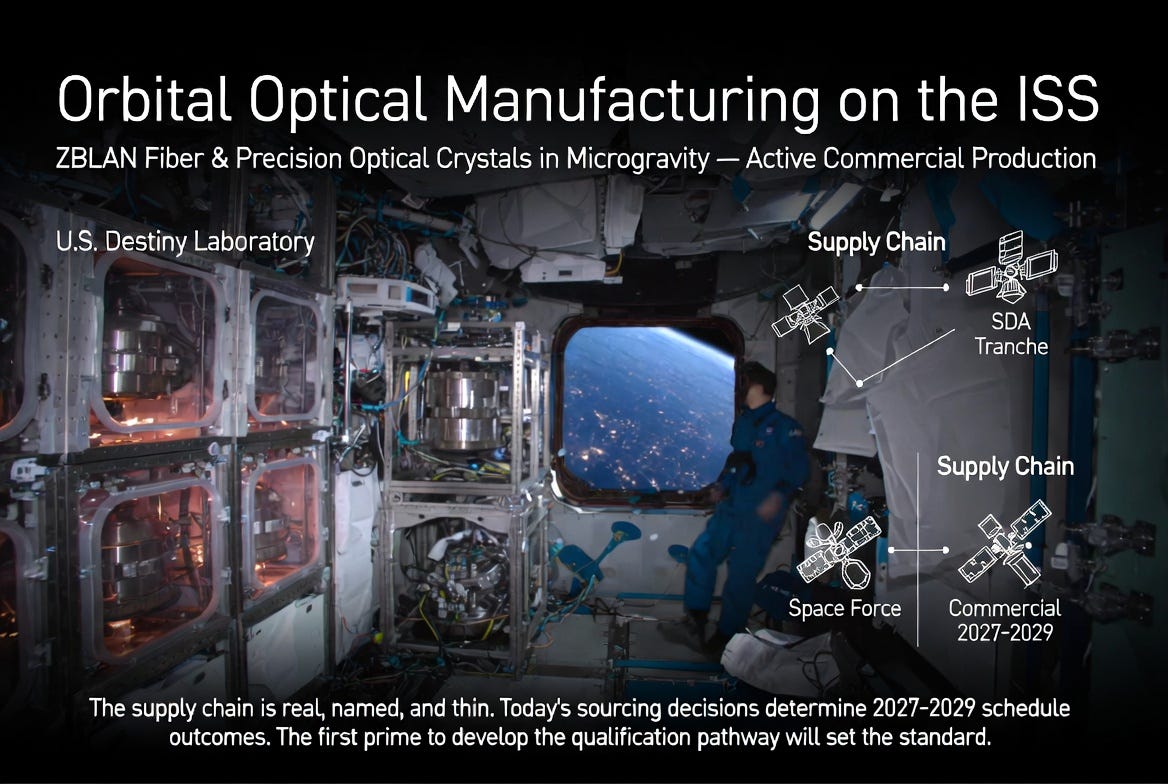
Orbital optical manufacturing — producing ZBLAN fiber and precision optical crystals in microgravity — has moved from government-funded experiments to active commercial production. The supply chain is real, named, and thin. Satellite primes building to SDA Tranche, Space Force, and commercial constellation timelines in 2027–2029 are already inside the procurement window where today’s sourcing decisions will determine tomorrow’s schedule outcomes. The qualification pathway does not yet exist in published form — which means the first prime to develop it will set the standard.
Most satellite procurement teams have a list of approved optical component vendors. It probably includes a handful of established domestic suppliers, maybe a few European names, and a lead time column that everyone internally agrees is uncomfortable but manageable. What very few of those lists include is an orbital address.
That may be a problem.
In February 2026, the UK Space Agency quietly awarded £295,000 to a British startup called OrbiSky Ltd to design a payload capable of producing ZBLAN fluoride glass optical fiber in low Earth orbit. It was not the kind of announcement that moves markets or generates conference keynotes. But taken alongside a lengthening string of similar signals — ESA’s second cohort for Advanced Materials and In-Orbit Manufacturing naming ZBLAN as a priority in January 2026, Varda Space Industries’ W-5 mission returning a U.S. Navy payload from orbit in February, and the Air Force Research Laboratory’s continuing contract relationship with Redwire — it forms a pattern worth paying attention to. Governments and defense agencies are making directional bets on orbital optical manufacturing. Most commercial satellite primes have not yet asked whether that bet should show up on their vendor qualification lists.
This article maps what orbital optical manufacturing actually looks like today — who produces what, at what scale, and for whom — and asks the procurement question that the industry has so far declined to answer directly: at what point does this go from a government-funded curiosity to a second-source requirement?
What Makes ZBLAN Different — and Why Earth Cannot Fix It
The story starts with two French brothers in 1974 and an accident in a chemistry lab. Michel and Marcel Poulain, researchers at the University of Rennes, were studying fluoride complexes when they inadvertently created an amorphous crystal that broke existing models for glass structure. The material — zirconium fluoride, barium fluoride, lanthanum fluoride, aluminum fluoride, and sodium fluoride, or ZBLAN — turned out to have optical transmission properties that silica fiber, the backbone of modern telecommunications infrastructure, cannot match.
ZBLAN’s theoretical signal loss is 10 to 100 times lower than silica across a meaningful portion of the optical spectrum. A 2,000-kilometer length of ZBLAN fiber, if manufactured to its theoretical best, would have roughly the same signal loss as 10 kilometers of silica. For satellite operators building high-bandwidth optical intersatellite links — exactly the kind now being specified for next-generation SDA Tranche constellations and commercial broadband architectures — that gap is not academic. It is a system design parameter.
The catch is that ZBLAN manufactured on Earth does not come close to its theoretical performance. The culprit is gravity. When ZBLAN is drawn into fiber on Earth, convection currents and sedimentation effects cause microscopic crystals to form inside the glass matrix, scattering light and destroying the very low-loss properties that make the material valuable. NASA understood this problem as early as 1994, when researchers flew ZBLAN manufacturing equipment on a KC-135 parabolic aircraft to test whether even 25 seconds of microgravity would reduce crystal formation. It did. The conclusion was unavoidable: to make ZBLAN that performs to specification, you need orbit.
The physics here is not a maturity problem that better terrestrial manufacturing processes can eventually solve. It is a constraint built into the Earth’s gravitational field. For procurement teams accustomed to evaluating suppliers on process improvement trajectories and cost reduction roadmaps, that is a different kind of sourcing conversation.
