


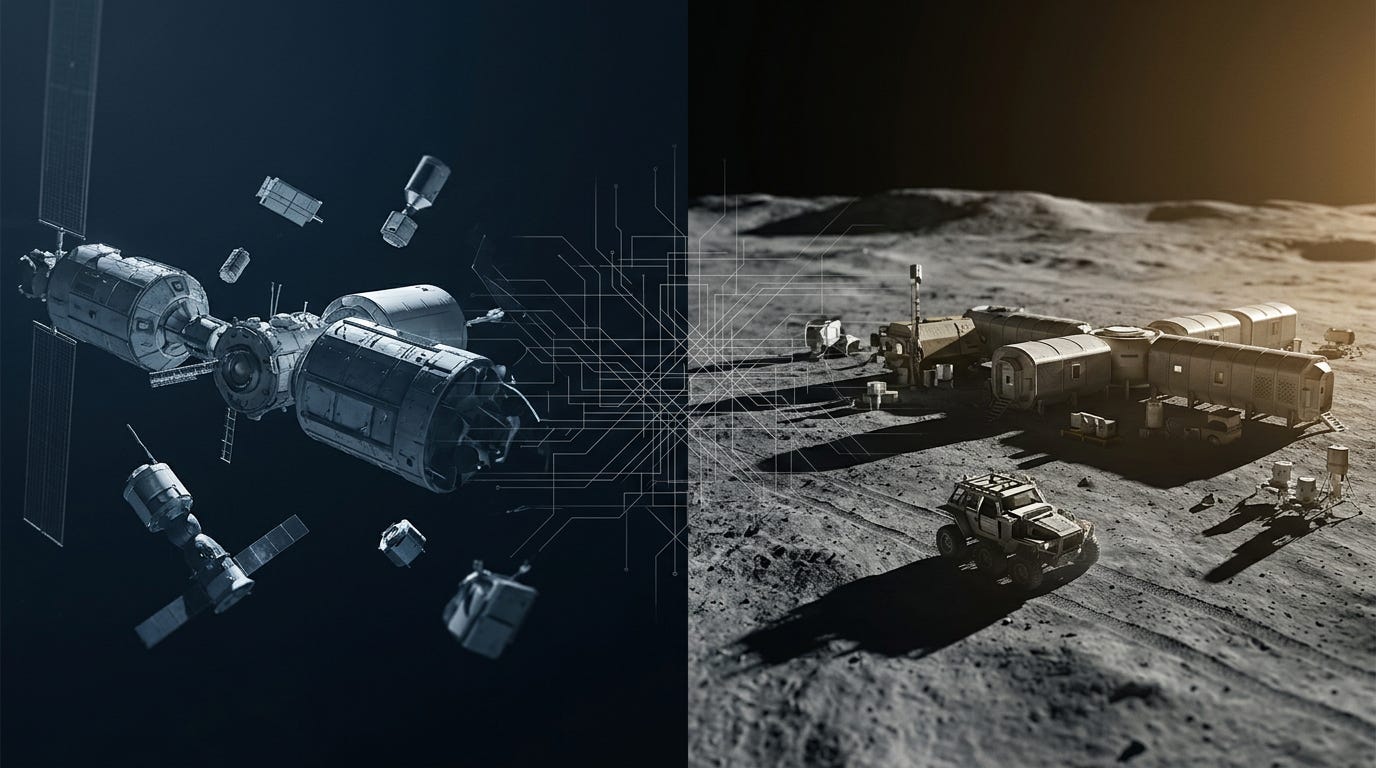
What This Means:
NASA’s March 24, 2026, pivot from the Lunar Gateway to a phased permanent Moon Base is not a program reset. It is a procurement architecture scramble with roughly $20 billion in new acquisition instruments layered on top of a supply chain the agency’s own inspector general warned, in 2023, it cannot adequately see or manage. The companies holding hardware, open purchase orders, or sub-tier dependencies tied to the Gateway need to know which of three contractual categories they occupy. The companies now competing for Moon Base Phase 1 need to understand they are entering a supply chain environment with documented single-source risks, no mature logistics infrastructure, and a congressional budget environment that has already bent the Artemis timeline twice. Executives, investors, program managers, and BD teams that treat the Moon Base as a single opportunity will get the category wrong, underbid what they can win, and miss what they can shape.
From Gateway to Ground: What Actually Changed on March 24
The announcement that came out of NASA’s “Ignition” event on March 24, 2026, was framed as a strategic leap forward. Administrator Jared Isaacman told the crowd the agency was redirecting approximately $20 billion over seven years toward a permanent lunar surface base, structured in three deliberate phases, with Gateway “paused in its current form” (NASA, “Moon Base”). What the press release framing obscured is that “paused in its current form” is not a legal category. The Federal Acquisition Regulation (FAR) recognizes termination for convenience, suspension of work, and stop-work orders. It does not recognize “paused,” and that ambiguity is not semantic — it is financial (Ex Terra Media, “’Paused’ Is Not a Contractual Term”).[1][2]
The Gateway supply chain breaks into three groups with meaningfully different exposure profiles. Hardware that has been delivered and accepted carries limited financial exposure but real strategic exposure, since its repurposing architecture is undefined. Hardware in active integration with no defined repurposing path is accumulating standby costs with no settlement trigger. And international module work under European Space Agency (ESA), Japan Aerospace Exploration Agency (JAXA), and Canadian Space Agency (CSA) Memoranda of Understanding (MOUs) carries no FAR termination provisions at all — renegotiation runs through diplomatic channels, not contract officers. Companies that categorized themselves correctly within thirty days of the March 24 announcement are in a defensible posture. Companies still awaiting guidance from their prime are not.
What NASA Is Actually Buying: The Three-Phase Architecture
The Moon Base program is not one program. It is three procurement architectures operating in sequence, and conflating them is the most expensive mistake a BD team can make (Ex Terra Media, “The $20B Moon Base Procurement Architecture”).
Phase One (now through 2029): Experiment and Learn is the only phase with live procurement instruments as of May 2026. NASA has committed approximately $10 billion and is riding existing contract vehicles: two draft Requests for Proposals (RFPs) live against the Commercial Lunar Payload Services (CLPS) 1.0 Indefinite Delivery, Indefinite Quantity (IDIQ) vehicle, and a Lunar Terrain Vehicle (LTV) Services down-select expected in the second half of 2026. Carlos García-Galán, NASA Moon Base Program Executive, confirmed at the May 27, 2026, briefing that Phase One encompasses 25 launches and 21 landings, targeting delivery of approximately four metric tons of cargo to the lunar south pole surface before 2029 (García-Galán, qtd. in Mack). The May 27, 2026, contract announcement totaling nearly $1 billion is Phase One’s first major visible milestone: $220 million each to Astrolab and Lunar Outpost for LTV design and delivery, a $234 million per-unit delivery contract to Blue Origin using the Blue Moon Mark 1 lander, and a $75 million Firefly Aerospace subcontract awarded through the Jet Propulsion Laboratory (JPL) for lunar drone deployment on the MoonFall mission (Strickland).
Phase Two (2029 to 2032): Establish Early Infrastructure carries another $10 billion and is the phase where international hardware becomes load-bearing. JAXA’s pressurized rover is a confirmed contribution. The acquisition vehicles for Phase Two are, as of late May 2026, blank paper. Two shaping Requests for Information (RFIs) published March 24 and 26 are the only active instruments: SAM.gov Notice 26-01-PS70, titled “Enabling Commercial Lunar Transportation to Support a Sustained Lunar Base,” and a second notice titled “Capability Demonstrations and Supply Chain Challenges for NASA Moon Base Development.” For companies that want to compete in Phase Two, responding to those RFIs is the only lever currently available. Note: all sub-tier supplier analysis for Phase Two constitutes structural inference from Phase One program architecture and the 2023 OIG report, as no acquisition instruments have been released.[2]
Phase Three (2032 onward): Sustained Human Presence includes the Italian Space Agency’s (ASI) Multi-purpose Habitats, CSA’s Lunar Utility Vehicle, and cargo-capable human landing systems. No U.S. acquisition instruments are attached to Phase Three yet. The technical requirements entering Phase Three will be shaped by whoever responded to Phase One and Two RFIs, making early shaping participation a strategic asset, not an administrative burden (NASA, “Moon Base”). Note: Phase Three sub-tier analysis is structural inference only.
The Supply Chain Map: Who Is Actually Building This
As of May 2026, NASA’s prime contractor network contributing to the broader Moon Base program spans more than 2,700 suppliers across 47 states (Supply Chain Digital; Procurement Magazine). The prime tier includes Aerojet Rocketdyne, Axiom Space, Bechtel, Blue Origin, Boeing, Amentum, Jacobs, Lockheed Martin, Maxar Space Systems, Northrop Grumman, and SpaceX. Lockheed Martin holds the lead contract for the Orion spacecraft. Northrop Grumman built the solid rocket motor boosters for the Space Launch System (SLS). Boeing led SLS core stage production (NASA, “Artemis Partners”).
The Phase One roster introduced a second tier of emerging prime-adjacents. Astrolab and Lunar Outpost are now funded LTV developers with $220 million commitments each. Blue Origin secures its position as the Phase One delivery prime with the Blue Moon Mark 1 lander serving all three initial LTV delivery missions. Three missions originally designated under CLPS have been redesignated as Moon Base Missions 1 through 3: Blue Origin’s Blue Moon Mk.1 targeted for fall 2026, Astrobotic’s Griffin-1 for late 2026, and Intuitive Machines’ IM-3 for late 2026. Firefly Aerospace enters Phase One through the Elytra Dark drone deployment mission, which will test scouting capabilities in 2028 (Strickland; PBS NewsHour).
The sub-tier is where the supply chain map thins rapidly, and where the Office of Inspector General (OIG) data becomes most relevant. The OIG’s 2023 report on NASA’s management of the Artemis supply chain found that “most importantly, the Agency lacks visibility into its critical suppliers with many Artemis programs and projects not tracking their prime contractors’ supply chain impacts” (NASA OIG, IG-24-003 4). Even when subcontractor performance issues were identified, the OIG found they were not shared across Artemis teams to enable effective procurement decisions. NASA’s Logistics Management Division (LMD) was not utilized by Artemis programs or projects at the time of the report, and NASA’s initial Holistic Agency Study found that supply chain issues “are usually a surprise to the agency, with mitigation therefore reactive rather than proactive” (NASA OIG, IG-24-003 7; NASAWatch). The practical meaning for Phase One suppliers: the agency’s institutional supply chain visibility infrastructure was not adequate for Artemis, and Moon Base Phase One is launching before that infrastructure has been measurably rebuilt.
The next section maps the five structural risks every supplier in the Moon Base program must document now — Gateway contractual overhang with no FAR settlement trigger, CLPS fixed-price model tension, single-source concentration in radiation-hardened electronics and propulsion systems, international partner schedule exposure with no contract pass-through, and budget continuity across a multi-administration timeline. It also includes the supplier category map showing where you sit as of May 2026. Paid subscribers get the full supply chain map, all named sub-tier dependencies, and the recommended documentation posture for each exposure category.
