


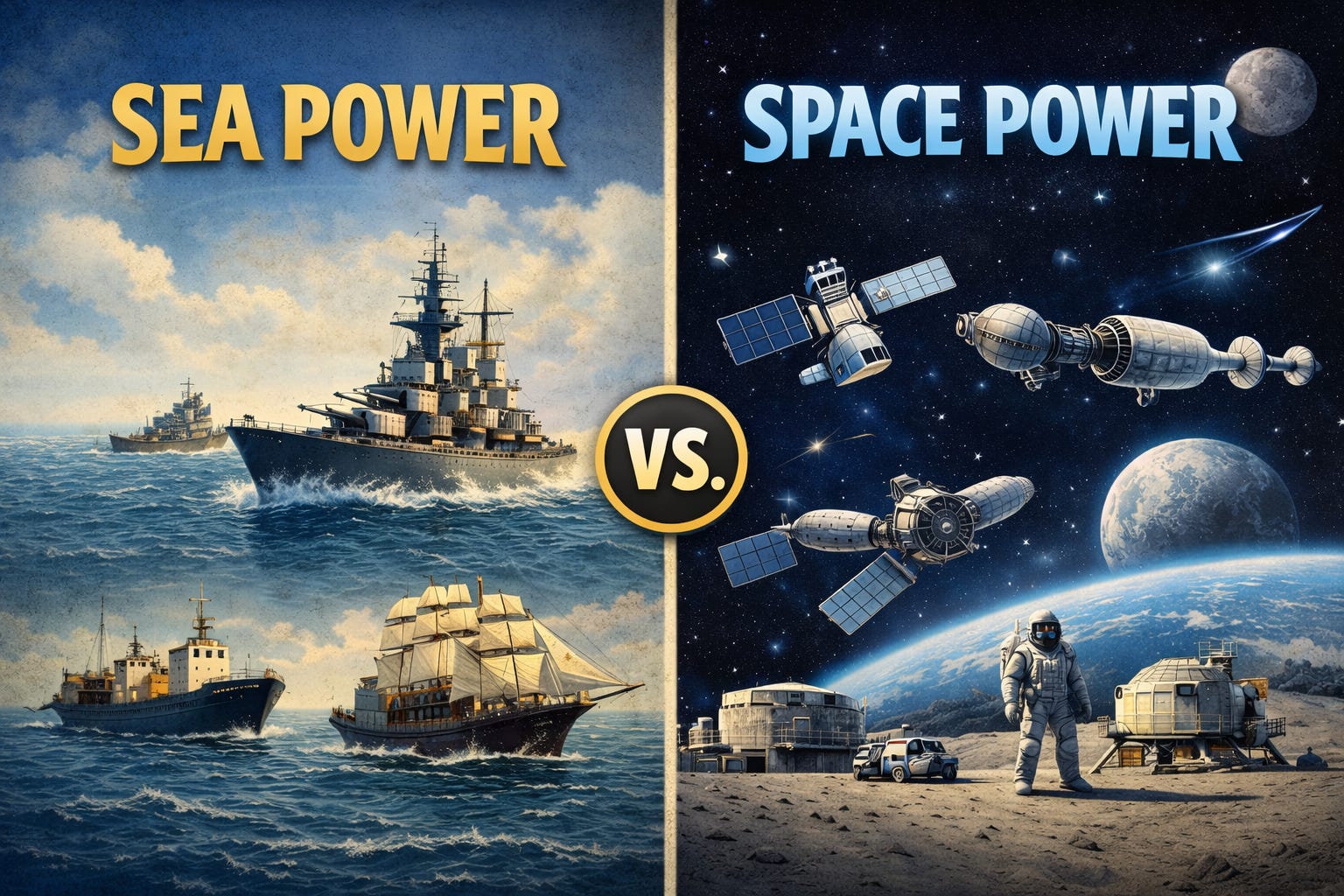
The first instinct is always to look up. To the rockets rising in fire and spectacle, to the satellites gliding in silent precision, to the lunar landers poised to return humanity to the Moon. It is an understandable instinct. Hardware is visible. Missions are dramatic. They give form to ambition. But more than a century ago, Alfred Thayer Mahan offered a harder truth. Power in any domain is never the platform. It is the system that produces it, sustains it, repairs it, and replaces it when it is gone.
That truth now sits at the center of the modern space age. As the United States and its partners move forward with NASA Artemis program, the objective is no longer a singular achievement. It is not a flag planted or a mission completed. It is the creation of something far more demanding: a resilient and secure space ecosystem that does not falter after one success, but continues, adapts, and endures. In space, as at sea, the system is the strategy.
There is, however, a familiar mistake beginning to take shape. It echoes a historical misreading of Mahan’s theory of sea power. As observed by Charles C. Jett1, naval thinkers once fixated on the visible symbol of power, the capital ship, while neglecting the industrial and logistical foundation that made sustained operations possible. Today, space risks falling into the same trap. Heavy-lift launch vehicles, lunar landers, and satellite constellations are treated as proof of strategic advantage. Yet they are no different from the aircraft carriers of another era: formidable, expensive, and ultimately exposed if the system behind them is fragile.
A satellite constellation without rapid replacement is not resilient. A lunar base without redundant logistics is not sustainable. A launch cadence without industrial depth is not power. It is exposure.
Mahan’s framework translates seamlessly into the space domain. Production becomes the manufacturing of launch vehicles, propulsion systems, and components. Shipping becomes launch cadence and orbital transfer. Overseas stations become orbital platforms, lunar infrastructure, and deep space relays. The language changes, but the principle does not. Operational capability is only the visible expression of a deeper system. If that system is brittle, then the power it supports is brittle as well.
The lesson is not theoretical. When the USS Gerald R. Ford was sidelined by something as mundane as a laundry fire, the issue was not the platform itself. It was systemic fragility. A multibillion-dollar asset was rendered operationally irrelevant not by an adversary, but by a breakdown in maintenance, logistics, and integration. The platform did not fail. The system failed.
Translate that reality into space and the vulnerabilities become clear. A single-point failure in a propulsion supplier can halt progress. A compromised semiconductor supply chain can ripple across missions. A cyber intrusion into a vendor can undermine an entire architecture. A shortage of a specialized component can cascade into launch delays. These are the quiet failures, the “laundry fires” of space power, and they will not occur in isolation. They will emerge under pressure, at scale, and often in the presence of adversarial intent.
For that reason, space security must be understood not as a matter of weapons alone, but as a function of architecture. Anti-satellite systems, electronic warfare, and orbital hazards occupy the visible layer of risk. Beneath them lies the decisive layer: the supply chain itself.
A secure space supply chain absorbs disruption without collapse. It regenerates lost capability with speed. It scales under pressure rather than stalling. It distributes risk so that no single node becomes catastrophic. And it maintains trust at every level, from hardware to software to partnerships. This is not logistics as a supporting function. This is logistics as strategy in its purest form. Mahan would have recognized it immediately.
The implications grow sharper within the Artemis era. The return to the Moon is not a centralized national effort. It is a distributed enterprise, spanning government agencies, prime contractors, startups, international partners, and academic institutions. Security, therefore, is no longer centralized. It is diffused across the entire network.
Every supplier becomes strategically significant. Every subcontractor introduces potential vulnerability. Every delay or defect carries mission-level consequences. In such an environment, no single organization, not even NASA, can claim sole responsibility for security. It is a shared burden across the ecosystem. The smallest manufacturer carries weight. The newest entrant carries risk. The most obscure software provider carries implications for mission assurance. Modern space power is defined by this reality: it is only as strong as its weakest supplier.
Compounding this challenge is the economic asymmetry of modern conflict. Increasingly, low-cost, distributed actions can neutralize high-cost, concentrated systems. In space, this means adversaries do not need to match capability platform for platform. They can instead target the system. Cyber-attacks against supply chain software, disruption of critical manufacturing nodes, interference with rare materials, and pressure on commercial launch dependencies all represent pathways to strategic effect. The objective is not to destroy the visible asset. It is to collapse the system that sustains it.
If that system lacks resilience, the outcome is already decided.
This reality reshapes the concept of deterrence. It is tempting to measure strength in numbers: satellites deployed, launches executed, payload mass delivered. But the more powerful deterrent is less visible. It is the capacity to replace what is lost faster than it can be destroyed. That capability resides entirely within the supply chain.
A nation or alliance that can regenerate space assets at scale renders attacks strategically futile. Damage becomes temporary. Disruption becomes manageable. Endurance, not spectacle, defines power. This principle has revealed itself in multiple domains, but its relevance to space is immediate and profound. In this domain, endurance is industrial.
There is, however, a persistent institutional risk. Organizations tend to prepare for the last conflict. They invest in what succeeded before rather than in what sustains success over time. Space is not immune to this tendency. There is a natural pull toward larger launch systems, more complex spacecraft, and longer, more expensive programs. These pursuits are not inherently flawed, but without equal investment in the systems that support them, they become liabilities.
A lunar architecture that cannot be resupplied is not a foothold. It is a stranded asset. A satellite network that cannot be replenished is not a capability. It is a countdown. The essential question is not whether a system can perform once, but whether it can perform continuously, under stress, and in the face of disruption.
If space is to remain secure, the focus must shift with intention. Investment must move toward diversified manufacturing and supplier redundancy. Launch and production systems must be built with surge capacity. Supply chains must be secured across both digital and physical dimensions. Allied and commercial integration must be expanded to enhance resilience. And capabilities for rapid repair, replacement, and reconstitution must be embedded from the outset.
This work does not command attention. It does not generate spectacle. But it produces something far more valuable: stability.
Mahan’s warning carries forward with striking clarity. A great power that neglects the system behind its strength will eventually discover that its most advanced capabilities are unusable when they are needed most. The Artemis era will determine whether that lesson has been absorbed or ignored.
Space security will not be decided at launch, nor will it be decided in orbit. It will be determined in factories, in supply networks, in the integrity of software, and in the quiet, continuous functioning of an industrial ecosystem that few will ever see.
The future of space power will not belong to the nation with the most impressive missions. It will belong to the nation, and the network, that can sustain them.
About the Author

Michael Daily is the President of NewSpace Brand Builders, a strategic consultancy dedicated to advancing the branding, marketing, and communications excellence of the global space industry. With an extensive background in brand strategy, public affairs, and community strategy development, Daily established NewSpace Brand Builders to help organizations define their identity, strengthen their market position, and contribute to a sustainable and innovative space ecosystem. You can reach Mike at mike.daily@newspacebb.com or visit https://newspacebrandbuilders.com/
 | A guest post by
|