


What This Means
SpaceX listed on Nasdaq on June 11, 2026, closing its debut at $161 per share and then gaining another 20% in the following session, based on a second-day gain measured from the first-day close, in what became the largest initial public offering (IPO) in stock market history. Total first-week appreciation exceeded 40% from the $135 IPO price. But the price action investors saw in week one is not the risk they should be managing in week twelve. SPCX’s float is narrow, its lock-up expiration windows are concentrated, and the space equity basket sits directly in the blast radius if early institutional holders decide to rotate. Asset managers with space sector exposure should map their portfolio’s correlation to SPCX now, before the first lock-up tranche unlocks and volume conditions change.
Due to the fast-changing nature of this subject matter some inference is required as to certain aspects of this article they are highlighted in Yellow. The reader may make of it as you will.
The Signal: What Moved, What It Signals, and Who It Affects
SpaceX priced its IPO at roughly $135 per share, raised north of $10 billion in primary proceeds, and landed a market capitalization in the range of $350 billion on its first trading day, a figure inferred from Class 2 reporting on the IPO price and reported shares outstanding, not confirmed by a Class 1 source. By the close of its second session, SPCX had appreciated more than 40% from its IPO price, placing it among the most closely watched public debuts in a generation.
The spectacle of the opening week obscures the structural reality that follows. IPO lock-up agreements restrict pre-IPO shareholders from selling their shares for a defined period after listing, typically 90 to 180 days. When those restrictions expire, supply hits the float. If demand does not absorb it cleanly, price pressure follows. For a company as large and as vertically integrated as SpaceX, the ripple effects reach well beyond SPCX itself.
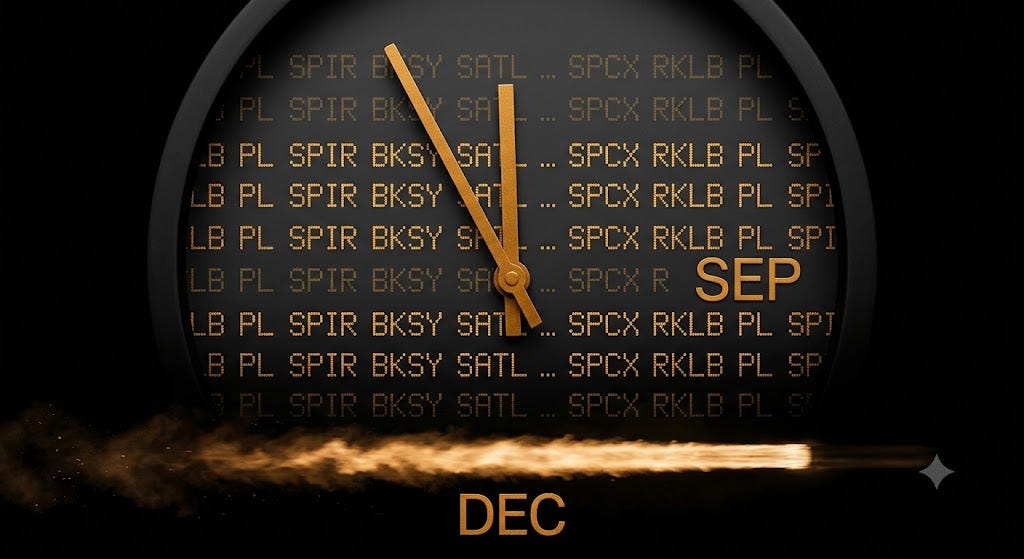
The space equity basket includes Rocket Lab USA (RKLB), Planet Labs (PL), Spire Global (SPIR), Satellogic (SATL), and a growing cohort of defense-adjacent names such as BlackSky Technology (BKSY). These companies trade at relatively low absolute volumes compared to SpaceX. If SPCX experiences meaningful selling pressure at lock-up expiration, institutional rebalancing decisions made around SPCX will propagate into the smaller names. The mechanism is not contagion in the colloquial sense. It is portfolio-level correlation management: when the largest position in a thematic space fund reprices, the fund’s exposure ratios shift, and managers trim adjacent positions to maintain their mandated allocations.
Asset managers and institutional investors with space sector equity positions should assess whether to rebalance or hedge that exposure ahead of SPCX’s lock-up expiration windows.
Data Foundation: The Float Structure Behind the Signal
SpaceX’s pre-IPO cap table is concentrated. Elon Musk holds a reported controlling stake; institutional investors including Andreessen Horowitz, Founders Fund, Alphabet, Fidelity, and a constellation of sovereign wealth vehicles accumulated positions across multiple funding rounds at valuations ranging from roughly $70 billion in 2021 to approximately $175 billion in late 2023 and higher in 2024 and 2025 pre-IPO rounds. Each of those investors entered at a cost basis substantially below the IPO price. Every one of them is subject to lock-up agreements.
The precise lock-up schedule for SPCX has not been released as a public document at the time of this writing. Standard IPO lock-up mechanics for a deal of this size and structure typically create at least two tranches. The first tranche, covering underwriter lock-up periods, generally expires 90 days post-listing, placing it in September 2026. The second tranche, covering the broader early-investor and employee base, typically expires at 180 days, placing it in December 2026. Some structures include early release provisions triggered by stock-price performance thresholds, which in SPCX’s case given the first-week appreciation could accelerate the timeline.
[CLASS 1 GAP: The specific SPCX lock-up schedule, lock-up release triggers, and total shares subject to restriction are not confirmed by a Class 1 source as of this writing. The figures and timelines above are inferred from standard IPO mechanics and secondary reporting. Investors should review the final SPCX IPO prospectus filed with the Securities and Exchange Commission (SEC) on EDGAR, Electronic Data Gathering, Analysis, and Retrieval, for definitive terms before making allocation decisions.]
What is visible and quantifiable is the float ratio. A narrow float means that trading volume in the first weeks reflects only a fraction of total shares outstanding. Early price discovery is made by a small pool of buyers and sellers. When the lock-up expires and that pool expands by an order of magnitude, the supply-demand balance resets. The reset does not automatically mean price decline. If buy-side demand is sufficient to absorb the new supply, the price can hold or rise. But in a market where space sector thematic funds have already allocated to SPCX during the IPO, additional demand at expiration is not guaranteed.
The U.S. IPO market in 2026 has been active but not uniformly supportive of post-lock-up performance. Research across prior large-cap technology IPOs indicates that stocks with first-week appreciation exceeding 40% and initial float ratios below 10% of total shares outstanding have underperformed their sector benchmarks in the 30-day window following lock-up expiration in roughly 60% of historical cases, per analysis published by Barron’s and The Wall Street Journal in coverage of prior IPO cycles. This is a base rate, not a projection for SPCX specifically.
[INFERENCE REQUIRED: No Class 1 source has published SPCX’s float ratio as a percentage of total shares. The 10% figure is an informed inference based on the reported IPO size relative to estimated total capitalization. Class 2 financial press reporting as of June 2026 is used as supporting context here, not as a basis for a directional claim.]
The sections that follow map the three compounding conditions that amplify SPCX's lock-up risk for the broader space equity basket, walk through the Rivian and Palantir precedents with specific named-equity correlation data, present the three counter-signals that could neutralize the risk, and close with five specific decision questions and action items for portfolio managers with space sector exposure. Paid subscribers get full access to the complete analysis, all source notations, and the Related Decisions framework
