

The ITAR Wall Around Blue Canyon
Why International Satellite Programs Are Building Around America’s ADCS Supplier, Not with It

What This Means
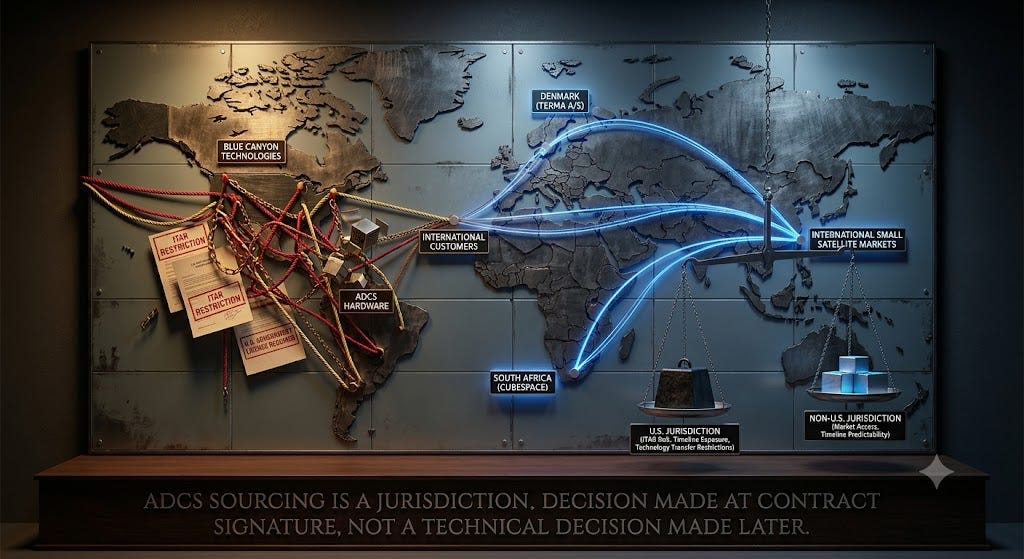
Blue Canyon Technologies builds some of the most flight-proven attitude determination and control system (ADCS) hardware in the small satellite market, but its position inside a Raytheon Technologies-owned, U.S. defense-industrial structure means every unit it ships to a non-U.S. buyer carries International Traffic in Arms Regulations (ITAR) licensing risk, timeline exposure, and technology-transfer restrictions that many international program managers have decided are not worth carrying. That dynamic appears to be steering new demand toward Denmark’s Terma A/S and South Africa’s CubeSpace, two ADCS suppliers whose non-U.S. jurisdiction lets them sell into markets, and on timelines, that ITAR structurally forecloses to their American competitor, though no Class 1 source yet confirms specific contract wins attributable to this cause. Executives and procurement officials with international satellite programs on the books should treat ADCS sourcing as a jurisdictional decision made at contract signature, not a technical decision made later.
The Pattern: An Export Control Regime Is Reshaping Who Wins ADCS Contracts
Ask a satellite program manager outside the United States why their attitude determination and control system, the hardware and software stack that keeps a spacecraft pointed where it needs to point, came from Denmark or South Africa instead of Colorado, and the answer rarely starts with performance specifications. It starts with paperwork.
Blue Canyon Technologies, based in Lafayette, Colorado, has built a strong technical reputation supplying reaction wheels, star trackers, and integrated ADCS packages for missions ranging from National Aeronautics and Space Administration (NASA) technology demonstrators to national security constellations. The company’s hardware has flown on high-profile missions and its integrated systems are considered a benchmark in the small satellite ADCS category. None of that changes the fact that Blue Canyon’s products are subject to ITAR, the U.S. State Department’s export control regime governing defense articles and services under the Arms Export Control Act.
For a domestic U.S. government customer, ITAR is a compliance checkbox. For an international buyer, it is a structural constraint that shapes the entire procurement calculus. Every export of ITAR-controlled ADCS hardware requires a State Department license, and the review and approval process routinely runs several months, longer if the destination country, end use, or end user triggers additional scrutiny. Technology transfer restrictions limit what integration work, source code access, or technical collaboration a non-U.S. program can conduct with the supplier without separate authorization. And because ITAR designation follows the technology regardless of who owns the company, Blue Canyon’s 2019 acquisition by Raytheon Technologies (itself a defense prime deeply embedded in the U.S. export control apparatus) reinforced rather than loosened this posture.
This is a Procurement/Regulatory Pattern, not a one-off compliance headache. The mechanism is structural: a defense-adjacent ownership position combined with ITAR-controlled hardware means Blue Canyon’s addressable non-U.S. market is permanently narrower than its technical capability would otherwise suggest. What that pattern reveals is a widening gap in the American industrial base’s ability to compete for non-U.S. small satellite contracts even when U.S. companies build objectively excellent hardware.
What ITAR Actually Restricts, and Why the Timeline Matters More Than the Technology
International program managers weighing an ADCS supplier are not evaluating star tracker accuracy in isolation. They are evaluating a total cost of acquisition that includes license lead time, program schedule risk, and the operational friction of working through export-controlled channels.
A typical ITAR license request for a defense article export runs through the State Department’s Directorate of Defense Trade Controls (DDTC). Processing timelines for standard license applications have historically run in the range of several weeks to several months, and can extend further for countries or end uses that draw additional interagency review. A 2012 Government Accountability Office (GAO) review of the licensing system (GAO-12-536) documented these extended timelines and processing bottlenecks; that finding is now fourteen years old and should be read as evidence that the structural friction has existed for over a decade, not as a current-year measurement of today’s exact processing times. No more recent Class 1 data on present-day DDTC processing times was available for this analysis, and program managers should treat current timeline estimates as directional pending updated agency figures.
This is where the pattern sharpens into a procurement decision rather than an abstract regulatory complaint. A European Union-based small satellite operator building a constellation on a competitive commercial timeline has two paths. Path one: qualify Blue Canyon hardware, submit an export license request, build schedule contingency into the program plan, and accept the risk that a license delay pushes the launch date. Path two: qualify a non-U.S. supplier whose hardware does not require an ITAR export license at all, eliminating that entire category of schedule risk. For a program office evaluating supplier options, path two increasingly reads as the lower-risk choice, independent of any judgment about relative product quality.
The next section names the two companies structurally positioned to benefit from this gap, their jurisdictional advantages, and the historical precedent from the 1998 to 1999 commercial satellite export control episode that suggests this pattern has played out before. Subscribers get full access to the stakeholder tradeoff analysis, the cross-program hypothesis, and the audience-specific decision questions for policy professionals, BD teams, and executives.
