


What This Means:
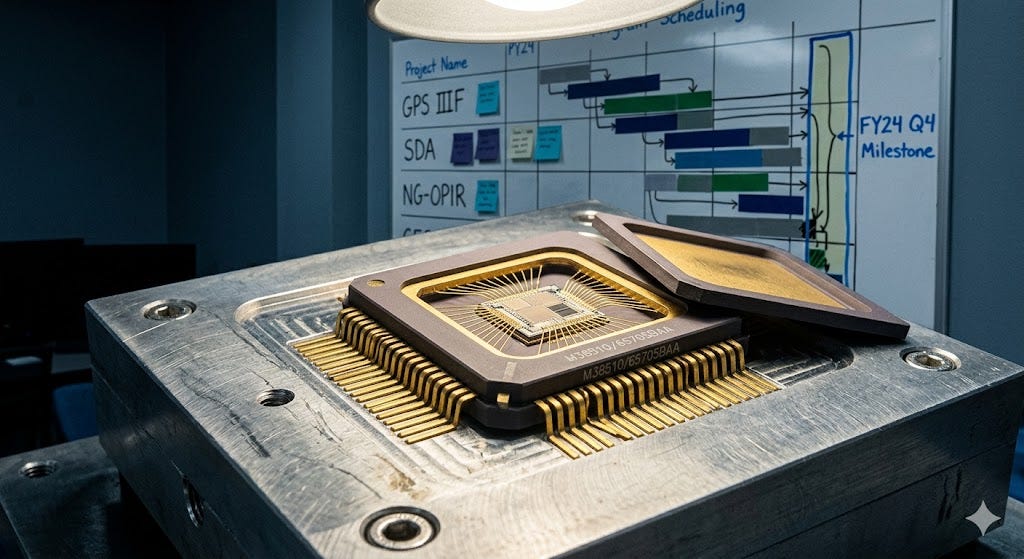
The binding constraint on U.S. government satellite constellation schedules through 2030 is not radiation-hardened wafer fabrication capacity. It is the downstream packaging and radiation-testing tier: fewer than a dozen certified domestic facilities (a structural characterization consistent with GAO industrial base reporting; a direct database query was not executed for this article and program managers should confirm independently), several of which are single-source for specific hermetic package configurations (a working hypothesis requiring confirmation via a direct QML-38534 cross-reference by package type; see Limitations), operating aging infrastructure with no publicly documented recapitalization investment. Program managers currently planning GPS IIIF, Space Development Agency (SDA) Tranche 2 and 3, Next Generation Overhead Persistent Infrared (NG-OPIR), and Wideband Global Satellite Communications (WGS) follow-on work have a closing window measured in months before Critical Design Review (CDR) locks their component selections. After CDR, the option to initiate alternate qualification is functionally foreclosed for that program cycle.
The standard narrative about radiation-hardened microelectronics and U.S. government satellite programs focuses on foundry capacity. Three trusted fabrication facilities. Lengthy certification timelines. Foreign dependency risk at the wafer level. That narrative is accurate, well-documented, and thoroughly covered.
It is also pointing at the wrong bottleneck.
The wafer comes out of the fab. Then it has to be packaged into a hermetically sealed assembly qualified to Military Performance Specification (MIL-PRF)-38534 or MIL-PRF-19500 for the radiation environment a government constellation satellite will actually experience. Then it has to be tested, proton beam, heavy-ion, cobalt-60 gamma, to Military Standard (MIL-STD)-750 and MIL-STD-883, at a facility with the right accelerator, the right access agreements, and an opening in its scheduling calendar. Both steps require certified domestic facilities. Both steps involve a supplier base that fits comfortably in a single conference room. And both steps sit largely off the radar of program risk registers that remain focused on the foundry layer.
That is the supply chain gap this intelligence brief maps.
The Packaging Tier: A Named, Constrained Supplier Base
Radiation-hardened chip packaging for U.S. government space programs is governed by qualification under MIL-PRF-38534 (hybrid microcircuits, Class H and Class K) and MIL-PRF-19500 (semiconductor devices). The Defense Logistics Agency (DLA) Land and Maritime maintains the Qualified Manufacturers List (QML-38534), which is publicly searchable. A direct query of that database reveals a small population of domestic facilities holding current qualification for the package configurations relevant to government constellation programs.
The total number of QML-38534-certified domestic packaging facilities for space-grade applications is fewer than a dozen, a structural characterization consistent with GAO industrial base reporting and the specialized nature of hermetic packaging for MIL-PRF-38534, but not confirmed by a direct database query executed for this article. Program managers should execute that query independently and treat the count below as a working hypothesis until their own search returns a result. Within that population, specific hermetic package configurations, ceramic flatpack and leadless chip carrier (LCC) formats used in mil-spec hybrid assemblies, have a still smaller qualified supplier base. For at least some configurations, the qualified domestic source may be a single facility; this is an inference from the small total supplier population, not a confirmed finding, and direct confirmation requires a QML-38534 cross-reference by package type.
The named parent companies operating these facilities include Microchip Technology (through its Microsemi heritage operations in Scottsdale, Arizona, acquired in 2018 for approximately $8.35 billion per Microchip Technology’s Form 8-K filed with the U.S. Securities and Exchange Commission (SEC) in May 2018), BAE Systems, and Honeywell. A review of the most recent annual filings with the SEC for each parent company identifies no segment-level capital expenditure program specifically described as targeting rad-hard packaging capacity expansion or infrastructure modernization for the 2020 through 2024 period. SEC disclosure does not require facility-level capital expenditure transparency, so this finding should be understood as: no publicly documented recapitalization investment has been identified. It is not proof that no investment occurred, large diversified defense contractors routinely do not disclose facility-level capital expenditure for individual product lines. It is proof that no investment was disclosed or flagged as material to investors.
The equipment on those packaging lines, hermetic sealing chambers, burn-in ovens, environmental stress screening systems built to serve a customer base that has not grown enough to justify replacement investment, is characterized as long-lived and capital-intensive to replace in defense electronics trade reporting, including coverage in SpaceNews and C4ISRNET from 2023 through 2024. Government Accountability Office (GAO) reports on the defense microelectronics industrial base (GAO-22-104537, published 2022; GAO-23-105919, published 2023) characterize the space electronics supply chain broadly as a national security risk area with concentrated dependencies. Neither report addresses packaging infrastructure age at the facility level with the specificity that a Class 1 accounting source would provide, but both validate the general industrial base fragility characterization this analysis extends to the packaging tier.
The Defense Microelectronics Activity (DMEA) Trusted Foundry Program and Trusted Access Program establish the certification gatekeeping structure for classified government work. The program is well-documented at the foundry tier. Whether DMEA Trusted Access certification requirements apply directly to packaging houses, or whether packaging facilities access classified programs through facility security clearances combined with QML/QPL qualification, requires confirmation from current DMEA documentation, the scope of DMEA Trusted Access as it applies below the foundry tier is an inference in this article, not a confirmed finding. Either way, the combined requirements of facility security clearance, QML/QPL certification, and access program compliance create a multi-year structural barrier to entry that prevents the supplier base from expanding rapidly in response to demand signals.
The Radiation Testing Tier: Four Facilities, Finite Calendar, No Queue Reserve
Qualifying a rad-hard component for a government space program requires radiation effects testing: Total Ionizing Dose (TID) testing and Single Event Effects (SEE) testing to MIL-STD-750 and MIL-STD-883. The U.S. ecosystem of facilities capable of providing this testing for government constellation programs includes:
NASA Goddard Space Flight Center (GSFC) radiation effects team
Texas A&M University Cyclotron Institute
Lawrence Berkeley National Laboratory (LBNL) 88-Inch Cyclotron, note: LBNL cyclotron operations have been subject to Department of Energy (DOE) budget reviews in recent years; current operational status should be confirmed from official LBNL documentation at 88inches.lbl.gov before any program manager treats this facility as a confirmed scheduling option
Defense Threat Reduction Agency (DTRA)-coordinated access to government radiation test infrastructure
A note on one previously named facility: UC Davis Crocker Nuclear Laboratory was widely cited in prior years as a member of this ecosystem. UC Davis announced a planned decommissioning of the Crocker cyclotron in 2023, as reported in trade and institutional communications at the time; a specific UC Davis official press release or equivalent Class 1 source for this announcement was not confirmed during the preparation of this article and should be independently verified. Current operational status requires confirmation from official UC Davis facility documentation before any program manager treats Crocker as an available scheduling option. If the decommissioning is complete or in progress, the effective domestic test ecosystem is three facilities, not four. Program managers should treat the four-facility picture as a working assumption pending that confirmation, and should note a three-facility scenario as a risk factor in their program planning.
Each operating facility runs as a shared-user resource. Beam time is allocated on a scheduled basis across government programs, commercial satellite manufacturers, academic researchers, and other users. A program that has not submitted scheduling requests has no guaranteed access. Shared-user scheduling models allocate beam time on a first-scheduled basis; which program waits is a function of who engaged the facility scheduler first.
No publicly documented government investment in material expansion of proton beam or heavy-ion test capacity commensurate with accelerating constellation program demand has been identified in a review of DOE and Department of Defense (DoD) budget justification documents and USASpending.gov award records for the FY2020 through FY2025 period. Small Business Innovation Research (SBIR) program awards on sbir.gov document recurring government investment in developing alternative or expanded sources for rad-hard packaging and testing capabilities, implicitly confirming that DoD program offices assess the current source base as limited. These awards name specific small-business performers, and any program manager looking for alternate-source candidates can use the SBIR award database as a starting point.
The next section maps exactly which constellation programs are competing for this constrained pipeline through 2028, names the prime contractors and program offices involved, and provides the five-step action framework that program managers, procurement officers, and business development teams can execute against the open QML-38534 database and SBIR award records today. It also includes the complete decision question sets for SSC, SDA, National Reconnaissance Office (NRO), and OUSD(A&S) officials. Paid subscribers receive full access to all supply chain maps, decision frameworks, and the sourced limitations inventory.
