

The Invisible Bottleneck
How Golden Dome, Next-Gen Starlink, and Sovereign Constellations Are Competing for Solar Cells You Can’t See in the Queue

What This Means
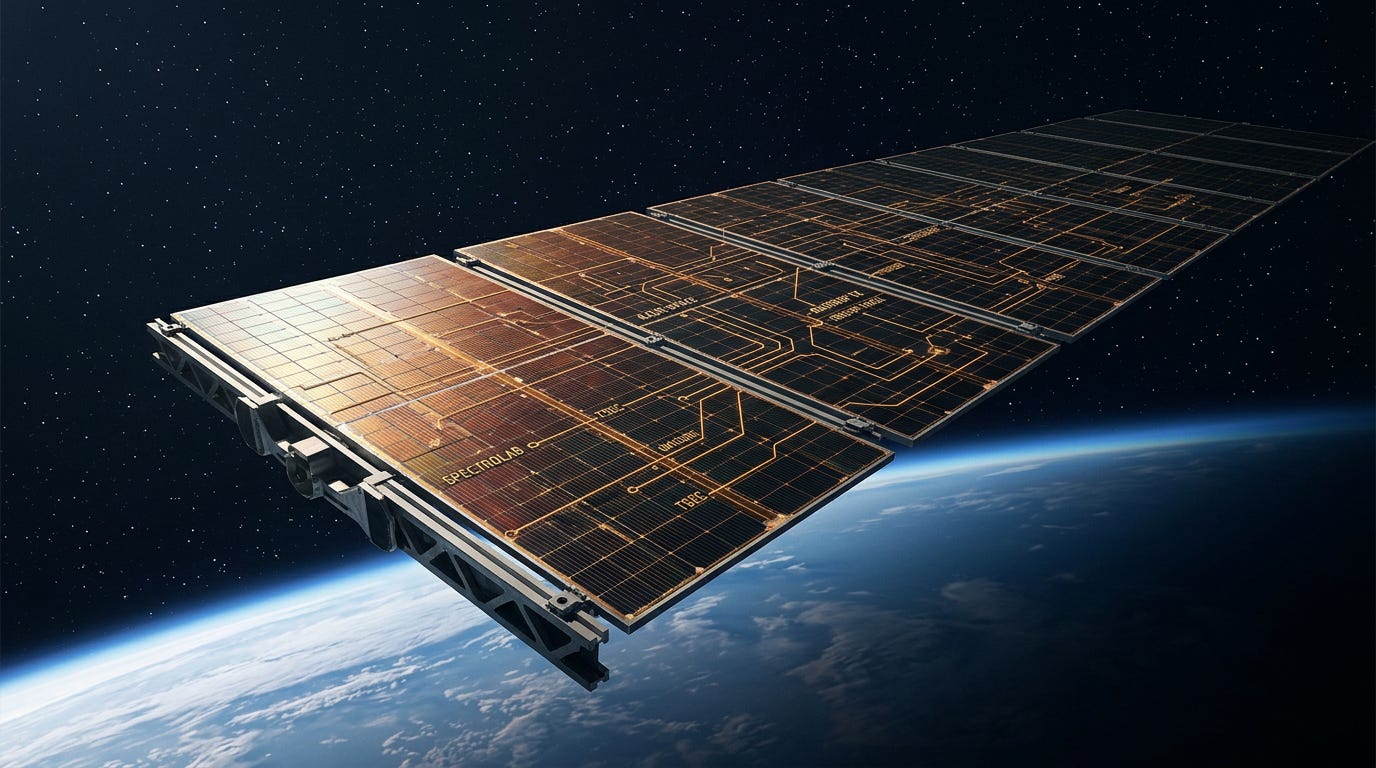
The 16,900-satellite constellation pipeline is not primarily a launch story — it is a solar cell story. The supplier base for space-qualified photovoltaics is concentrated in two dominant GaAs players, while the silicon supply chain that powers Starlink is undergoing a deliberate, active restructuring by SpaceX itself. The combined effect of Golden Dome Space-Based Interceptor (SBI) prototype demand, next-generation Starlink build requirements, sovereign constellation acceleration, and SpaceX’s move toward vertical solar integration is converging on a supplier base that was already at capacity before any of these demand variables materialized. Supply-chain leaders and program managers who have not locked in multi-year solar panel allocations are already competing for capacity they cannot fully see — and the window to secure 2027 and 2028 production slots is closing faster than most forward procurement schedules assume.
The satellite forecast is striking: 16,900 small satellites projected for launch between 2026 and 2035, according to Novaspace’s 11th-edition market report, averaging roughly 640 kilograms of hardware delivered to orbit every single day. That figure alone would stress any specialty components supply chain. But smallsats are only part of the picture, and focusing on the headline number understates the actual demand problem.
In April 2026, Space Systems Command (SSC) announced that the U.S. Space Force had awarded 20 Other Transaction Authority (OTA) contracts worth up to $3.2 billion to 12 companies tasked with prototyping orbital Space-Based Interceptors (SBIs) capable of boost, midcourse, and glide-phase missile engagements by 2028. The program’s goal is to demonstrate initial SBI capability within two years and ultimately deploy a proliferated Low Earth Orbit (pLEO) constellation of interceptors as part of the broader Golden Dome architecture. The 12 awardees include Anduril Industries, Booz Allen Hamilton, General Dynamics Mission Systems, GITAI USA, Lockheed Martin, Northrop Grumman, Quindar, Raytheon, Sci-Tec, SpaceX, True Anomaly, and Turion Space. Each prototype carries power requirements that must be met by space-qualified solar cells from a supplier base already serving the commercial and civil markets — and none of that demand appears in the commercial procurement queues.
Simultaneously, SpaceX’s next-generation Starlink build cycle has evolved beyond a simple satellite refresh. Elon Musk publicly described “Space AI Data Centers” as the optimal solution to Earth’s power and heat dissipation bottlenecks for artificial intelligence computing, identifying two binding constraints for orbital AI infrastructure: power generation and heat rejection. The next-generation Starlink architecture is widely expected to require substantially larger solar arrays per satellite than the current constellation, driven by the power requirements of on-orbit AI processing workloads. Musk’s stated technical requirements, high efficiency, scalability, and mass deployability, are driving SpaceX toward a fundamental restructuring of its solar supply chain, not merely an incremental order increase.
Sovereign constellation programs from Europe, India, the UAE, Japan, and others are adding additional demand layers that were not in most supply-chain forecasts eighteen months ago. The result is a demand curve that is steeper, broader, and less transparent than the headline satellite count suggests.
Who Actually Makes These Cells
Two names dominate every conversation about space-grade solar cells: Spectrolab, a Boeing subsidiary based in Sylmar, California, and AZUR SPACE Solar Power GmbH, a 5N Plus subsidiary headquartered in Heilbronn, Germany. Spectrolab has delivered more than 6.5 million multijunction space solar cells over its lifetime and powers everything from GPS satellites to Mars rovers with triple-junction gallium arsenide (GaAs) cells reaching 33% efficiency with its latest XTE+ product line. AZUR holds a comparable position in Europe and serves many of the same prime contractors, with a product line spanning 3G28, 3G30, and advanced variants used across commercial, civil, and defense constellations.
The rest of the qualified supplier base is thin in ways that matter. SolAero Technologies, acquired by Rocket Lab in January 2022, was characterized at acquisition as one of only two companies in the United States producing high-efficiency, space-grade solar cells — a description from Rocket Lab’s own acquisition announcement that is the most precise public statement available about the structural thinness of the domestic GaAs supply base. SolAero now operates as a Rocket Lab subsidiary, meaning its capacity is not fully available to the open commercial market on equal terms with independent suppliers. CESI in Italy rounds out the European-adjacent supplier base for GaAs cells.
MicroLink Devices, based in Niles, Illinois, occupies a distinct position in the qualified supplier ecosystem. MicroLink produces high-efficiency epitaxially lifted off (ELO) triple-junction cells with AM0 efficiency exceeding 30% and specific power exceeding 2,000 watts per kilogram specifications that make them attractive for mass-sensitive applications where power-to-weight ratio matters more than absolute panel area. MicroLink has an expansion program underway toward a roughly one-megawatt annual facility. To contextualize that ceiling: a single large GEO satellite can require 15 to 30 kilowatts of power, and orbital AI data center satellites, each requiring approximately 100 kilowatts of power based on published estimates of Musk’s stated requirements, would each consume the equivalent of 10% or more of MicroLink’s entire planned annual output. The math on secondary-supplier scale against next-generation demand is not a future problem. It is a present one.
SpaceX has famously departed from the GaAs consensus for Starlink, sourcing silicon-based solar cells from Taiwan Solar Energy Corp (TSEC), Taiwan’s largest photovoltaic manufacturer and a company that simultaneously supplies Tesla’s solar roof tile program, accounting for approximately 30% of TSEC’s annual capacity. TSEC Chairman Liao Kuo-jung has publicly described TSEC as a direct representative of the SpaceX supply chain, and TSEC cells are confirmed to be powering current LEO Starlink satellites. The rationale for the silicon approach was cost: GaAs cells were prohibitively expensive at Starlink’s volume, and SpaceX compensated for silicon’s lower efficiency by deploying significantly larger panels. The consequences of that tradeoff are now reverberating through the supply chain in ways no one fully mapped when the decision was made.
The Capacity Expansion Picture: Real Progress, Insufficient Scale
AZUR has been the most aggressive expander in the qualified GaAs supplier base. After a 35% capacity increase in 2024 and a 30% increase in 2025, the company announced in February 2026 an additional 25% expansion targeting second-half 2026 activation, covering back-end and front-end operations through process optimization and additional automation. The investment specifically included additional metal-organic vapor phase epitaxy (MOVPE) reactors, a detail that reveals where the actual binding constraint sits. MOVPE reactor capacity, not cell assembly throughput, is what ultimately limits how many triple-junction cells AZUR can produce in a given period. Over three years, AZUR will have grown capacity by roughly 118% on a compounding basis. That is a credible operational achievement for a specialty semiconductor manufacturer operating in a capital-intensive, long-lead-time fabrication environment.
The problem is baseline. AZUR’s expansion is being measured in percentage points atop a production base that was already considered a bottleneck before the 2026 demand acceleration. The germanium wafer substrate market, the foundational input for all GaAs triple-junction cells, had a total global value of approximately $125 million in 2024, projected to grow to $138 million in 2025 and $253 million by 2032 at a 10.5% compound annual growth rate. That is a small market for a material that must underpin 16,900 satellites, a proliferated SBI constellation, and multiple sovereign megaconstellations. The entire germanium wafer substrate market for space solar cells is smaller than the annual revenues of a mid-sized defense subcontractor.
Spectrolab has not announced comparable expansion programs at the scale the new demand curve requires, and its revenue base reflects a mature, government-relationship-anchored business model with limited structural incentive to make speculative capital-intensive investments that commercial megaconstellation volumes would demand without long-term take-or-pay commitments in hand. Spectrolab does not publish production capacity figures; the absence of public expansion announcements, against a backdrop of documented demand acceleration, is itself a signal worth building into procurement planning assumptions.
The availability gap is already showing up downstream. Satellite integrators and mission designers have reported significant delays in solar cell procurement, with lead times lengthening and costs rising materially. For small satellite programs operating on fixed-price contracts, this is not a theoretical risk it is an active schedule and margin threat that is compressing the contingency buffers programs depend on when hardware deliveries slip.
The Sub-Tier Nobody Mapped: Germanium, Umicore, and China Germanium
The supply chain risk in space-qualified solar cells does not begin at Spectrolab or AZUR. It begins one level deeper, at the germanium wafer substrate, the semiconductor foundation on which every GaAs triple-junction cell is built.
Germanium’s properties make it nearly irreplaceable for this application: high electron mobility, excellent radiation resistance, and thermal stability in the extreme orbital environment. There is no commercially qualified alternative substrate for space-grade triple-junction GaAs cell production at scale. The germanium wafer must be produced through a crystal-pulling process that requires specialized equipment, tight process controls, and long qualification timelines. New entrants into this sub-tier do not arrive quickly.
The global market for germanium wafer substrates for space solar cells is dominated by two players: Umicore, a Belgian materials technology company with its germanium crystal-pulling facility in Olen, Belgium, and China Germanium, a state-linked Chinese enterprise. Umicore is one of the few facilities in the world capable of pulling dislocation-free germanium ingots at the quality levels required for space-grade cell production, and the company has publicly confirmed its role powering satellites and Mars missions. The Umicore-AZUR relationship is not inferred, it is documented through joint ESA technical studies and a publicly disclosed germanium recycling collaboration in which Umicore brings its recycling process directly to AZUR SPACE installations, with AZUR’s backgrinding waste stream feeding back into Umicore’s germanium supply chain. AZUR’s February 2026 expansion investment in additional MOVPE reactors directly references the epitaxy-level constraint that this sub-tier bottleneck creates.
The China Germanium presence in this sub-tier deserves direct analytical attention. China is the world’s dominant producer of raw germanium, accounting for roughly 60% of global refined output, and China Germanium, as a state-linked enterprise, operates within a supply chain that the U.S. government has explicitly identified as a strategic vulnerability. In a scenario where U.S.-China trade tensions escalate or export controls tighten, a germanium supply disruption would propagate not just through AZUR but through the entire GaAs cell production base. Spectrolab’s germanium sourcing strategy is not publicly disclosed, and that opacity is a risk in itself for any program that has not independently mapped its sub-tier dependencies to this level.
The practical implication for supply-chain leaders is significant: even a fully funded, contract-in-hand procurement from AZUR or Spectrolab does not immunize a program from sub-tier germanium risk. Multi-year allocation agreements for cells are necessary but not sufficient. The actual binding constraint may sit one level below where most procurement teams are looking.
