

The Consolidation Signal
Why 2026 Marks the Shift from Venture-Led Space to Strategic Buyer Control

What This Means:
The commercial space sector is undergoing a structural ownership transition, not a market correction. Strategic acquirers with operating revenue and spectrum assets are displacing venture capital as the primary capital source for maturing space companies, and the deals completed in the first half of 2026 establish a template that will govern who controls critical infrastructure through the early 2030s. Investors holding positions in sub-scale space companies and executives at firms without a clear path to strategic relevance face a narrowing window to negotiate from strength. The question is no longer whether consolidation will reshape the sector, but which companies will be acquired on their own terms and which will be absorbed at distressed prices.
The Signal
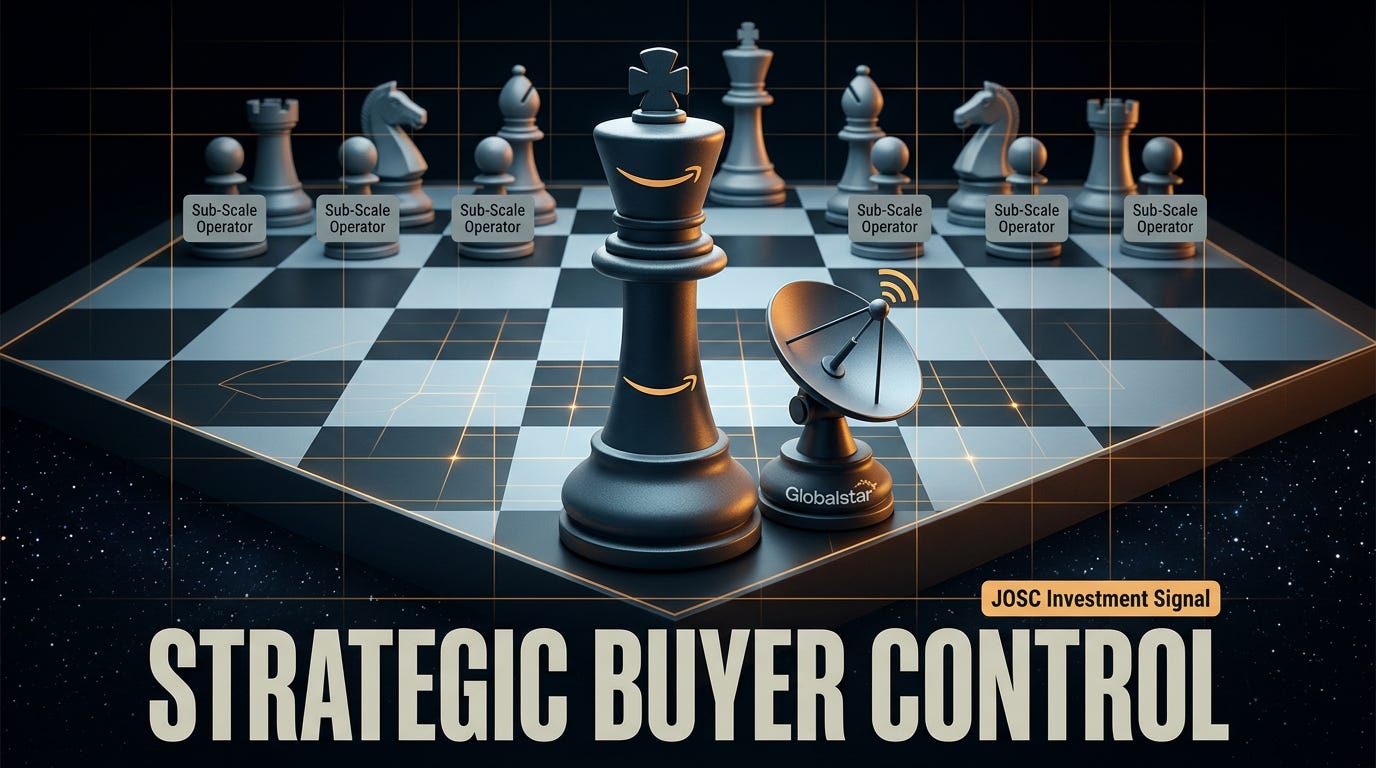
Amazon’s $11.57 billion acquisition of Globalstar, announced in April 2026, is the clearest data point yet that the commercial space sector has crossed a structural threshold. This was not a venture-backed startup reaching for a strategic exit. This was a trillion-dollar logistics and cloud infrastructure company acquiring satellite spectrum and a global constellation to build a competitive alternative to Starlink’s direct-to-device network. The buyer’s identity matters as much as the price. Amazon is not a space investor. Amazon is a logistics, retail, and cloud infrastructure company that has concluded satellite connectivity is too strategically important to source from a competitor.
That distinction is the signal. When companies of Amazon’s scale stop treating space capabilities as something to monitor and start treating them as something to own, the capital formation logic of the entire sector changes. Venture-backed growth rounds that once funded a decade-long path to relevance now fund a much shorter path to a strategic buyer’s acquisition shortlist. Sub-scale operators who cannot articulate their strategic value to a named acquirer are not in a funding market anymore. They are in a liquidation market.
The broader first-quarter 2026 investment data reinforces the directional read. Asian launch vehicle companies attracted $1.34 billion in new capital and North American commercial space station developers raised $1.04 billion, according to aggregate reporting from Payload and SpaceNews. These headline figures contain two different stories sitting side by side: early-stage technology bets still flowing into launch and orbital infrastructure, and consolidation-stage capital flowing into companies with spectrum assets, existing customer bases, and near-term revenue visibility. The asset profile of the capital magnet has shifted materially.
The Data Foundation
Four capital events in the past 60 days define the current market structure.
Amazon’s acquisition of Globalstar is the anchor. The deal gives Amazon access to Globalstar’s licensed spectrum bands and its network of terrestrial and satellite infrastructure. The $11.57 billion price represents a significant premium to Globalstar’s pre-announcement market capitalization. Based on the buyer’s stated strategic rationale and the structure of the deal, spectrum scarcity, rather than operating cash flow, appears to be the primary valuation driver, though no independent financial advisor has publicly quantified what portion of the purchase price is attributable to spectrum versus operating business. Reporting in SpaceNews and Reuters confirms the strategic framing: Amazon is building a connectivity layer for its logistics network, its devices, and its cloud customers that does not depend on SpaceX.
Vast Space closed a $250 million funding round led by Andreessen Horowitz (a16z) at a reported $5.5 billion valuation, as confirmed in Vast’s official announcement and covered in SpaceNews. The a16z involvement is consistent with how sophisticated technology investors have been approaching space infrastructure: backing companies they assess as positioned to either win a National Aeronautics and Space Administration (NASA) Commercial Low Earth Orbit Destinations (CLD) contract or become attractive acquisition targets for a strategic buyer seeking a foothold in the post-International Space Station (ISS) orbital economy. That read of investor intent is an inference from observable behavior, not from any attributed a16z statement, and readers should weight it accordingly.
K2 Space raised $120 million to advance large-format satellite manufacturing, per reporting from SpaceNews and Payload. The thesis here is manufacturing efficiency at scale. K2’s investors appear to be betting that the demand curve for large satellite buses will attract either defense contracts or a strategic acquirer who needs manufacturing capacity without building it from scratch. No Class 1 company announcement has been identified to supplement the trade press coverage of this round.
SpaceX filed a confidential S-1 with the Securities and Exchange Commission (SEC), per multiple trade press accounts. Reporting suggests the filing targets a valuation exceeding $2 trillion with approximately $75 billion in anticipated public float, though these figures remain unverified pending public registration, and readers should treat them as unconfirmed estimates until a public registration statement is released. A public SpaceX nonetheless creates a liquid benchmark against which every other space asset in the market will be marked. Post-initial public offering (IPO), fund managers who cannot hold private securities will be able to take a SpaceX position. That reallocation of institutional capital toward SpaceX is the most plausible mechanism by which sub-scale operators will face valuation compression, though the magnitude of the effect will depend on how the offering prices and how institutional allocators respond across the sector.
The next sections map the four specific capital events defining current market structure, identify the three assets strategic buyers are actively targeting, and name the decision questions that investors, executives, and prime contractor strategy teams should be running against their current positions before the SpaceX S-1 becomes a public document. This is the level of analysis paid subscribers receive every week.
