

The $1.5 Trillion Premium
What the FY2027 Request Has Already Priced Into Defense-Exposed Space Valuations, and What It Costs When Congress Pulls Back

WHAT THIS MEANS
The White House Fiscal Year 2027 Presidential Budget Request asks for $1.5 trillion in total defense spending, a 44 percent jump over Fiscal Year 2026 enacted levels and the largest single-year defense spending total since World War II, according to the Center for Strategic and International Studies. The United States Space Force share is approximately $71 billion, nearly double the prior year. Defense-exposed space equities have treated the number as a floor. They should be treating it as a ceiling. The historical gap between requests and enacted appropriations averages 6 to 12 percent, and this request depends on $350 billion of reconciliation funding that has to survive a midterm election, a narrow House majority, and Senate procedural rules that have never cleared a missile defense constellation before. Investors and primes who have not already modeled a downside case are carrying uncompensated risk.
On April 4, 2026, the Office of Management and Budget transmitted the Fiscal Year 2027 Presidential Budget Request to Congress. The defense portion lands at $1.5 trillion across all national security accounts, structured as $1.15 trillion in regular discretionary base funding plus $350 billion the administration intends to move through a second budget reconciliation bill later this year. The Space Force share is $71 billion in combined baseline and reconciliation funding, a 77 percent year-over-year increase that would take the service’s Research Development Test and Evaluation (RDT&E) account alone past $40 billion, more than the entire Space Force topline enacted in Fiscal Year 2026.
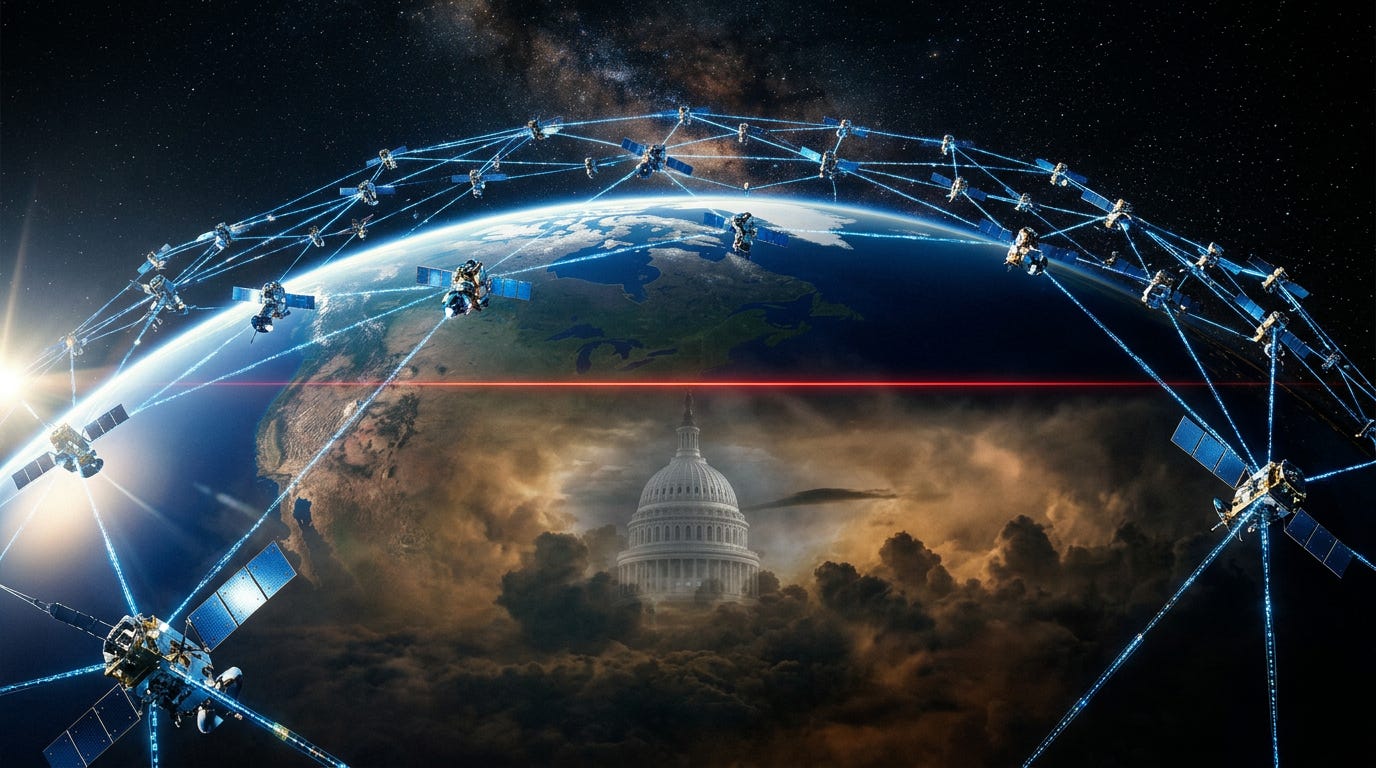
For institutional investors holding defense-exposed space names, the request looks like confirmation of a multi-year demand curve. Golden Dome for America, the missile defense architecture first outlined in a January 2025 Executive Order, receives dedicated funding lines across space-based sensors, ground interceptors, and kill chain integration. The full FY2027 budget justification documents released April 20–21 place the total Golden Dome request at $17.9 billion, of which $17.1 billion flows through reconciliation and $398 million through regular discretionary appropriations. Proliferated Low Earth Orbit satellite communications picks up $1.5 billion in new procurement. National Security Space Launch grows to roughly $4 billion for 22 missions. Air and Ground Moving Target Indicator programs together pick up more than $8 billion, with the majority flowing through reconciliation.
York Space Systems (YSS), which completed a $629 million Initial Public Offering on January 29, 2026, priced at $34 per share, the high end of a $30–$34 range, before opening on the NYSE at $38, closed at $39.23 on April 15, giving the company a market capitalization of roughly $4.3 billion on trailing twelve-month revenue near $375 million. Rocket Lab has accumulated approximately $1.3 billion in defense contract commitments in recent quarters, comprising the $816 million Space Development Agency Tranche 3 satellite contract, the $515 million SDA Transport Layer award, and the $190 million MACH-TB 2.0 hypersonic test contract announced March 18, 2026. Voyager Technologies and Karman Holdings have confidential Initial Public Offering filings positioned for the 2026 window, though the terms of those filings are not publicly available; competitive positioning claims about both companies in this report are based on public reporting rather than the filings themselves. Every one of those valuations carries an implicit assumption about what the Space Force buys in Fiscal Year 2027, Fiscal Year 2028, and the years beyond. If the $1.5 trillion number survives intact, the valuations are defensible. If it does not, the premium embedded in defense-aligned names compresses, and the companies furthest from enacted revenue absorb the most pain.
The problem is that Presidential Budget Requests are not enacted law. They are negotiating anchors. And this particular anchor depends on a funding mechanism that has never moved a constellation through the Senate rules process before.
Data Foundation
The shape of the Space Force request reveals what the administration is actually trying to do. Baseline USSF discretionary funding rises from $31.86 billion enacted in Fiscal Year 2026 to approximately $59 billion in the Fiscal Year 2027 base request, with another $12 billion layered on through reconciliation. Research Development Test and Evaluation grows from $14.7 billion baseline and $5.5 billion reconciliation in Fiscal Year 2026 to $38.3 billion baseline and $2.3 billion reconciliation in the Fiscal Year 2027 request, a doubling of the account. Classified research funding nearly triples, from $6.5 billion to $17.3 billion, a clear signal that offensive and defensive space capabilities are where the money is moving.
Procurement growth is even steeper. The Space Force procurement account balloons from roughly $3.6 billion in Fiscal Year 2026 to $19 billion requested for Fiscal Year 2027. Inside that account, Air Moving Target Indicator procurement gets $7.06 billion in reconciliation funding against zero requested in the prior year. Ground Moving Target Indicator procurement moves from $154 million enacted to $1.02 billion requested. The Resilient Missile Warning Tracking program in Medium Earth Orbit more than doubles from $1.69 billion to $3.56 billion. Launch services grow from $1.33 billion to $4.2 billion. Space Domain Awareness research increases from $528 million to $1.37 billion.
The $17.9 billion Golden Dome total confirmed by Pentagon briefing materials released April 20 is distributed across space-based sensors, interceptor development, kill chain integration, and the Missile Defense Agency’s separate reconciliation carveout. The budget documents make clear that $17.1 billion of this total is reconciliation-dependent — meaning more than 95 percent of Golden Dome’s FY2027 funding requires the reconciliation bill to clear the Senate in substantially intact form. Pursuit strategies that treat any Golden Dome-adjacent line as money in the bank before the reconciliation bill passes are significantly underpricing procedural risk.
One line tells a different story. The commercial services account that houses the Tactical Surveillance Reconnaissance and Tracking (TacSRT) program sits at $23.7 million in the Fiscal Year 2027 request, below the $36.6 million requested for the same account in Fiscal Year 2026. Congress doubled TacSRT to $80 million in Fiscal Year 2026 enacted appropriations because the administration under-requested it. The Fiscal Year 2027 request signals a willingness to repeat that pattern. The Pentagon’s published commercial-first doctrine and its budget request are telling two different stories, and buyers of commercial satellite data, analytics, and services are sitting on the seam between them. For companies in the remote sensing, geospatial analytics, and commercial data-services segments, including Planet, Maxar Technologies, and smaller data-as-a-service vendors, this gap between doctrine and dollars means that congressional adds, not administration requests, remain the realistic planning assumption for commercial-services revenue through Fiscal Year 2027.
What follows is a program-by-program analysis of the $350 billion reconciliation dependency, the three historical budget precedents that predict where enacted numbers land, five decision-forcing questions for institutional investors and primes, and a framework for stress-testing your FY2027 exposure at 100%, 85%, and 65% request-to-enacted scenarios. Full access for subscribers.
