


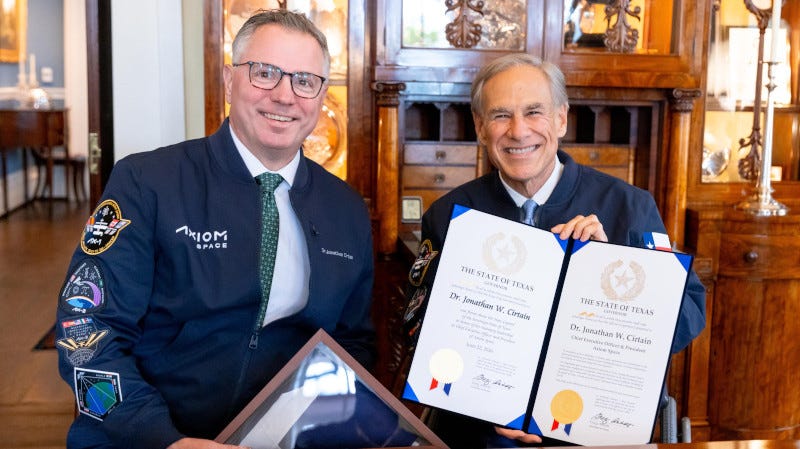
Axiom Space has shifted its legal headquarters from Delaware to Texas, formally aligning its corporate domicile with its long-standing operational base in Houston and underscoring the state’s growing role in the commercial space economy. The redomicile, announced June 23 by Axiom Space CEO and President Dr. Jonathan Cirtain alongside Texas Governor Greg Abbott, further embeds the company in a state that has made substantial policy and financial commitments to space-related industries.
“Texas has demonstrated, consistently and deliberately, that it wants innovative companies to thrive here and has built the policy and regulatory framework accordingly.”
Dr. Jonathan Cirtain, Axiom Space
The company’s redomicile changes Axiom Space’s legal home from Delaware to Texas, bringing its corporate registration into line with operations centered at Houston Spaceport at Ellington Airport. Axiom has called Houston home since its founding in 2016 and describes the move as “planting its roots deeper” in a state it says shares its conviction that developments in space can profoundly shape life on Earth.
“Texas has demonstrated, consistently and deliberately, that it wants innovative companies to thrive here and has built the policy and regulatory framework accordingly,” said Dr. Jonathan Cirtain, CEO and President of Axiom Space. “For Axiom Space, establishing Texas as both our operational and legal home puts us squarely in a state that understands our mission, supports our industry, and shares in what we are working to achieve.”
Texas has actively pursued a role as what Axiom describes as a “nerve center of the new space economy,” backing that ambition with hundreds of millions of dollars in funding for research and infrastructure. In 2023, the state legislature created the Space Exploration & Aeronautics Research Fund (SEARF) with a $150 million appropriation, and allocated another $200 million for the Texas A&M Space Institute, a multi-tenant facility focused on lunar and Mars systems.
Lawmakers followed in 2025 with an additional $300 million in grants overseen and advocated by the Texas Space Commission, support Axiom says is creating a “gravitational pull” for companies committed to long-term growth in space and to returning benefits to Earth. Axiom Space is a direct beneficiary, receiving a $5.5 million SEARF grant to advance its orbital computing capabilities and expand its role from hardware manufacturer to broader space infrastructure provider.
Axiom Space reports it employs about 700 people, most of them in Texas, and positions itself as a growing contributor to the state’s economy and technical workforce. The company’s Houston-based Assembly Integration and Test Facility, built as an anchor tenant at the Houston Spaceport, will host final assembly and integration of Axiom Station modules before they are launched to low Earth orbit (LEO).
Nearby, a Space Station Development Facility houses design and mission services work that Axiom says will help define tomorrow’s orbital economy. The company also operates a spacesuit lab where engineers are developing next-generation spacesuits intended to support human missions returning to the lunar surface for the first time in more than half a century.
Axiom Space’s broader mission is to turn LEO into a permanent laboratory and platform for tackling challenges in medicine, materials, manufacturing and other fields by leveraging the unique environment of microgravity. The company emphasizes that research and technology developed aboard Axiom Station are intended to “return” to Earth as new therapies, materials and technologies that can benefit people worldwide.
By reincorporating in Texas, Axiom says it can focus more fully on innovation and expansion of space infrastructure while ensuring the United States maintains leadership in LEO operations. The company frames its work as helping guarantee humanity “never loses its footing” in low Earth orbit and that microgravity remains open and productive for scientists, innovators and industries.