


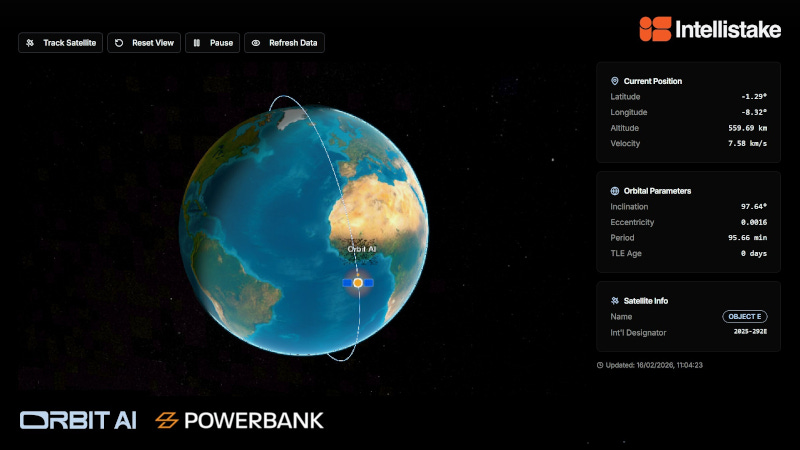
Since its deployment on December 10, Genesis-1 has been actively operating in orbit and running a 2.6-billion-parameter artificial intelligence model, according to Intellistake. The satellite is equipped with an NVIDIA AI core and is currently performing real-time analysis of infrared remote sensing data.
“What we’re seeing here is AI operating beyond traditional Earth-based infrastructure. Real-time decision-making in orbit changes how satellite systems can function.”
Jason Dussault, Intellistake
Instead of transmitting large volumes of raw satellite data back to Earth for processing, Genesis-1 analyzes information directly in space and sends back only the results. According to Orbit AI, this approach reduces response times from hours to seconds and lowers transmission bandwidth requirements by up to 99%. Genesis-1 demonstrates that advanced AI systems can operate as active decision-making platforms in orbit rather than relying entirely on ground-based data centers.
The Genesis-1 satellite operates a 2.6-billion-parameter AI model. In artificial intelligence systems, a parameter is a learned weight inside a neural network. The total number of parameters broadly reflects how much information a model can store, how complex the patterns it can learn are, and how capable it is at tasks such as reasoning, language understanding, and generation.
Models in the 2–3 billion parameter range are widely deployed for efficient, real-time applications. Examples at a similar scale include:
Meta’s LLaMA-3.2 3B1
Google’s Gemma 2B2
Research models such as OPT-2.7B and GPT-NeoX 2.7B3,4
This places Genesis-1 within the range of modern, production-level AI systems. By operating directly in orbit rather than relying solely on large data centers on Earth, it demonstrates how AI can function beyond a single centralized location.
“What we’re seeing here is AI operating beyond traditional Earth-based infrastructure. Real-time decision-making in orbit changes how satellite systems can function,” said Jason Dussault, CEO of Intellistake. “As AI expands into new operating environments, reliable verification and transparency will become increasingly important.”
“Genesis-1 is already in orbit and actively performing real-time AI analysis on a satellite. This demonstrates that meaningful intelligence can operate beyond Earth-based infrastructure, with reduced latency and bandwidth requirements,” said Patrick Zhou, CEO of Smartlink AI. “Our focus has always been on proving capability first. Genesis-1 is that proof, and it shows what becomes possible when compute and decision-making move directly into orbit.”
Intellistake previously completed a $500,000 strategic equity investment in Orbit AI. The continued live operation of Genesis-1 confirms that Orbit AI’s AI system is functioning as intended in orbit. Genesis-1 represents the first operational node in Orbit AI’s planned orbital architecture, with development progressing toward the next mission, Genesis-2.
As AI systems begin operating beyond traditional terrestrial infrastructure, reliable methods to validate performance and ensure data integrity may become increasingly relevant. Intellistake continues to evaluate how blockchain-based verification infrastructure could integrate into future missions, subject to engineering feasibility and regulatory approvals.