

Swift Boost Mission Potentially Launching Today
NASA Contractor Designed, Built and Tested the Rescue Mission in Less than a Year

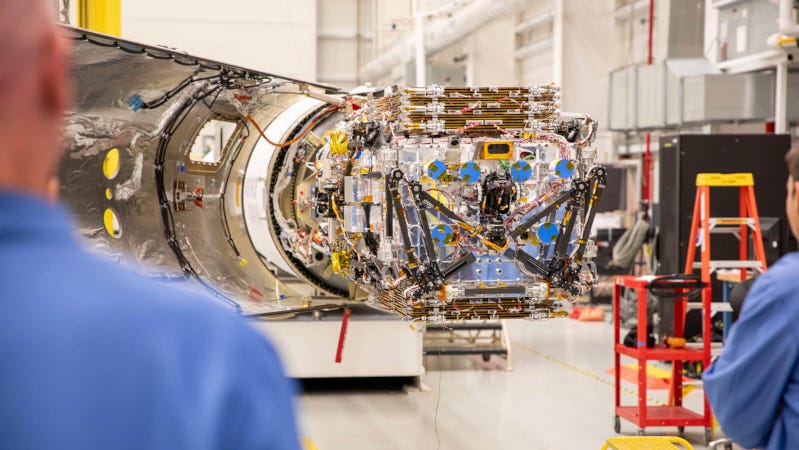
A robotic spacecraft is ready to launch no earlier than June 30 on a first-of-its-kind mission to capture and raise NASA’s Neil Gehrels Swift Observatory, which has been gradually losing altitude due to increased atmospheric drag caused by recent solar storms.
“We’re doing this on a time scale that’s kind of crazy by space standard. It’s a different risk posture than NASA is used to working with.”
Brad Cenko, NASA Goddard
The Katalyst Space LINK spacecraft completed integration with Northrop Grumman’s Pegasus XL rocket at NASA Wallops Flight Facility’s Horizontal Integration Facility in Virginia on June 15, marking the final major pre-launch milestone. The Pegasus XL will be mated to Stargazer, Northrop Grumman’s L-1011 carrier aircraft, which will transport the rocket to Kwajalein Atoll in the Republic of the Marshall Islands for the June 30 launch attempt.
Designed, built, and tested in just eight months by the Flagstaff, Arizona-based company, LINK will attempt to rendezvous with Swift in low Earth orbit and boost it to a higher altitude, preserving one of NASA’s most versatile astrophysics observatories.
“What the Katalyst team has accomplished in just eight months is extraordinary,” said Ghonhee Lee, CEO of Katalyst Space. “The team designed, built, tested, and integrated a robotic spacecraft capable of performing one of the most ambitious commercial servicing missions ever attempted. Completing encapsulation marks the transition from development to operations.”
Launched in 2004, Swift is NASA’s astrophysics multitool, capable of rapidly observing cosmic objects across visible, ultraviolet, X-ray, and gamma-ray wavelengths. It remains unique within NASA’s portfolio for its ability to detect and quickly study gamma-ray bursts and other short-lived, energetic phenomena.
All spacecraft in low Earth orbit experience slight drag from Earth’s upper atmosphere, which gradually lowers their orbits if they lack propulsion systems to compensate. A recent bout of elevated solar activity magnified this effect on Swift, causing it to sink faster than anticipated.
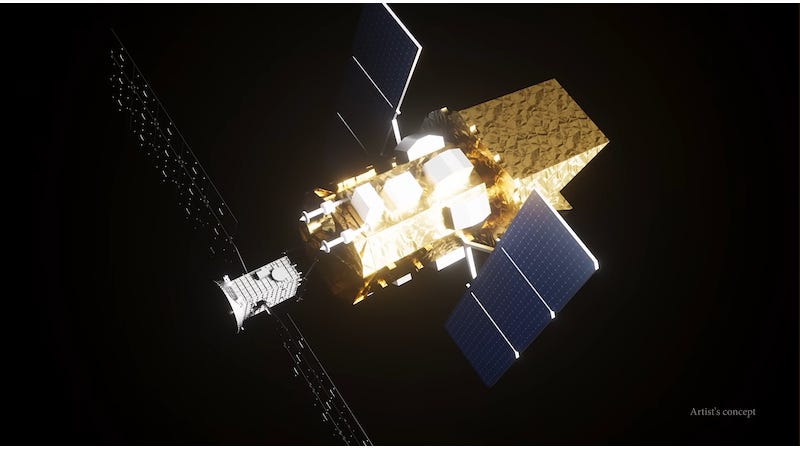
NASA awarded Katalyst the contract in September 2025, giving the company less than a year to design, build, test, and launch a spacecraft capable of meeting, grabbing, and lifting Swift. In the meantime, teams at NASA’s Goddard Space Flight Center in Greenbelt, Maryland, and Pennsylvania State University’s Eberly College of Science in University Park made operational changes to keep Swift at least 185 miles (300 kilometers) above Earth — the minimum altitude at which the boost mission has the best chance of success.
“We’re doing this on a time scale that’s kind of crazy by space standards,” said Brad Cenko, a research astrophysicist at NASA Goddard and principal investigator for Swift. “It’s a different risk posture than NASA is used to working with.”
Cenko noted that Swift’s capabilities made the rescue effort worthwhile. “That’s the kind of capability that is unique in NASA’s astrophysics portfolio that we would like to keep going with this reboost mission. So when this opportunity came along, it was a tremendous relief.”
While NASA could have allowed Swift to re-enter the atmosphere, the situation presented an opportunity to demonstrate a key commercial servicing capability. Choosing a reboost mission also extends Swift’s scientific lifetime at a lower cost than replacing the observatory’s unique instruments.
NASA Associate Administrator for the Science Mission Directorate Nicky Fox emphasized the broader significance. “By moving quickly to pursue innovative commercial solutions, we’re further developing the space industry and strengthening American space leadership,” Fox said. “This daring mission will demonstrate our ability to go from concept to implementation in less than a year.”
Once on orbit, LINK will rendezvous with Swift over the course of several months and gradually raise its altitude, buying the observatory more operational time. Lee said the mission points toward a new era of on-orbit operations: “LINK is about putting hands on orbit. Once we can physically interact with spacecraft, we can extend their lives, improve their capabilities, and build a more resilient space economy.”