


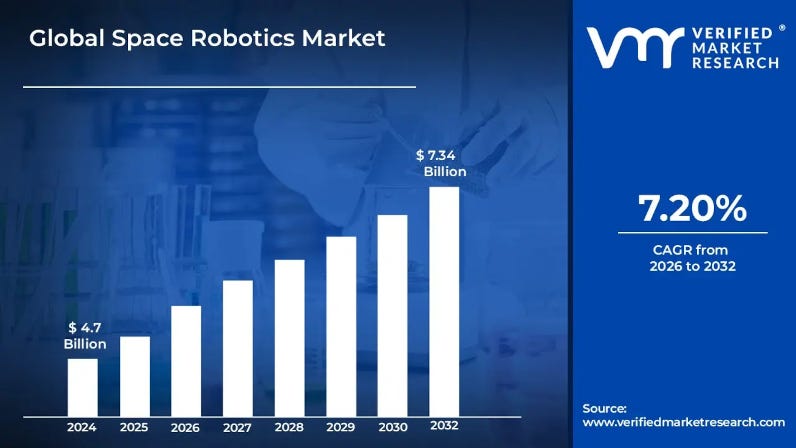
The global Space Robotics Market is experiencing sustained momentum driven by rising investments in autonomous mission systems, rapid advancements in AI-enabled robotics, and expanding commercial and governmental space activities, according to a new report from Verified Market Research.
According to the report, the global Space Robotics Market, valued at $4.7 billion in 2024, is projected to reach $7.34 billion by 2032, expanding at a CAGR of 7.20% during the forecast period from 2026 to 2032. The market trajectory reflects increasing commercialization of space operations, expanding satellite constellations, and growing reliance on robotic technologies for mission safety, efficiency, and operational precision.
The increasing complexity of orbital and deep-space missions is accelerating the deployment of autonomous robotic systems capable of performing inspection, assembly, repair, and exploration tasks with minimal human intervention. Enterprises and space agencies are prioritizing robotics to reduce mission risk, optimize payload efficiency, and extend operational lifespans of assets. For market research buyers, this driver signals long-term capital allocation shifts, technology procurement opportunities, and evolving supplier ecosystems.
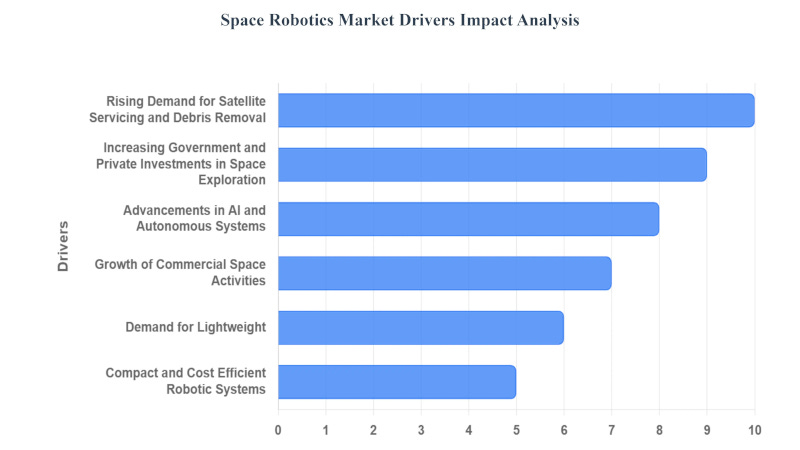
Satellite servicing, refueling, debris management, and in-space infrastructure maintenance are creating sustained demand for precision robotic platforms. Commercial operators and defense organizations are increasingly adopting robotic servicing technologies to protect high-value orbital assets. This driver highlights strategic revenue pools, partnership models, and technology differentiation opportunities, making competitive benchmarking and investment analysis critical for enterprise decision-makers.
Technological progress in AI, machine learning, sensor fusion, and space-qualified robotic mobility is enabling higher levels of autonomy and operational reliability. These innovations are reducing mission constraints while expanding application feasibility across lunar, Martian, and orbital environments. For industry stakeholders, understanding innovation pipelines, IP landscapes, and commercialization pathways becomes essential for strategic planning and portfolio development.
However, there are some challenges to the market. Space robotics systems require extensive testing, radiation hardening, and mission-specific customization, leading to elevated capital expenditures and prolonged development cycles. These cost structures influence procurement decisions, vendor selection strategies, and market entry dynamics, posing financial and operational challenges for emerging participants and enterprise buyers.
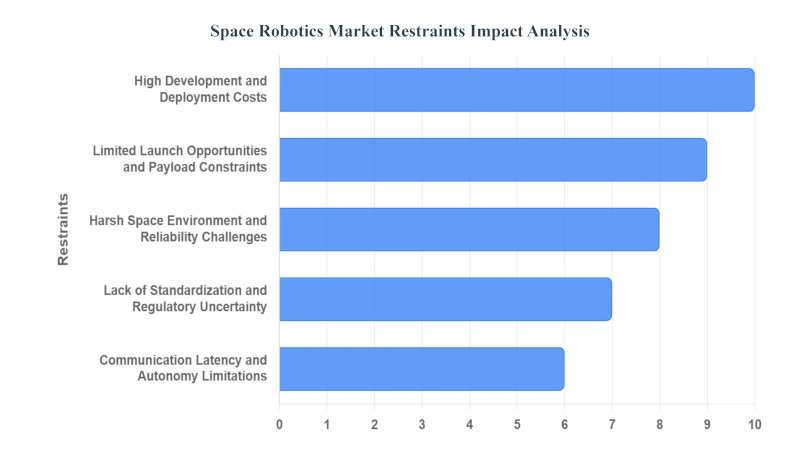
Robotic failures in space environments carry significant financial and reputational consequences. Reliability assurance, redundancy engineering, and validation protocols increase deployment complexity. Buyers must evaluate supplier capabilities, technology maturity, and lifecycle support frameworks to mitigate operational risks and safeguard mission success.
International space governance, export controls, and mission authorization processes introduce compliance burdens and strategic uncertainties. Variability in national policies and licensing frameworks can impact deployment timelines and cross-border collaborations, necessitating careful regulatory intelligence and risk assessment.
North America maintains dominance within the Space Robotics Market, supported by robust governmental funding, private sector innovation, and a mature aerospace ecosystem. The United States continues to drive advancements through sustained investments in space exploration initiatives, defense programs, and commercial satellite operations. Europe represents a strong secondary market, characterized by collaborative research frameworks and increasing robotic mission deployments. Asia-Pacific is emerging as a high-growth region, with China, India, and Japan expanding space capabilities, national missions, and robotics research. Emerging economies are increasingly viewed as future opportunity zones due to expanding space ambitions and technology partnerships.