

Study Will Assess LEO Navigation Layer
u-blox Evaluates ESA’s Celeste Satellites as Complementary Signals for Resilient Navigation and Timing

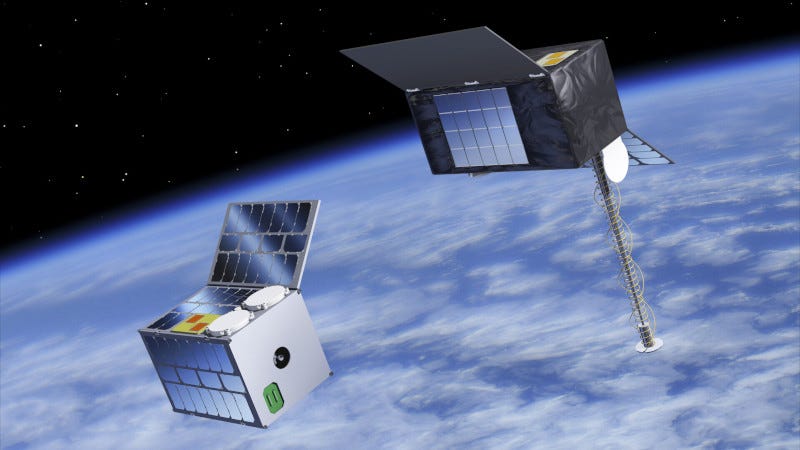
A study to evaluate how signals from low Earth orbit satellites could complement existing global navigation satellite systems is being conducted by Swiss positioning technology company u-blox following recent launches under the European Space Agency’s Celeste program.
“As part of the NAVISP Element 2 project, we are assessing how emerging signal sources can complement GNSS and contribute to robust and reliable positioning performance.”
Jani Käppi, u-blox
The work comes after ESA placed its first two Celeste low Earth orbit positioning, navigation and timing (LEO‑PNT) demonstration satellites into orbit on March 28, marking the agency’s initial step toward extending satellite navigation services beyond traditional medium Earth orbit constellations such as Galileo.
u-blox said it is studying how LEO-based signals could be integrated with established GNSS signals to improve positioning performance for mass‑market receivers, particularly in environments where satellite visibility is limited or degraded. “As the positioning ecosystem evolves, LEO-based signals are emerging as a complementary layer to established GNSS,” the company said in an April 13 statement.
Unlike traditional GNSS satellites, which orbit at roughly 20,000 kilometers (≈12,430 miles), LEO satellites fly much closer to Earth. The lower altitude results in stronger received signals and rapidly changing satellite geometry — characteristics that researchers believe could improve convergence speed and robustness in challenging conditions such as urban canyons or indoor environments.
u-blox emphasized that the approach is not intended to replace GNSS. Instead, the company is assessing how an additional orbital layer could improve overall performance when combined with existing systems such as Galileo.
The research is being carried out under ESA’s Navigation Innovation and Support Program, known as NAVISP, specifically Element 2, which focuses on technology maturation. The project is co-funded by ESA and includes a technical assessment of how LEO signals interact with GNSS measurements in multi-layer positioning architectures.
“As part of the NAVISP Element 2 project, we are assessing how emerging signal sources can complement GNSS and contribute to robust and reliable positioning performance,” said Jani Käppi, head of technology positioning at u-blox.
The scope of the work includes characterizing new LEO signal transmissions, analyzing interactions between LEO and GNSS measurements, and evaluating the effects of the rapidly changing geometry typical of low Earth orbit satellites, according to the company.
u-blox said early integration activities are underway on its X20 GNSS platform, where engineers are examining how different signal types and frequency bands could be incorporated into future receiver designs.
The ESA Celeste initiative is structured as an in‑orbit demonstration, with a planned constellation of 11 satellites and one spare to test novel navigation signals across multiple frequency bands. The program is intended to inform future European decisions on resilient navigation and timing infrastructure.