


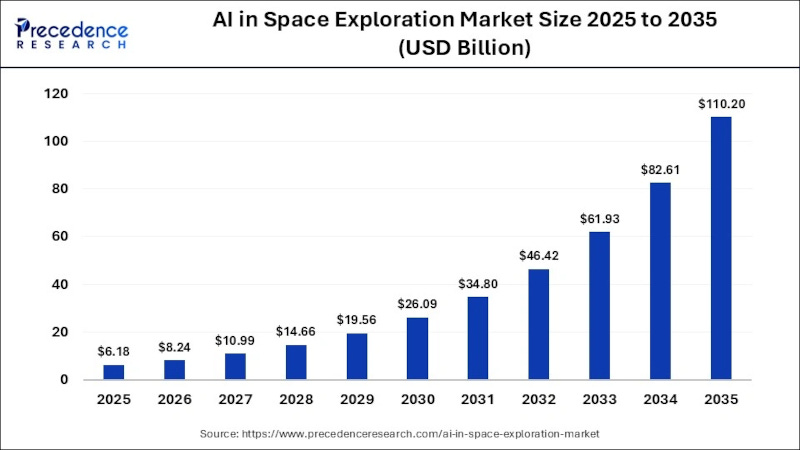
The global AI in Space Exploration market size was calculated at $6.18 billion in 2025 and is predicted to increase from $8.24 billion this year to approximately $110.20 billion by 2035, expanding at a CAGR of 33.40% from 2026 to 2035, according to a new report from Precedence Research. The market is driven by rising demand for autonomous mission operations, an increase in the number of satellite constellations, and significant investment by governments and private companies in deep space and planetary exploration missions.
The market has been growing rapidly, with governments and private companies investing in advanced space technologies. Applications of AI in space technology range from guiding autonomous spacecraft and controlling satellites to the analysis of huge space datasets and precision mapping of planets and asteroids. AI facilitates real-time decision-making in harsh and remote environments where immediate human intervention is not possible. The market growth is driven by ambitious Mars and lunar missions, increased satellite constellations, and commercial space activities.
The rapid pace of innovation in AI technologies is driving significant technological shifts in the market. For instance, autonomous navigation is being used to plan routes for robots on planetary surfaces and asteroids. There are AI-based data analysis applications that process satellite and telescopic data to facilitate faster mapping and detection of anomalies and objects. Advanced technologies such as predictive maintenance for improved reliability and swarm intelligence applications for satellite coordination are being widely adopted in the market. The applications that integrate artificial intelligence and machine learning, along with quantum computing, have been developed.
AI in Space Exploration Market Trends
Collaborations & Partnerships: Space agencies are collaborating with technology companies to integrate AI in mission-critical applications. The collaborations aim to develop autonomous navigation and decision-making, as well as real-time analytics. For instance, NASA has collaborated with IBM to leverage AI in the processing of satellite and planetary data.
Government Initiatives: Governments are investing in the adoption of AI technologies in space exploration to improve the efficiency of missions. Governments are also promoting the development of AI technologies specifically for robotics, deep space missions, and earth observation. For instance, the Indian Space Research Organization (ISRO) launched the Chandrayaan mission with AI-based terrain observation systems.
Business Expansions: Space technology companies are expanding their AI portfolios to meet the increasing demand for intelligent space missions. They are providing AI-based satellite services. For instance, Maxar Technologies is expanding its geospatial AI capabilities to provide real-time intelligence and useful parameter insights.
Growth by Segment
The software segment led the market and held approximately 46.8% share in 2025 and is estimated to have the fastest CAGR during the forecast period.
The services segment is expected to grow at a significant CAGR during the forecast period due to escalating demand for AI integration services, testing, and support services.
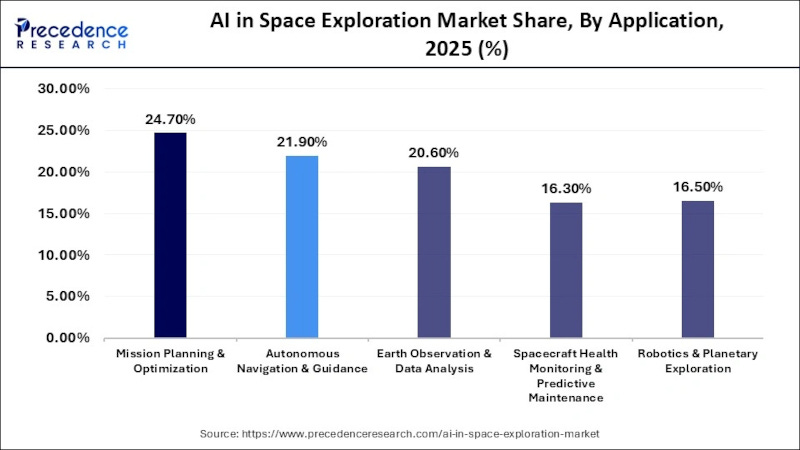
The mission planning & optimization segment dominated the market with approximately 24.7% share in 2025.
The robotics & planetary exploration segment is expected to grow at the highest CAGR between 2026 and 2035 due to an increase in deep space missions and lunar and Mars exploration programs.
The U.S. AI in space exploration market size is calculated at $2.03 billion in 2025 and is expected to reach nearly $36.61 billion in 2035, accelerating at a strong CAGR of 33.54% between 2026 and 2035. The U.S. leads the market in North America due to a well developed space industry with robust federal and private funding. NASA contributes significantly to the market by developing space programs that perform deep space missions with the integration of AI, along with autonomous spacecraft systems and planetary exploratory programs.