


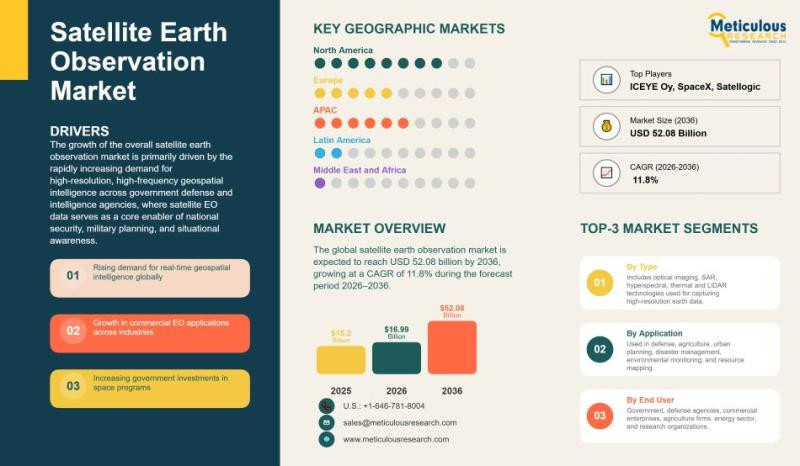
The global satellite earth observation market has been witnessing steady expansion, reflecting its growing importance across both government and commercial sectors. Valued at $15.20 billion in 2025, the market is projected to reach $52.08 billion by 2036, rising from an estimated $16.99 billion in 2026. This growth corresponds to a compound annual growth rate (CAGR) of 11.8% during the forecast period from 2026 to 2036. According to a new report from Meticulous Research, the consistent upward trajectory highlights the increasing reliance on satellite-based data for monitoring, analysis, and decision-making across a wide range of industries and applications.
At its core, the satellite earth observation market represents a comprehensive ecosystem that integrates satellite platforms, data acquisition systems, and advanced analytics to monitor the Earth’s surface, atmosphere, and oceans. This ecosystem spans the entire value chain, including satellite hardware such as spacecraft, payloads, and ground infrastructure, as well as data products like multispectral, hyperspectral, radar, and thermal imagery. In addition, it encompasses value-added services that transform raw satellite data into actionable intelligence through advanced analytics and artificial intelligence-driven insights. These capabilities serve a diverse set of end users, including government agencies, defense organizations, commercial enterprises, and research institutions.
The demand for satellite earth observation is being driven by the increasing need for high-resolution and high-frequency geospatial intelligence. Government and defense agencies rely heavily on such data for national security, surveillance, and strategic planning. Satellite imagery and analytics enable real-time situational awareness, which is critical for monitoring borders, tracking potential threats, and supporting military operations. At the same time, the commercial sector is rapidly adopting earth observation solutions across industries such as agriculture, energy, insurance, infrastructure, and logistics. The declining cost of satellite imagery, driven by the rise of small satellite constellations and improved launch economics, has made these technologies more accessible to a broader range of users.
Other key takeaways from the report:
Environmental considerations are playing a crucial role in shaping market growth
Technological advancements are transforming the market from a traditional imagery-focused model into a more sophisticated intelligence-driven ecosystem
With over 1,600 active earth observation satellites in orbit by early 2026, the market is benefiting from increased data availability and improved revisit rates
Optical imaging continues to hold the largest share of the market due to its versatility and ease of interpretation.
The market is also evolving through the introduction of advanced sensor technologies, including hyperspectral imaging
Infrastructure and urban planning represent a major area of demand
The market is geographically led by North America, which benefits from strong government support and a well-established commercial ecosystem
Despite its strong growth prospects, the satellite earth observation market faces certain challenges. High capital requirements for satellite development, launch, and infrastructure remain a significant barrier.
Overall, the global satellite earth observation market is transitioning into a more advanced and dynamic phase, driven by technological innovation, expanding applications, and increasing demand for data-driven insights. As the market continues to evolve, it is expected to play a critical role in addressing global challenges, supporting economic development, and enabling informed decision-making across a wide range of industries.