


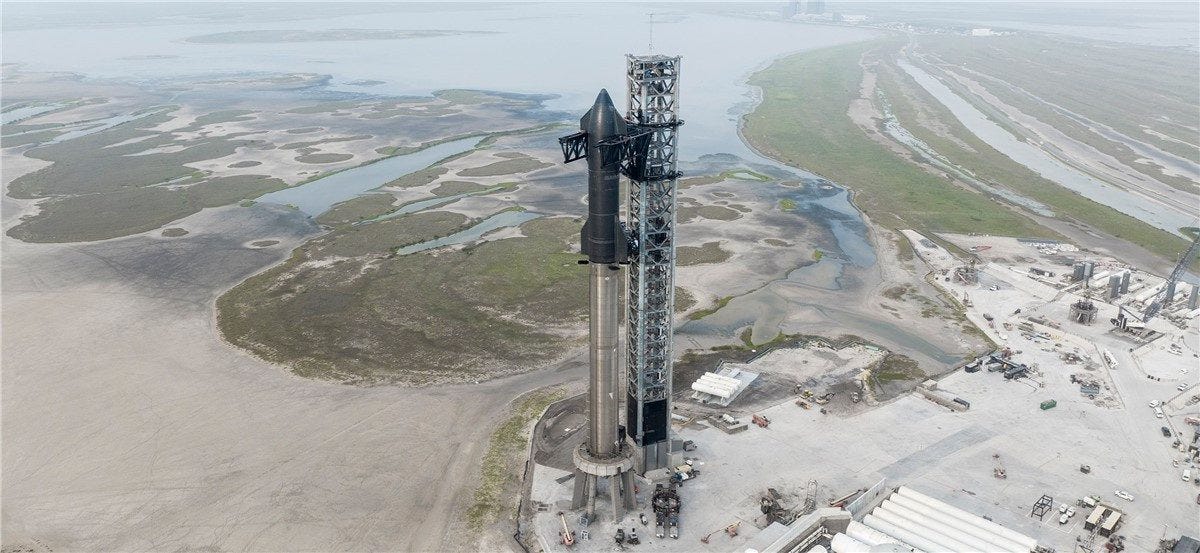
What This Means
Falcon 9 is approaching a structural cadence ceiling, and Starship’s orbital debut — the event the entire commercial launch economics story hinges on — has not yet occurred and has slipped three times in 2026 alone. The market is consuming available launch capacity faster than new capacity is being certified, while the business models that depend on Starship-level pricing (orbital compute, large-constellation architectures, in-space manufacturing) continue to attract capital at valuations that embed a cost crossover most plans have not explicitly stress-tested. Executives and investors with launch-dependent capital commitments should formally model a Plateau scenario — Falcon 9 pricing persisting through 2028 — alongside their current assumptions, and identify which milestones on their critical path cannot survive an 18-to-24-month Starship delay.
The Plan You Haven’t Written Down
Most capital allocation plans in commercial space share a quiet assumption. Nobody puts it in a slide deck or a board memo, but it’s there. Somewhere between the constellation rollout schedule, the space-based infrastructure pro forma, and the launch manifest commitments is a line that reads, in effect: and at some point, Starship makes this cheaper.
That assumption is doing a lot of work. It is carrying the economics of orbital data centers, the financing structures of second-generation constellations, and the go-to-market timelines of in-space services companies that cannot be profitable at Falcon 9 pricing. None of those businesses are wrong to wait for it. But there is a meaningful difference between “waiting for Starship” as a considered strategic position — with explicit Plateau contingencies — and “waiting for Starship” as background optimism that nobody has formally stress-tested.
At SATELLITE 2026 in late March, SpaceX’s vice president of commercial sales confirmed what procurement teams have been hearing informally for months: the manifest is full, scheduling runs well into 2028 and 2029, and the binding constraint is no longer rocket production — it is payload processing throughput and launch site capacity. Falcon 9 is not at its ceiling. But it is approaching the zone where incremental gains require serious infrastructure investment and regulatory throughput, and where slot scarcity starts to look less like a temporary condition and more like a structural market feature.
Every operator and investor in this sector is, right now, implicitly assigning a probability to one of two futures. The only question is whether that probability has been assigned deliberately or by default.
Falcon 9’s Cadence: A Record That Tells Two Stories
SpaceX flew 167 missions in 2025 — another record, and a number that would have been considered science fiction fifteen years ago. For 2026, SpaceX’s stated goal is approximately 145 launches — a deliberate reduction, not a sign of constraint, that reflects fleet management optimization and refurbishment scheduling. The company has not hit a wall. But the wall is visible.
The FAA has formally capped Vandenberg SLC-4 at 50 launches per year. A March 2025 Finding of No Significant Impact approved an expansion of KSC’s SLC-40 from 50 to 120 launches annually — a significant step, but one that required years of environmental review and regulatory process. The Space Force’s internal planning target for Florida is 500 launches per year by 2030. The gap between 145 today and 500 by 2030 is not primarily a SpaceX manufacturing problem. It is a regulatory throughput problem, a ground processing problem, and a physical infrastructure problem — each with its own timeline.
Aviation Week’s March 31 assessment put it plainly: “Space Launcher Shortages Are Poised to Persist.” New entrants are falling short of their cadence promises. The FAA licensing backlog is a real structural bottleneck, not a political inconvenience. And at the smallsat tier, launch prices are rising as alternative vehicles stall on the pad.
None of this means Falcon 9 is broken. It means the market is consuming available capacity faster than new capacity is being certified. That dynamic is not self-correcting in the next 12 months, regardless of what Starship does.
