

Starship-Optimized Spacecraft Platform Targets Constellation Scale
Muon Space Says Its New Condor-Ultra Can Stack Hundreds of Satellites for a Single Launch

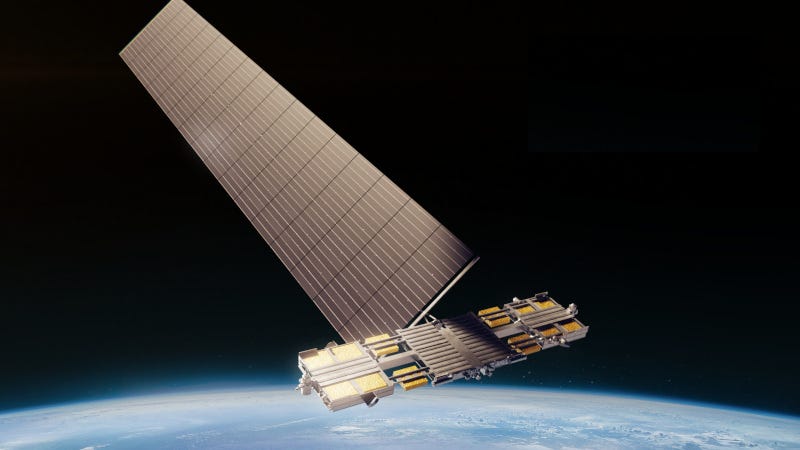
Muon Space unveiled a spacecraft platform this week designed to deploy in stacked configurations aboard SpaceX’s Starship, targeting constellation operators that need hundreds to thousands of satellites on orbit.
“The most compelling space infrastructure missions of the next decade, from global communications networks to scaled remote sensing to distributed orbital compute, require a managed and integrated platform that is powerful, stackable, and built to scale cost effectively.”
Jonny Dyer, Muon Space
The Mountain View, California company introduced the platform, called Condor-Ultra, less than a year after unveiling its Condor-XL. The new design targets communications networks, remote sensing and orbital data center applications. A pathfinder satellite is slated for delivery in 2028.
The platform delivers 20 kilowatts of power at initial configuration, with variants scaled to 100 kilowatts planned for later. It offers more than 194 square feet (18 square meters) of Earth-facing payload area, 100 Gbps intersatellite optical mesh networking, and persistent 25 Gbps connectivity through Starlink. Muon says configurations for Falcon 9 and Rocket Lab’s Neutron are also available.
“The most compelling space infrastructure missions of the next decade, from global communications networks to scaled remote sensing to distributed orbital compute, require a managed and integrated platform that is powerful, stackable, and built to scale cost effectively,” said Jonny Dyer, chief executive officer of Muon Space. Condor-Ultra delivers exactly that, and it does it on the strong foundation of a flight-proven satellite, operations, data, and software stack our customers already trust.”
The company is positioning orbital data centers as a primary use case. Condor-Ultra’s architecture is designed to support high-density compute workloads and autonomous operations at constellation scale. Muon said it has conducted feasibility work with hyperscalers on large-scale AI infrastructure in orbit, and that work shaped the platform’s design priorities.
The platform is architected to integrate NVIDIA’s Space-1 Vera Rubin Module, a space-qualified AI inference unit NVIDIA developed for orbital workloads. Muon said the Rubin GPU delivers up to 25 times the AI compute performance of the H100 for in-space applications.
Muon is extending vertical integration with the new platform, keeping all critical subsystems in-house. The company already designs and manufactures its own avionics, propulsion, communications hardware, guidance, navigation and control systems, flight software and networking gear. Dyer said that level of control optimizes mission performance, strengthens quality assurance and reduces recurring unit costs.
The platform uses Muon’s proprietary Starlight propulsion system, which the company first developed for its earlier spacecraft lines. Muon did not disclose the propellant type or specific thrust figures in Tuesday’s announcement.
The company, founded in 2021, operates production facilities in Silicon Valley and has multiple constellations on orbit. Condor-Ultra is the third platform in its Condor series.