

Star Catcher $65 Million Round Targets First-Ever Orbital Power Beaming Demonstration
Space Force’s Founding General Joins Board as Star Catcher Advances In-Orbit Energy Grid

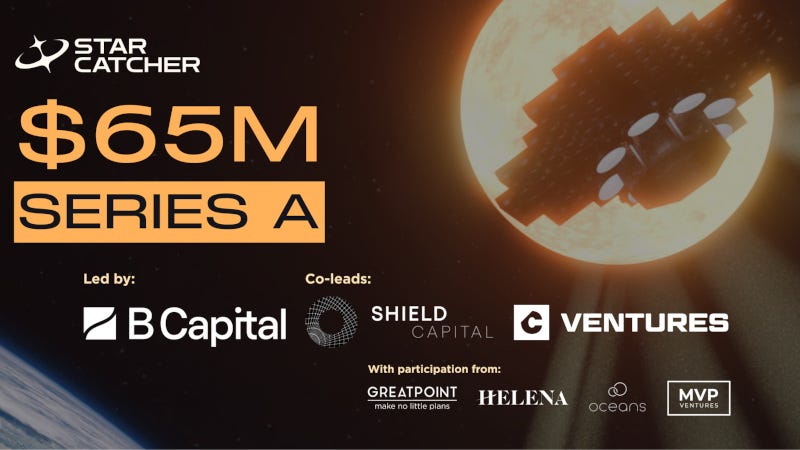
A $65 million Series A funding round to build the first power grid in space has been closed by Star Catcher Industries, a Jacksonville, Florida-based company developing space-based energy infrastructure. The oversubscribed round brings the company’s total capital raised to $88 million.
“This investment underscores the conviction that orbital infrastructure is now as fundamental as terrestrial infrastructure.”
Andrew Rush, Star Catcher
The round was led by B Capital and co-led by Shield Capital and Cerberus Ventures, the venture arm of Cerberus Capital Management. GreatPoint Ventures, Helena, Oceans Ventures, and MVP Ventures also participated.
Three new board members join as a result of the financing: General John W. “Jay” Raymond (Ret.), the first Chief of Space Operations of the United States Space Force and a Senior Managing Director at Cerberus; Jeff Johnson, General Partner and Global Head of Energy at B Capital; and David Rothzeid, Principal at Shield Capital. Raymond’s appointment adds prominent national security space experience to Star Catcher’s leadership structure.
“Energy and infrastructure resilience are core national and economic priorities on Earth, as in orbit,” Raymond said. “Persistent surveillance, resilient communications, and unhindered maneuverability are all constrained today by power. An on-demand power grid can change that, expanding critical capabilities across commercial and national security missions.”
Star Catcher is building a space-based energy infrastructure layer that delivers electricity on demand to satellites and other spacecraft using optical power beaming. The company says the technology can increase available power to spacecraft by up to 10 times with no retrofit or custom receiver required. Founded less than two years ago, the company has already set a world record for optical power beaming, completed a critical on-orbit subsystem demonstration, and validated its end-to-end system architecture.
“This investment underscores the conviction that orbital infrastructure is now as fundamental as terrestrial infrastructure,” said Andrew Rush, co-founder and CEO of Star Catcher. “Every major application driving the space economy — connectivity, computing, security, sensing — is power-limited today. Star Catcher is lifting that ceiling — making it possible to build in orbit at the scale the next century of life on Earth will demand.”
For B Capital, the investment reflects the same dynamics the firm sees playing out in terrestrial energy markets. “There is exploding demand, limited shared infrastructure, and a generational opportunity for the company capable of building the first in-orbit grid,” said Johnson. “The traction we’ve seen thus far speaks for itself, and we’re proud to lead this round in support of a team that brings unmatched operational depth to solve this critical challenge.”
The first-ever space-based optical power beaming demonstration is scheduled to launch later this year — the first of a series of flight missions designed to progressively retire technical risk and deploy operational capability. A second orbital mission is already in development, and the Series A will fund both missions while strengthening the company’s engineering and operations capacity.
“Star Catcher is solving the constraint that plagues every space-based mission: power,” said John Serafini, Partner at Shield Capital. “They’ve moved from concept to world-record performance to flight hardware on a timeline almost no frontier-tech company achieves, and they’re building infrastructure with direct relevance to both commercial operators and the national security community.”
Star Catcher’s customer base spans commercial space operators and U.S. government stakeholders. The company has signed seven power purchase agreements, secured multiple government contracts, and is managing a qualified commercial pipeline representing more than $3 billion in projected annual recurring revenue. The Series A will support continued commercial expansion alongside deeper engagement with national security customers.