

SpaceX Contract Sets Up Major Dedicated Microgravity Drug Research Flight
Federal Mission-Authorization Rules for Such Flights Are Still Being Written


Space Microgravity Development LLC has signed a contract to fly up to 32 pharmaceutical research payloads aboard SpaceX’s Starfall spacecraft in 2028, in what the company says would be the largest dedicated commercial microgravity research mission flown to date.
“Space-based pharmaceutical development is reaching an inflection point.”
John Vellinger, SpaceMD
The company, known as SpaceMD, is a wholly owned subsidiary of Redwire Corp. based in Jacksonville, Florida. Starfall is a new SpaceX spacecraft designed to provide routine, lower-cost access to microgravity for on-orbit manufacturing and research. Under the contract, announced Aug. 6, SpaceMD’s payloads would fly a next-generation version of its Pharmaceutical In-Space Laboratory, or PIL-BOX, sized to fill the entire Starfall spacecraft.
The announcement did not specify the value of the contract, whether it covers additional future missions, or which drug candidates would fly. It also comes as the federal government’s mission-authorization framework for new categories of commercial space activity — the process that would apply to novel missions like this one — remains under development.
“Space-based pharmaceutical development is reaching an inflection point,” said John Vellinger, CEO of SpaceMD. Vellinger said pairing the company’s PIL-BOX hardware with Starfall would let SpaceMD serve more customers and speed up its research cadence.
SpaceMD has flown 54 PIL-BOX units to the International Space Station since November 2023, with 12 more scheduled to launch in September, October and December of this year. The company says it has crystallized 45 unique compounds through that program, including insulin and molecules targeting cancer, cardiovascular disease, obesity and diabetes.
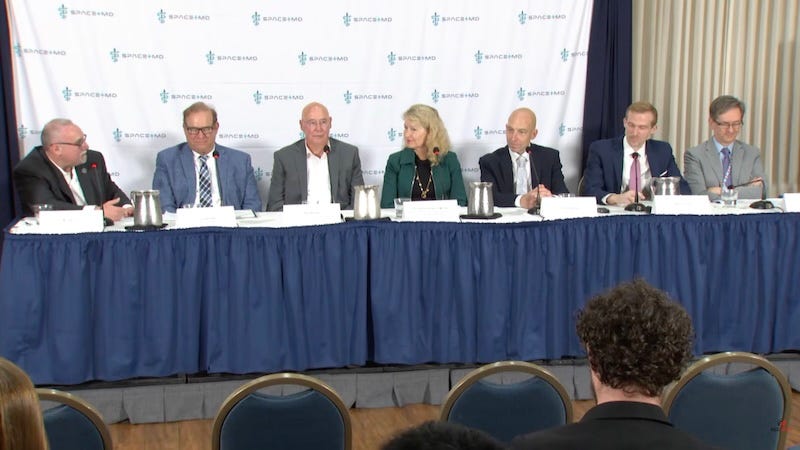
Officials from the Commerce Department’s Office of Space Commerce addressed the announcement Aug. 7 during a panel with government, industry and medical research representatives. Taylor Jordan, director of the Office of Space Commerce, said mission authorization — the regulatory framework directed by executive order — is advancing with input from industry and other federal agencies. “Soon you will see on the Federal Register a call for applications to begin the process of authorizing all these new, novel technologies,” Jordan said. “You have a great mission ahead of us, and we look forward to working directly with you.
Gabriel Swiney, acting deputy director of the office, tied the announcement to a broader administration goal. Swiney said the office is “attract(ing) $50 billion of additional investment into the commercial space industry,” under a presidential directive, and said missions like SpaceMD’s would help demonstrate that new kinds of space-based business are viable.
“Obviously, this is an enormous deal not just for all involved, but for the entire space community,” Swiney said. “What it takes is to prove that this is possible — prove that it is possible to use space and the capabilities that space can bring to do things that we’ve never done before, in space. That’s what will unlock the rest of space for all the other companies and, ultimately, the American people and the benefits.”