

Spacecraft Commissioning for NASA’s ESCAPADE Mars Mission Completed
Rocket Lab Is Preparing to Hand Over Operational Control to UCB-SSL

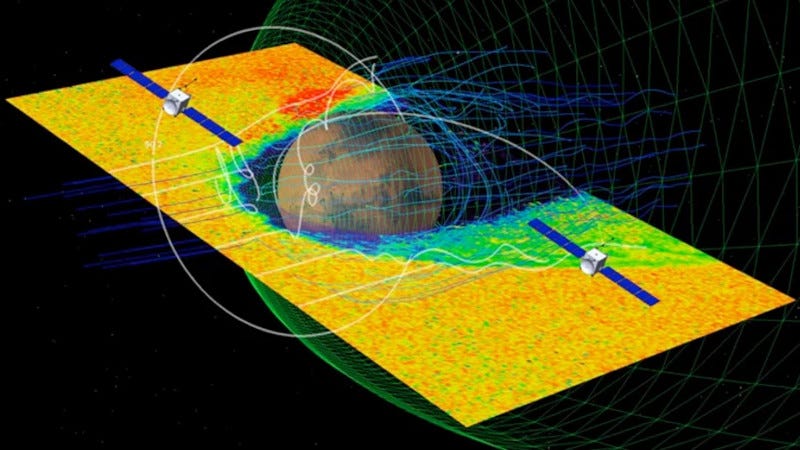
Commissioning of the twin NASA ESCAPADE Mars mission has been completed, and Rocket Lab, which designed, built and launched the spacecraft, is now preparing to hand over operational control to the University of California Berkeley Space Sciences Laboratory (UCB-SSL).
“The science ESCAPADE unlocks will be crucial to designing the infrastructure needed for a lasting human presence on the Red Planet, including a Mars Telecommunications Orbiter.”
Sir Peter Beck, Rocket Lab
Both spacecraft have been deemed fully operational at the Earth–Sun Lagrange Point 2 (L2). UCB-SSL, which commissioned the spacecraft, will now lead science operations at L2 and prepare the mission for its cruise to Mars.
Under contract from UCB-SSL, Rocket Lab was selected to design, build, and provide commissioning operations of the two high delta-V Explorer-class interplanetary spacecraft for ESCAPADE. Rocket Lab moved from concept to launch readiness in just over three years, proving commercial collaboration can deliver important science key to supporting future human and robotic exploration of Mars on ambitious schedules and for significantly smaller budgets than typical interplanetary missions. This speed was made possible through Rocket Lab’s vertically integrated spacecraft production, with key components including solar arrays, reaction wheels, propellant tanks, star trackers, radios, avionics, and flight software designed and built in-house.
Launched from Cape Canaveral Space Force Station in November 2025, the twin ESCAPADE spacecraft, known as Blue and Gold, completed spacecraft commissioning and executed two precise trajectory correction maneuvers, placing both spacecraft into their loiter trajectory near L2, approximately 1.5 million kilometers from Earth.
“ESCAPADE proves what’s possible when government, university and commercial teams come together with ambition, drive, and determination to do things differently,” said Rocket Lab Founder and CEO Sir Peter Beck. “Rocket Lab designed and built two Mars spacecraft on a timeline most would call impossible. We have established a long track record of relentless execution across launch, spacecraft development, and complex deep space missions. ESCAPADE is yet another example of the Rocket Lab team delivering mission success for NASA and our mission partners. With Blue and Gold now positioned for their cruise to Mars, we’re laying the groundwork (for) NASA’s long-term objectives at Mars. The science ESCAPADE unlocks will be crucial to designing the infrastructure needed for a lasting human presence on the Red Planet, including a Mars Telecommunications Orbiter. This is just the beginning.”
The ESCAPADE mission will study how the solar wind strips molecules from Mars’ atmosphere offering insight into the planet’s atmospheric escape history and space weather environment and informing future human exploration strategies. The ESCAPADE spacecraft will continue operating in proximity to Earth, near L2, until November 2026, allowing UCB-SSL to test its science instruments and collect early heliophysics data in the Earth’s magnetotail, the elongated region of the magnetosphere stretched downstream by the solar wind.
In November 2026, both spacecraft will perform a gravity assist maneuver around Earth to slingshot toward Mars. Blue and Gold are scheduled to arrive at Mars in September 2027, with science operations expected to begin in 2028.