

Space-Weather Payload to Fly on HEX20’s MAYA-V1 LEO Platform
Mission Space Books Fourth In-Orbit Sensing Mission for Radiation Intelligence Network

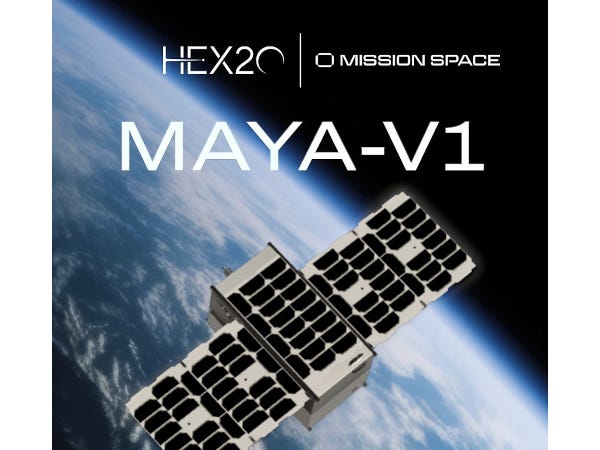
A fourth space-weather sensing payload will fly in low Earth orbit under an agreement between Mission Space and HEX20, expanding a growing network of in-situ environmental monitoring missions the Boulder, Colorado-based company is assembling across the LEO sector. The announcement was made during the 2026 Space Weather Workshop.
“We are seeing growing interest in real-time, in-situ space-weather data from LEO.”
Mary Glaz, Mission Space
Mission Space’s payload will fly aboard MAYA-V1, HEX20’s 16U-class hosted-payload platform built on the company’s NX spacecraft bus. MAYA-V1 is part of HEX20’s Multi-Application Yearly Assimilated Vehicle mission series, a platform designed to support multiple hosted payloads across science, security, propulsion, and in-orbit system validation, with a mission life exceeding one year.
“We are seeing growing interest in real-time, in-situ space-weather data from LEO,” said Mary Glaz, CEO of Mission Space. “Mission Space is building a constellation of compact, 1 kg payloads to close that data gap by measuring the charged-particle environment directly from orbit and turning those measurements into localized warnings, forecasts, modeled outputs, and validated data for specific missions.”
The HEX20 mission is the latest addition to Mission Space’s in-orbit roadmap, which began with its ZOHAR-I pathfinder mission and now includes upcoming payload deployments with Starcloud and Rogue Space. Together, those missions are intended to support a multi-point, high-temporal-resolution measurement layer covering radiation, charged particles, neutral density, and surface-charging intelligence.
“MAYA-V1 was designed to give advanced payloads a practical route to in-orbit validation,” said Amal Chandran, CEO of HEX20. “Mission Space’s payload fits directly into that purpose: it brings operational space-weather sensing into orbit and supports the kind of environmental intelligence future missions will require.”
Glaz added that the MAYA-V1 mission gives Mission Space another operational data point in orbit and brings the company closer to deploying what she described as a distributed measurement network. Chandran noted that Mission Space is among the first cohort of mission partners on MAYA-V1.
The four-mission in-orbit program represents a methodical expansion strategy for Mission Space, which serves satellite operators, government agencies, and defense customers with localized space-weather forecasts and real-time warnings derived from its proprietary in-orbit sensors. The company’s focus spans LEO, cislunar, and lunar environments.
Space weather — the collective term for charged-particle and radiation conditions generated by solar activity — poses operational risks to satellites, including degraded electronics, surface charging, and elevated radiation doses for spacecraft and crew. As satellite constellations in LEO expand and cislunar activity increases, demand for granular, mission-specific environmental data has grown beyond what traditional ground-based and limited space-based monitoring networks can provide.
Mission Space’s approach is to deploy compact, standardized payloads as hosted instruments aboard third-party spacecraft — reducing development costs and launch timelines while progressively building measurement density across orbital regimes. The MAYA-V1 payload fits that model, riding a platform specifically engineered to host and validate new space technologies in operational conditions.
HEX20’s MAYA-V1 mission adds a hardware-validated data node to what Mission Space describes as an emerging commercial space-weather intelligence layer — one positioned to support increasingly complex satellite operations across government and commercial sectors.