

Space Reactor-1 Freedom
What Nuclear Electric Propulsion’s First Deep Space Flight Means for the Industrial Base

What This Means
The National Aeronautics and Space Administration’s (NASA) March 23, 2026 announcement of Space Reactor-1 (SR-1) Freedom is not a science mission story — it is a government-financed first article for the nuclear space industrial base. NASA explicitly stated the mission will “activate the industrial base for future fission power systems across propulsion, surface, and long-duration missions,” naming a December 2028 launch window that creates a hard 32-month countdown for supply chain positioning. That urgency is now amplified by a second policy signal: on April 14, 2026, the White House issued National Security and Technology Memorandum-3 (NSTM-3), formally launching the National Initiative for American Space Nuclear Power and directing NASA to develop a mid-power space reactor of at least 100 kWe ready for launch in the 2030s — explicitly building on SR-1 as the foundation. The companies that establish flight heritage, regulatory precedent, and high-assay low-enriched uranium (HALEU) fuel supply chain positions before the December 2028 window closes will hold structural competitive advantages in every fission-powered mission that follows — and the investment landscape for those positions is open today.
The Hardware Reality
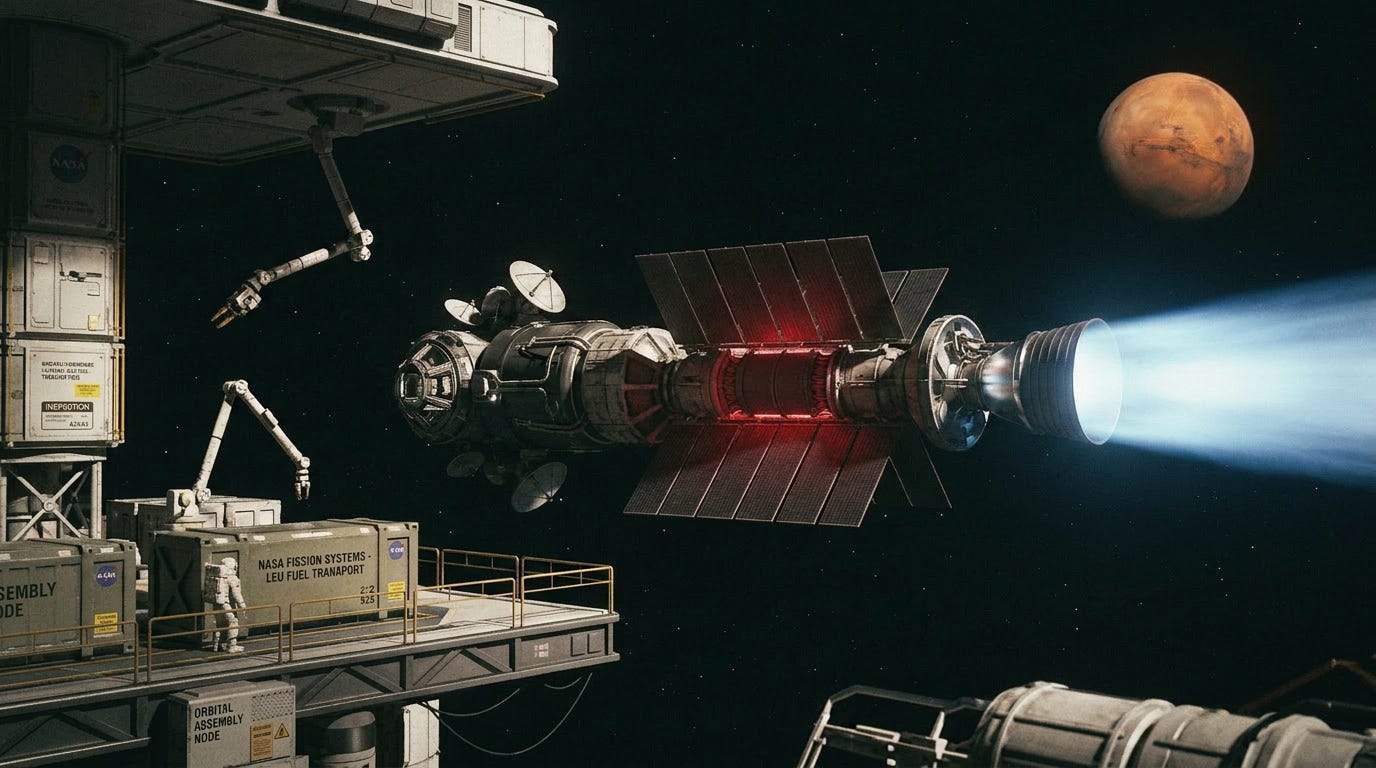
SR-1 Freedom’s architecture is engineered for speed, not maximum performance, and that choice has direct supply chain implications. NASA is combining a closed Brayton cycle fission reactor generating more than 20 kilowatts of electrical power with the Power and Propulsion Element (PPE) previously built and tested for the Lunar Gateway space station — a program NASA has since canceled. The reactor will be fueled by high-assay low-enriched uranium (HALEU), using uranium dioxide fuel encased in a boron carbide radiation shield. The PPE’s ion thrusters — already qualified hardware — will be driven by the reactor’s electrical output rather than solar panels, making SR-1 the first spacecraft to use fission-generated electricity for interplanetary propulsion.
The mission profile is clear: launch December 2028, reactor startup within 48 hours of launch, thrust for approximately one year to reach Mars orbit, deploy the Skyfall payload of Ingenuity-class helicopters, and — potentially — continue into the outer solar system. NASA Administrator Jared Isaacman described the reactor as “mostly built,” meaning the primary schedule risk is not reactor fabrication but system integration, HALEU fuel delivery, launch authorization, and industrial base readiness across the supply chain. Each of those risks has a named company or regulatory body attached to it — and at least four unresolved critical-path dependencies mean that investors and supply chain executives should not treat the December 2028 date as fixed. A 12–18 month slip driven by integration challenges, HALEU delivery delays, or Presidential Tier III authorization timing would extend the supply chain positioning window but defer the industrial base activation that SR-1’s launch is intended to trigger.
The power level — more than 20 kWe — is modest relative to what NASA’s roadmap and NSTM-3 now require. SR-1 Freedom’s value is not in its output. Its value is in the flight heritage it will establish: the first time a fission reactor operates in deep space, the first time HALEU fuel is launched on a U.S. rocket, and the first time the full regulatory stack for a nuclear interplanetary spacecraft is navigated from licensing through Presidential authorization through launch. Every future mission borrows from that precedent or builds on the industrial base it creates.
The Industrial Base: Named Companies and Their Positions
The current industrial base for space nuclear power is small, deeply government-connected, and now facing the most compressed deployment timeline in its history. Four names anchor the supply chain that SR-1 Freedom will stress-test.
IX (Intuitive Machines + X-energy) is the joint venture formed specifically to compete for NASA and Department of Energy (DOE) fission surface power contracts. In June 2022, DOE and NASA awarded IX a $5 million Phase 1 contract to mature a Fission Surface Power (FSP) design capable of delivering at least 40 kWe to the lunar surface; the IX team also includes Boeing and Maxar. Intuitive Machines separately holds an $8.2 million Air Force Research Laboratory (AFRL) contract extension — awarded October 2025 — to advance in-space nuclear power technology, with explicit application to national security missions requiring long-duration power during periods of darkness. X-energy’s small modular reactor (SMR) program, backed by Amazon and major private capital, positions the venture at the intersection of terrestrial and space nuclear markets — a cross-program credibility that matters in government source selection.
Westinghouse received one of three Phase 1 FSP contracts in 2022, competing against IX and Lockheed Martin. Westinghouse brings the deepest institutional nuclear engineering base of any U.S. commercial entity, and its January 2026 agreement with Nuclear Transport Solutions (NTS) to co-develop the Pegasus HALEU transport package signals active preparation for the logistics dimension of space nuclear fuel handling — a supply chain problem that has received far less public attention than reactor design.
BWX Technologies (NYSE: BWXT) is the only publicly traded pure-play nuclear space contractor with confirmed flight hardware deliverables in the recent program record. BWXT was selected to supply the nuclear reactor and fuel for DARPA’s Demonstration Rocket for Agile Cislunar Operations (DRACO) program — a nuclear thermal propulsion demonstration that DARPA canceled in 2025 due to changing technologies and requirements, prior to and independently from the SR-1 Freedom program’s development. SR-1 Freedom is a nuclear electric propulsion program that draws on the industrial base capabilities developed under DRACO but is not a continuation or successor of it; BWXT’s role as the most qualified commercial nuclear reactor fabricator for space applications is preserved under SR-1’s architecture, though the specific integration contract has not yet been publicly awarded.
The national laboratories remain the knowledge anchor of the entire enterprise. Idaho National Laboratory (INL), Oak Ridge National Laboratory (ORNL), and Los Alamos National Laboratory (LANL) hold the institutional expertise in reactor physics, fuel fabrication, and safety analysis that no commercial entity currently replicates. SR-1 Freedom’s explicit DOE partnership means the labs are participants in the critical path, not observers. The DOE’s role in managing nuclear fuel under the HALEU Availability Program makes the department simultaneously a program partner and the controlling authority over the mission’s most constrained input.
As of April 16, 2026, no public NASA announcement has named a prime integrator for SR-1 Freedom’s reactor system. The competitive landscape for any integration contract that follows will likely include Lockheed Martin (the former DRACO prime), BWXT, and potentially IX, but no award has been publicly confirmed. This is the largest open position in the current supply chain map.
