

Space Operations Software Aims To Simplify Constellation Management
New Platform Builds On Earlier Machine-Learning Diagnostic Tools

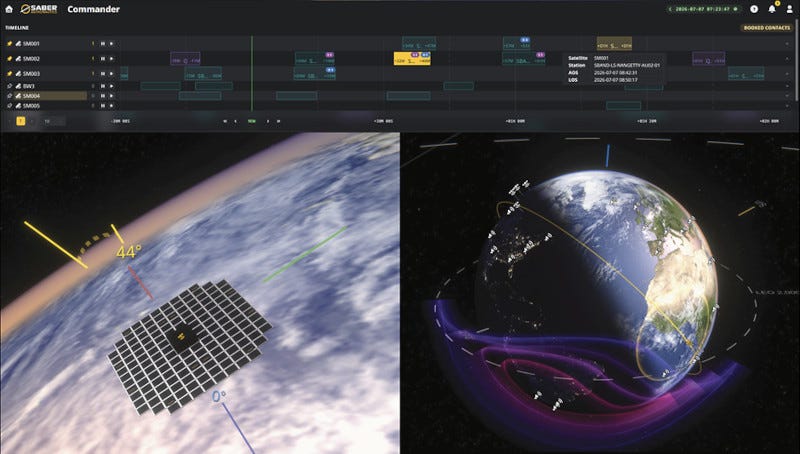
Saber Astronautics has rolled out a new spacecraft and constellation control platform designed to automate routine tasks and scale to larger satellite fleets under growing operational pressure.
“PIGI was about reducing the barrier to entry to satellites, making it easier and safer to fly.”
Jason Held, Saber Astronautics
The software, called Saber Commander, is the successor to the company’s Predictive Ground station Interface, or PIGI, a system first developed in 2010 and released in 2012 that introduced machine-learning-based spacecraft diagnostics and early digital twin capabilities, according to the company.
Saber said PIGI was recognized as a NASA Spinout and was the first product globally to use machine learning to determine the root cause of spacecraft health issues, giving operators a faster way to identify problems on orbit. The software also helped popularize real-time visualization of satellite constellations and was the first Unity game engine digital twin to receive fielding authority from the U.S. Space Force.
That work fed into Saber’s Space Battle Management System, now used as a protect-and-defend tool across U.S. Space Force Combat Command Deltas, and informed the design of Saber Commander as commercial and government operators move to larger and more complex satellite architectures.
“PIGI was about reducing the barrier to entry to satellites, making it easier and safer to fly,” Chief Executive Officer Jason Held said in the announcement. “Saber Commander carries that heritage forward, with new automation, visualization, and operational scale that modern satellite constellations require.”
The new platform was developed with heavy input from Saber’s in-house operators at its Responsive Space Operations Centres in Australia and the United States, where the company oversees about 36 metric tons (roughly 79,000 pounds) of spacecraft in orbit. Saber said that day-to-day experience with live missions shaped Saber Commander around faster situational awareness, clearer decision support and reduced manual workload through higher levels of automation.
“Saber Commander takes everything we learned from our first generation of products and turned it into a platform built for the realities of modern space operations,” Chris Schuck, head of product engineering, said. “Larger fleets and congested orbits demand a smarter approach. We designed Commander hand-in-hand with operators to bring automation, commanding, monitoring, and situational awareness together into a single platform to reduce operator workload while giving greater confidence and control.”
Saber did not disclose pricing, delivery timelines or specific customer deployments for Saber Commander. The company said it expects the software’s automation and visualization features to appeal to operators managing multi-satellite constellations and missions facing tighter staffing and operational tempo.