

Space Force Awards $1.9 Million Extreme Environment Materials Manufacturing Contract
SpaceWERX TACFI Funding Targets Domestic Production Bottleneck in Rocket Nozzles, Hypersonic Components, and Nuclear Materials

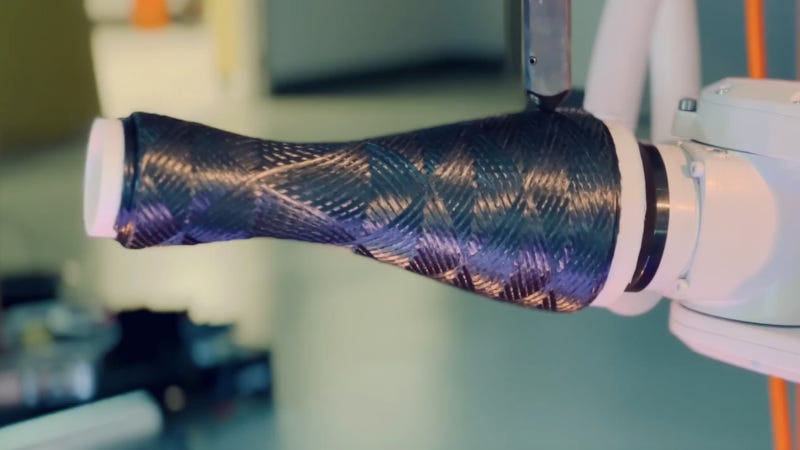
SpaceWERX, the innovation arm of the U.S. Space Force, has awarded a $1.9 million Tactical Funding Increase contract to Orbital Composites. Under the terms of the contract, the company will to develop robotic additive manufacturing technology for components engineered to withstand temperatures exceeding 3,000 degrees Celsius.
“We are building toward a future where AI-driven factories take in a design file and produce a mission-ready part.”
Cole Nielsen-Cole, Orbital Composites
The Campbell, California-based advanced manufacturing company announced the award June 25. The contract funds continued development of Orbital’s robotic additive manufacturing platform for extreme environment materials — parts used in rocket nozzles, heat shields, hypersonic vehicle structures, jet engine hot sections, and nuclear reactors.
The contract addresses what the company describes as a structural shortfall in U.S. domestic manufacturing capacity for these materials. Current production methods carry 12- to 18-month cycle times and limited output, constraints that defense and space customers say restrict what systems can be fielded at scale.
Amolak Badesha, chief executive officer of Orbital Composites, said the work is aimed squarely at one near-term chokepoint. “Our initial goal is to eliminate the supply constraints on solid rocket motors that have long limited what the warfighter can field — and this award is a concrete step toward that objective,” Badesha said. “This is also about restoring U.S. manufacturing dominance in materials that are foundational to our national security and economic competitiveness.”
The company combines robotics, advanced materials, and physical AI to automate production of those components. Cole Nielsen-Cole, founder and chief technology officer, said the current manufacturing environment is the core problem the company is solving. “Extreme environment materials are the bottleneck in some of the most critical systems the U.S. fields, and today’s manufacturing methods are too slow, too costly, and too capacity-constrained to meet what the moment demands,” Nielsen-Cole said. “We are building toward a future where AI-driven factories take in a design file and produce a mission-ready part, at operationally relevant cycle times and cost,” he said.
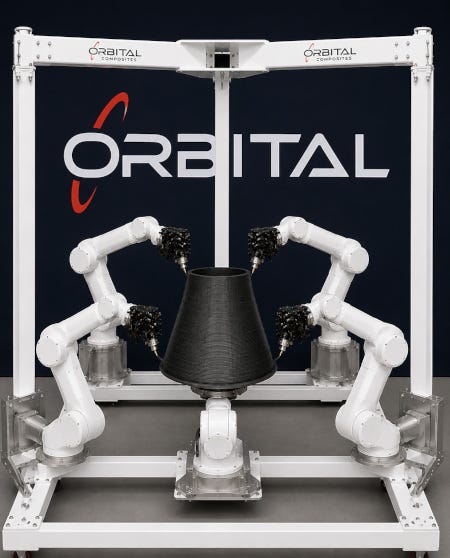
Orbital said it is working with defense prime contractors, U.S. government program offices, and commercial space and energy providers to scale qualification and production. The company is investing in manufacturing capacity, program qualification, and the autonomous production systems that underpin its platform.
The SpaceWERX TACFI program, run through AFWERX and the Air Force Research Laboratory, is structured to accelerate transition of small-business technology into operational use.