

Space Exploration and Tourism Market Still has Life
Forecast to Grow to $35.9 Billion by 2033

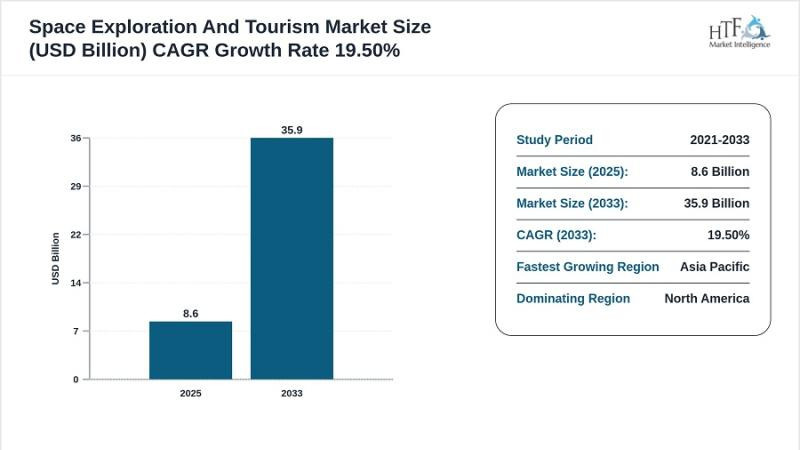
The global Space Exploration And Tourism market has the potential to expand from $8.6 Billion in 2025 to $35.9 Billion by 2033 at a compound annual growth rate (CAGR) of 19.5% from 2025 to 2033, according to a new report from HTF Market Intelligence Consulting Private Limited.
For the purposes of this study, the Space Exploration and Tourism Market refers to commercial ventures focused on providing access to space for recreational, research, and commercial purposes. This includes suborbital trips for civilians, private research missions, and eventual stays in space hotels or lunar bases. The industry, once dominated by government space agencies, is now fueled by private entities like SpaceX, Blue Origin, and Virgin Galactic. These companies are lowering the cost of access through reusable rockets and public-private partnerships. With rising public interest, especially among high-net-worth individuals, early demand for suborbital flights is strong. In parallel, space stations, lunar travel programs, and orbital infrastructure are under development.
This market is driven by advancements in reusable rocket technology, spacecraft design, and increasing accessibility of low Earth orbit (LEO) missions. Companies are actively developing passenger-ready spacecraft, training systems, and orbital platforms to support the next phase of human space commercialization.
The Space Exploration and Tourism Market shows strong regional variation driven by aerospace capability, funding levels, and technological maturity.
North America dominates the global market due to strong private-sector leadership, advanced aerospace infrastructure, and supportive regulatory frameworks for commercial spaceflight. The United States leads global innovation in reusable rockets and crewed spacecraft development.
Europe holds a significant share supported by collaborative space programs, strong government funding, and participation in international space missions. Countries such as Germany, France, and the United Kingdom play key roles in space research and satellite technologies.
Asia-Pacific is emerging as a high-growth region driven by increasing investments in national space programs and rising participation from China, India, and Japan in exploration missions and satellite launches.
Latin America and the Middle East & Africa are gradually entering the space economy through partnerships, satellite programs, and growing interest in space technology commercialization.
The regulatory framework for the market is evolving rapidly as commercial spaceflight becomes more viable. Governments are introducing licensing systems, safety standards, and liability regulations to govern human spaceflight activities.
In North America, regulatory bodies focus on ensuring safety certification, mission approval, and risk management for private space missions. Europe maintains strict compliance protocols aligned with international space treaties and environmental considerations.
In Asia-Pacific, regulatory structures are expanding to support both government-led exploration and private-sector collaboration, with increasing emphasis on technology security and space sustainability.
The market is witnessing rapid transformation driven by reusable rocket systems, AI-assisted mission control, and increasing commercialization of low Earth orbit platforms. Space hotels, orbital stations, and lunar mission concepts are gaining traction as long-term opportunities. The primary driver of the Space Exploration and Tourism Market is the rapid advancement of reusable launch technology combined with increasing demand for commercial space travel experiences.