

Space Development Agency Commits $1.75 Billion to Golden Dome Tracking Satellites
Sierra Space and L3Harris Split the Awards, With First Launches Due by Late 2028

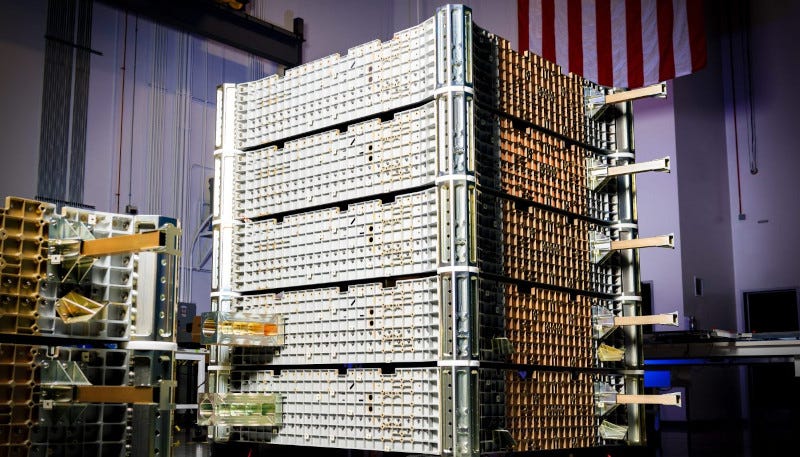
The Space Development Agency has awarded contracts worth a combined $1.75 billion to Sierra Space and L3Harris Technologies to build 36 missile-warning and tracking satellites for the Golden Dome missile defense system.
“By combining cutting-edge design and manufacturing systems with industrial depth and systems integration expertise, we’re able to move faster, manage risk better and deliver more cost-effective solutions.”
Dan Jablonsky, Sierra Space
The agency, part of the U.S. Space Force, announced the awards under its Accelerated Missile Defense Tranche 3 program July 13. Sierra Space, based in Louisville, Colo., received a Firm Fixed Price Other Transactional Agreement worth up to $798 million to design, manufacture and deliver 18 of the satellites, according to a Sierra Space news release. L3Harris was awarded $955 million for the remaining 18, the company has said.
Neither company’s satellites have flown yet. Sierra Space said it has completed structural builds for all 18 spacecraft under a separate, earlier contract — the Tranche 2 Tracking Layer program — and is preparing to qualification-test a nine-satellite launch configuration this summer, with system verification testing to follow later this year.
The new satellites will be built on Sierra Space’s Horizon spacecraft, part of its Eclipse satellite line and the same design used for the Tranche 2 program, the company said. Sierra Space CEO Dan Jablonsky said the award reflected the company’s approach to the work.
“By combining cutting-edge design and manufacturing systems with industrial depth and systems integration expertise, we’re able to move faster, manage risk better and deliver more cost-effective solutions,” Jablonsky said.
The Tranche 3 tracking satellites are intended to detect and track missile threats, including hypersonic and ballistic weapons, as part of the broader Golden Dome initiative — a layered network of sensors and interceptors intended to defend the U.S. against missile attacks across multiple phases of flight. The Space Development Agency said the satellites are expected to be available to launch by the end of 2028.
The agency has awarded other Golden Dome-related work in recent months, including a contract to Booz Allen Hamilton in May to develop a testbed missile interceptor for the U.S. Space Force’s Space Systems Command.
Sierra Space’s qualification testing is scheduled to begin this summer, with system verification testing to follow later in the year.