

Space Commerce Certification Proposal Draws Scrutiny And Support In House Hearing
Lawmakers Examine New Mission Authorization Pathway For Novel Commercial Space Activities

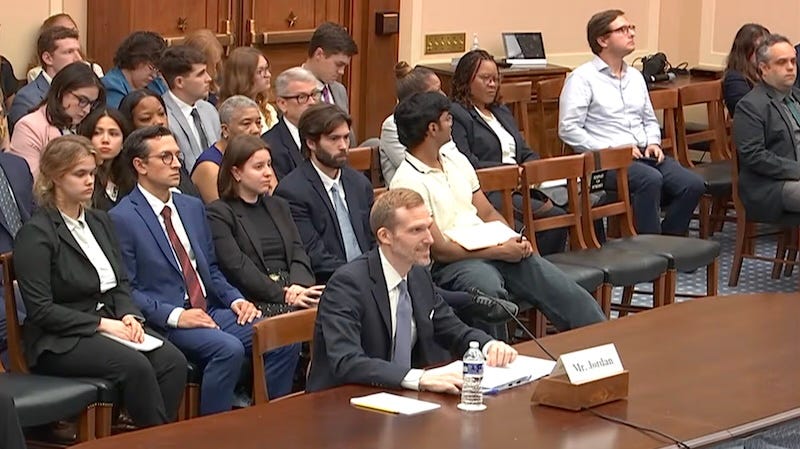
The Office of Space Commerce’s proposed Space Commerce Certification moved into the congressional spotlight July 15, when Director Taylor Jordan appeared before the House Science, Space, and Technology Committee’s space subcommittee to defend a new framework for authorizing commercial space missions that fall outside existing licensing regimes.
“U.S. regulations as they exist today do not offer a clear path to ‘yes’ for novel activities. Instead, they risk trapping our industry in an endless interagency maze.” Taylor Jordan, Office of Space Commerce”
Jordan, who also serves as NOAA’s Assistant Secretary for Environmental Observation and Prediction, told lawmakers the certification process is designed to give U.S. companies a clearer path to government approval for activities such as satellite servicing, commercial space stations, in-space manufacturing and lunar operations, while preserving the roles of the Federal Aviation Administration, Federal Communications Commission and other agencies.
The proposed framework stems from Executive Order 14335, signed by President Donald Trump, which directed the Department of Commerce to develop a process to authorize commercial activities in space that are not “clearly or straightforwardly governed” by current rules. The Office of Space Commerce released an updated mission authorization proposal, built around the Space Commerce Certification concept, for public review and comment on March 24.
Under the plan Jordan outlined, the Office of Space Commerce would act as a central clearinghouse for what the agency calls “novel in-orbit activities,” collecting information from companies in a single voluntary application and then circulating that application to the Department of War, FAA, FCC, State Department and NASA for review. The certification would not replace existing statutory responsibilities at those agencies, but it could allow FAA and FCC officials, at their discretion, to waive some regulatory requirements or avoid duplicative interagency reviews when missions already hold a Space Commerce Certification.
Jordan said the proposal rests on several core principles, including regulatory agility, a presumption of approval for applications, and efficiency in oversight. By presuming applications are approved unless the government can identify specific concerns, he argued, the process is intended to give investors more confidence that innovative missions can “get to yes” and move forward without prolonged regulatory uncertainty.
The certification scheme is also intended to keep the United States in compliance with Article VI of the 1967 Outer Space Treaty, which requires authorization and continuing supervision of non-governmental space activities. Jordan told the subcommittee that transparent, efficient oversight would help keep companies operating under the U.S. flag, rather than seeking foreign jurisdictions as “flags of convenience” to escape cumbersome regulation.
Jordan’s written testimony, posted by the Office of Space Commerce, emphasized that current U.S. rules often force novel missions into legacy processes never designed to handle complex orbital maneuvers, debris mitigation strategies or new types of on-orbit infrastructure. “U.S. regulations as they exist today do not offer a clear path to ‘yes’ for novel activities. Instead, they risk trapping our industry in an endless interagency maze,” he wrote.
The Office of Space Commerce has spent more than six months outlining the concept in public and soliciting industry feedback. Jordan’s testimony cites a series of outreach steps, including an online event to discuss preliminary ideas in December 2025, publication of an initial draft concept and request for stakeholder input later that month, briefings with the Consortium for Execution of Rendezvous and Servicing Operations in January, and release of the updated proposal on the agency’s website in March. Additional briefings followed at the AIAA ASCEND conference and the American Bar Association’s Forum on Air & Space Law this spring.
Jordan framed the response from industry as largely positive, describing a “record of public endorsement and support” for the Space Commerce Certification from companies that want more predictable authorization pathways. He also stressed that the certification process is intended to validate emerging industry standards and norms rather than impose detailed engineering requirements from the federal government.
Members of the subcommittee used the hearing to probe whether the proposed certification would adequately protect national security and international obligations while avoiding unnecessary burdens on companies. Jordan said applications would be reviewed by the Department of War, NASA and the State Department to ensure missions do not undermine security, operational safety or foreign policy commitments before a certification is granted.
The mission authorization proposal is still awaiting formal approval from the White House, and detailed implementation steps have yet to be announced. Jordan told lawmakers the Office of Space Commerce intends to start with an extended pilot phase focused on mature technologies and missions near operational status, then refine the process based on experience and evolving industry standards.
Jordan closed his testimony by arguing that U.S. commercial space leadership depends on regulatory frameworks that match the pace and scale of industry innovation. The Office of Space Commerce, he said, “stands ready” to work with Congress, the interagency community and industry to deliver a certification process that supports that goal.