

Solar Arrays, Radiators Selected to Power Orbital Energy-Relay Constellation
Vendor Partnership Aims to Eliminate Battery Dependency for Satellites in Eclipse

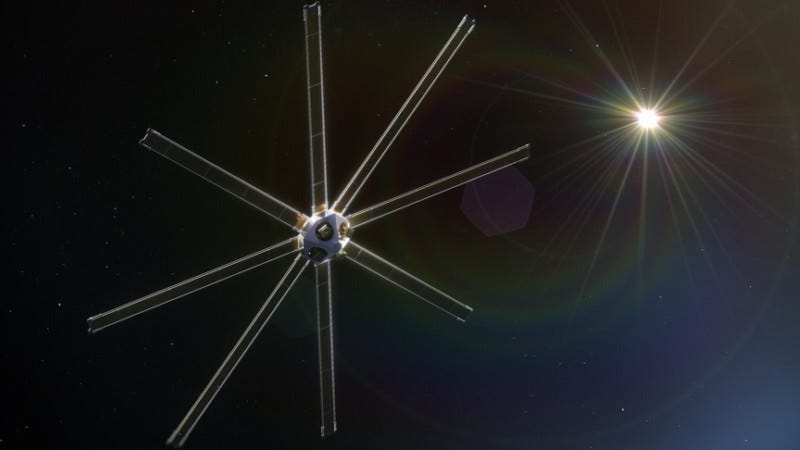
A preferred vendor partnership to supply solar arrays and thermal management systems for a new orbital power-relay platform has been announced by Mantis Space and Atomic-6. The agreement designates Atomic-6’s Light Wing solar arrays and Hot Wing radiators as the cornerstone technologies for a Mantis Space constellation designed to keep satellites powered around the clock — including during the eclipses that currently force operators to carry heavy, costly battery banks.
“By utilizing both the Light Wing solar arrays for power and the Hot Wing radiators for thermal control, we are adopting redeployable technology engineered from the ground up for the extreme demands of next-generation orbital operations.”
Eric Truitt, Mantis Space
Satellites spend nearly one-third of their operational lives in Earth’s shadow, losing access to direct sunlight and drawing down stored battery power to survive each dark interval. Mantis Space, based in Albuquerque, New Mexico, is developing a constellation of spacecraft engineered to orbit almost continuously in sunlight and transmit power in real time to customer satellites, stations and orbital computing platforms regardless of where those assets sit relative to the sun.
That mission demands both high-capacity power generation and the ability to shed the heat that builds up as substantial amounts of energy are transmitted across orbital distances. Light Wing solar arrays from Atomic-6 address the first requirement; the company’s Hot Wing radiators address the second.
“Partnering with Trevor Smith and the Atomic-6 team gives us access to critical and innovative solutions for very large solar array and radiator configurations on our satellites,” said Eric Truitt, CEO of Mantis Space. “By utilizing both the Light Wing solar arrays for power and the Hot Wing radiators for thermal control, we are adopting redeployable technology engineered from the ground up for the extreme demands of next-generation orbital operations.”
Atomic-6 was founded in 2019 in metro Atlanta and is headquartered in Marietta, Georgia. CEO Trevor Smith leads a team focused on lightweight composite solutions for power generation and thermal management in space. The company’s products are built as redeployable systems — meaning they can be reconfigured after launch — a capability suited to the operational demands of a constellation that must sustain high power throughput over the long term.
“Supporting Mantis Space’s vision requires hardware that can handle immense power throughput without the traditional weight penalties,” Smith said. “Our lightweight redeployable systems are designed specifically for this type of highly reliable, heavy-duty, long-term orbital infrastructure.”
Atomic-6 has received more than $3 billion in contract bid requests from major constellation operators, a figure that reflects expanding commercial interest in advanced orbital power and thermal systems.
The concept Mantis Space is pursuing addresses a structural cost built into conventional satellite design. To survive eclipse, spacecraft must carry enough battery capacity to sustain operations through each dark pass — a requirement that drives up mass, cost and design complexity. For missions requiring continuous high power, that burden is particularly pronounced.
By relaying power from a sunlit constellation to customer spacecraft in eclipse, Mantis Space aims to allow operators to eliminate or significantly reduce battery mass and redirect those resources toward payload, propulsion or extended mission life. The company describes this as eliminating the “battery tax” in orbit.
The orbital power infrastructure model would add an energy utility layer to a growing suite of in-space services that already includes on-orbit refueling, satellite servicing and orbital assembly. If validated, the approach could expand the operational envelope for satellites and emerging orbital facilities that demand sustained, high-level power delivery.
The Atomic-6 designation covers both the power generation and thermal control requirements of the Mantis Space constellation, with the two companies describing it as a foundational technology selection for the platform.