


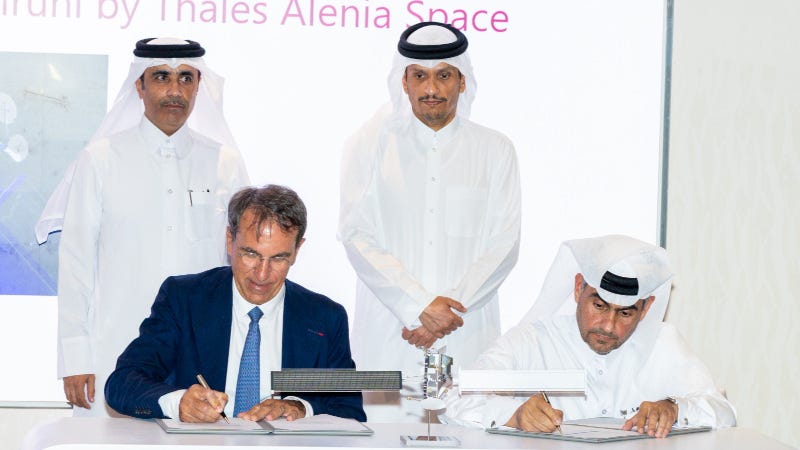
Qatari satellite company Es’hailSat has selected Thales Alenia Space to design and build a next-generation telecommunications satellite for geostationary orbit using the company’s Space Inspire software-defined platform. The spacecraft, named Eshail-3/Türksat-Biruni, will be shared with Turkish operator Türksat and is intended to deliver high-speed broadband connectivity and other services over a wide regional footprint.
Thales Alenia Space, a joint venture between Thales and Leonardo, will serve as prime contractor and is responsible for satellite design, manufacturing, testing, and delivery, as well as the associated ground segment. The companies did not disclose a target launch date but said the satellite is engineered for a planned operational life of about 15 years in geostationary orbit.
Eshail-3/Türksat-Biruni will rely on the Space Inspire (Instant Space In-orbit Reconfiguration) platform, which allows operators to reconfigure coverage and capacity in orbit to match shifting demand for broadband and other communications services. As a fully software-defined system, Space Inspire is designed to optimize use of satellite resources by reallocating power and bandwidth without hardware changes over the spacecraft’s service life.
From its geostationary slot, the satellite is planned to support applications including broadcast television, telecom services, government communications, mobility and maritime connectivity, enterprise VSAT links, and remote connectivity. Coverage will extend across the Middle East and North Africa, Sub-Saharan Africa, Europe, Central Asia and surrounding maritime regions, positioning the spacecraft as a regional backbone for high-throughput services.
Es’hailSat plans to use the satellite’s flexibility to enhance service continuity, capacity and resilience for customers, building on earlier spacecraft such as Es’hail-2 at 26 degrees East. By adopting a software-defined GEO platform, the operator is positioned to adjust beams and service profiles as market demand evolves, rather than relying solely on fixed transponder configurations.
Türksat’s participation in the shared Eshail-3/Türksat-Biruni mission extends that adaptability to Turkish and regional customers, aligning with broader demand for broadband and backhaul capacity across the coverage area. Industry reports describing the contract note that the spacecraft will support cellular backhaul and television distribution, in addition to broadband connectivity, as operators seek more flexible GEO infrastructure.
Thales Alenia Space will now move the program through detailed design, manufacturing and environmental testing ahead of on-ground delivery and launch integration. Once on station, the satellite is expected to serve as a key element of Es’hailSat’s sovereign and secure communications architecture, with Türksat using its share of capacity to expand broadband and media services in its home markets.
The order adds to a broader industry trend toward software-defined GEO platforms, as regional operators seek ways to manage fluctuating traffic patterns and competitive pressures without new hardware deployments for each market shift. For suppliers, such contracts underscore growing demand for configurable payloads and integrated ground systems that support in-orbit reprogramming as a standard operational tool.