

Small Demonstration Satellite will Demonstrate Optical Communication Technology
Spacecraft Under Development by NEC for Japanese Constellation

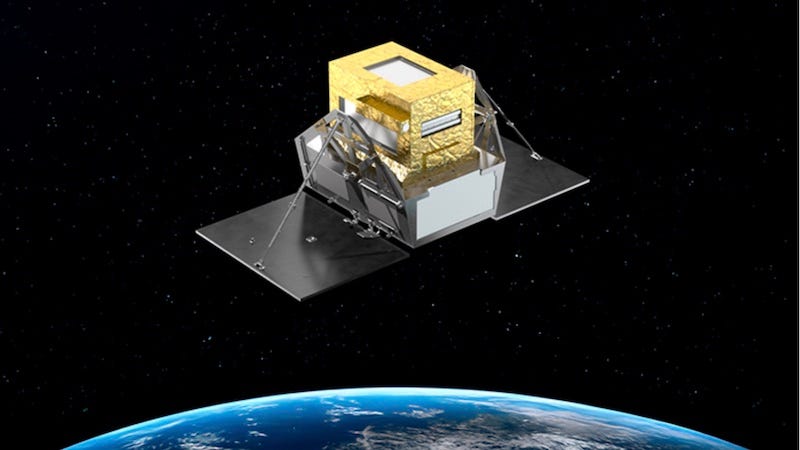
A small technology demonstration satellite is being designed by NEC that could lead to the creation of Japan’s first optical satellite communications constellation. The spacecraft, based on the Apex Technology Aires satellite bus platform, will conduct in-orbit verification of key technologies essential for realizing future optical communication satellite constellations, including optical communications, high-speed network routing design, and high-capacity millimeter-wave band communications.
“This mission is a strong example of how mass-manufactured spacecraft can enable next-generation constellations globally.”
Ian Cinnamon, Apex Technology
The design of the satellite-mounted equipment (payload) for this demonstration has now been completed. Moving forward, the payload will be manufactured and integrated into the satellite bus, the common functional component of the satellite, which is scheduled for launch into Earth’s orbit in fiscal year 2027.
In satellite constellations where numerous satellites collaborate and function together, optical communication is increasingly favored over conventional radio for satellite-to-satellite communications. This shift aims to avoid communication interference and enable high-capacity data transmission. However, in order to equip a large number of small satellites with optical communication devices, it is necessary to shorten the development and manufacturing times and reduce costs. Therefore, it is important to utilize general-purpose technologies that are highly functional, high-performance, and have a proven track record of mass production.
“NEC is exactly the kind of partner we built Apex for — a world-class technology leader pushing the boundaries of what’s possible in orbit,” said Apex Technology CEO, Ian Cinnamon. “By pairing NEC’s advanced optical communications with our configurable and productized satellite bus, we’re accelerating time to orbit and reducing risk. This mission is a strong example of how mass-manufactured spacecraft can enable next-generation constellations globally. We’re proud to support NEC’s on-orbit demonstration and to expand Apex’s footprint internationally as we help partners deploy resilient, high-performance space infrastructure at scale.”
Furthermore, in optical communication satellite constellations—which consist of tens to thousands of satellites and function as high-speed, dynamically moving mesh networks—high computational power is required for routing processes that enable low-latency, high-capacity communications in orbit. Consequently, high-performance applications are needed that differ from routing designs based on terrestrial network environments.
Against this backdrop, NEC will conduct demonstrations of the underlying technologies needed to solve these challenges.
“NEC aims to create social value through safety, security, fairness, and efficiency, positioning space utilization as a means to solve challenges in achieving these goals. Since the 1990s, NEC has been developing technologies in the field of space optical communications to support this vision,” said Yasushi Yokoyama, NEC Satellite Constellation Department General Manager. “We are very pleased to conduct this demonstration with the cooperation of APEX, a company based in the United States—where satellite manufacturing innovation is advancing—and a leader in the industry for its rapid provision of small satellite buses. The results of this demonstration will also be utilized in the research and development conducted under the Economic Security Critical Technology Development Program ‘Development and Demonstration of Satellite Constellation Core Technologies for Optical Communications, etc.’ (NEDO) and the Space Strategy Fund Project ‘Technology Development for Optical Communication Satellite Constellation Construction and System Demonstration’ (JAXA), both of which NEC is contracted to undertake. Going forward, NEC will continue advancing technological development with the goal of providing new space digital infrastructure.”