


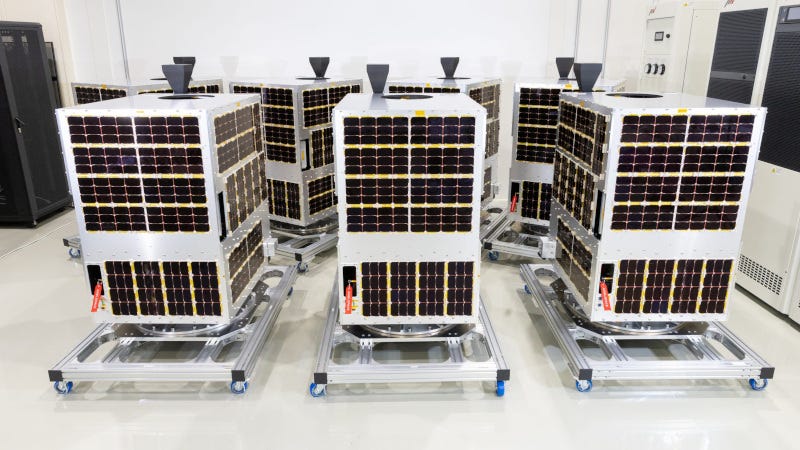
A fleet of seven next-generation Earth observation microsatellites is scheduled to launch no earlier than July 2026, expanding a Japanese commercial satellite constellation to more than 10 spacecraft and introducing new optical and spectral capabilities for monitoring the planet’s surface.
“The orbital deployment of the seven GRUS-3 satellites represents a significant milestone in advancing our AxelGlobe business to its next stage.”
Yuya Nakamura, Axelspace
The seven GRUS-3 microsatellites, built by Tokyo-based Axelspace Corporation, will ride to orbit aboard the Transporter-17 rideshare mission via launch services provider Exolaunch, lifting off from Vandenberg Space Force Base in California. Each satellite in the GRUS-3 series is equipped with a custom telescope manufactured by Nikon Corporation, building on a collaboration that dates to Axelspace’s first GRUS-1 satellite launched in December 2018.
Nikon Optics at the Core
For Earth observation microsatellites, the optical telescope is among the most critical components driving image quality and mission performance. Nikon developed a custom telescope for GRUS-3 that draws on the company’s Applied Optical and Precision Technologies and its experience in space telescope development — including optics that flew on NASA’s Apollo 15 mission in 1971. The Nikon telescope is paired with Axelspace’s own image sensor unit to achieve high-resolution imagery within the physical constraints of a microsatellite platform, while also improving cost efficiency for future mass production.
“From its founding, Nikon has sought the limitless potential of light,” said Yasuhiro Ohmura, President and CEO of Nikon Corporation. “We are honored that Axelspace has named Nikon as the partner of telescopes for its satellites, including GRUS-3, and we look forward to reinforcing our partnership with Axelspace, which will contribute to Earth observation from space and our further success in the space industry.”
Observation Performance
Each GRUS-3 satellite captures imagery at a spatial resolution of 2.2 meters — commonly expressed as ground sampling distance — with an effective swath of 17.6 miles and a maximum single-pass capture length of 842 miles. Operating from an altitude of approximately 364 miles, the seven-satellite formation is capable of imaging the same surface location once per day for areas north of 25 degrees latitude. Combined, the constellation achieves a daily capture capacity of roughly 888,000 square miles.

New Spectral and Monitoring Capabilities
GRUS-3 introduces a “coastal blue” spectral band not present on its predecessor, GRUS-1. The band is specifically effective for observing shallow underwater features — including seabed topography and seagrass beds — in addition to the true color imagery and vegetation health data already supported by GRUS-1. The expanded spectral capability broadens the operational range of the AxelGlobe Earth observation service into coastal and marine environments.
When combined with Axelspace’s satellite attitude control technology — which enables tasking, or on-demand imaging of designated areas — the constellation is positioned to serve a wide range of applications including precision agriculture, forest monitoring, map creation, environmental assessment and security monitoring.
Constellation Expansion
Axelspace currently operates five GRUS-1 satellites as part of its AxelGlobe data service. The addition of seven GRUS-3 satellites will bring the active constellation to more than 10 spacecraft, increasing the frequency and geographic coverage of commercially available Earth observation data from the company.
“We believe that combining Nikon’s optical technologies, cultivated over decades, with Axelspace’s expertise in the development and operation of microsatellites will not only enhance Earth observation performance but also demonstrate the reliability of space technologies originating from Japan to the global market,” said Yuya Nakamura, President and CEO of Axelspace Corporation. “Through GRUS-3, we aim to create new business opportunities across various industries and to address social challenges by working together with our partners.”