

Self-Healing Solar Technology to Be Integrated Into U.S. Spacecraft Supply Chain
York Space Acquisition of Solestial to Lock In Domestic Space Solar Manufacturing

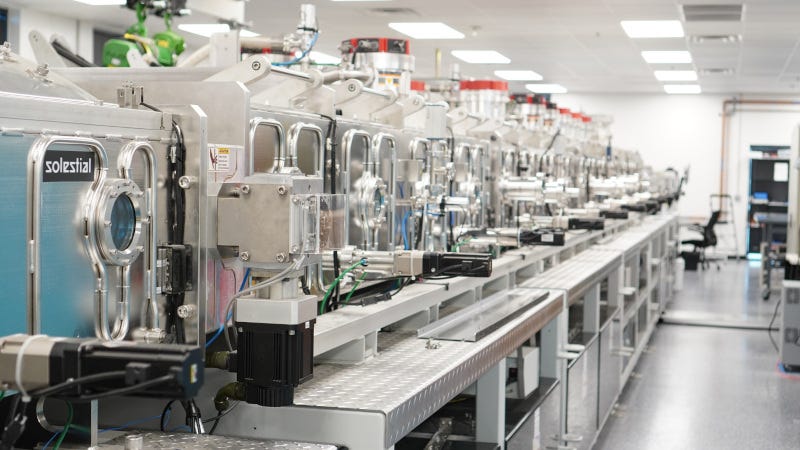
A definitive agreement to acquire Solestial, Inc., a Tempe, Arizona-based developer of next-generation space solar technology, has been signed by York Space Systems. The deal will bring a critical solar power subsystem fully under domestic U.S. manufacturing control, reducing the space industry’s reliance on Chinese-controlled materials and supply chains.
“York has consistently invested in U.S.-based manufacturing as a core part of how we deliver for our customers.”
Dirk Wallinger, York Space Systems
Upon closing, Solestial will operate as a wholly owned subsidiary of York, continuing to serve customers across commercial, civil, and national security markets. The transaction is subject to regulatory approvals and customary closing conditions, with completion expected in the second quarter.
“York has consistently invested in U.S.-based manufacturing as a core part of how we deliver for our customers,” said Dirk Wallinger, CEO of York Space Systems. “This acquisition builds on that approach, strengthening our supply chain by investing in a proven U.S. company, supporting the domestic industrial base, and reducing reliance on foreign sources for critical materials and manufacturing.”
Solestial has developed ultrathin, radiation-hardened silicon solar cells and modules engineered specifically for the space environment. The company holds a key distinction in the sector: it is the only space solar provider with self-healing silicon technology proven on orbit — a capability that enables sustained performance under the intense radiation conditions of space while maintaining a path to high-volume manufacturing.
The acquisition addresses a recognized gap in the space power market. Legacy III-V solar solutions — the conventional standard for spacecraft — remain expensive and capacity constrained, with lead times that can exceed two years. Terrestrial silicon alternatives, meanwhile, are not designed for space and degrade rapidly under radiation exposure. Both categories also rely heavily on Chinese-controlled materials and manufacturing, a vulnerability that has drawn increasing scrutiny from defense and national security customers.
“Solestial has proven a scalable, space-optimized solar technology that is designed to perform in ways legacy and terrestrial solutions cannot,” said Mike Lajczok, CTO of York Space Systems. “That will give us the ability to build more capable platforms with better performance, lower cost, and greater design flexibility.”
Headquartered in Tempe, Arizona, Solestial has established a growing U.S. manufacturing footprint, with approximately 95 percent of its supply chain already based domestically. The company recently expanded its production capabilities through the acquisition of advanced high-volume solar manufacturing equipment, enabling wafer-to-module manufacturing entirely within the United States — and has outlined a clear path to full domestic production.
“Solestial was founded to solve the space power bottleneck,” said Margo de Naray, CEO of Solestial. “Our customers need a solution that can scale, perform in space, and be manufactured reliably. Partnering with York allows us to accelerate all three — expanding production, deepening technical integration, and delivering a resilient, American-made capability to a broader set of missions.”
For York Space Systems, the acquisition represents a targeted step toward vertical integration of critical subsystems. The company, which describes itself as a U.S.-based national defense and commercial prime contractor, frames the move as part of a broader strategy to strengthen manufacturing reliability, scalability, and cost efficiency across its spacecraft platforms. Solestial is expected to continue serving as a supplier to the wider space industry beyond York’s own missions.
As demand for electrical power in space accelerates — driven by proliferating low Earth orbit constellations, on-orbit computing, and advanced payloads — the ability to source reliable, high-performance solar arrays from domestic manufacturers has emerged as both a strategic and commercial priority for spacecraft builders.