

Second Lot of Tactical Military Satellites Headed to Launch Pad for Summer Falcon 9 Mission
York Space Completes Back-to-Back Production Runs for Pentagon’s Proliferated Warfighter Space Architecture

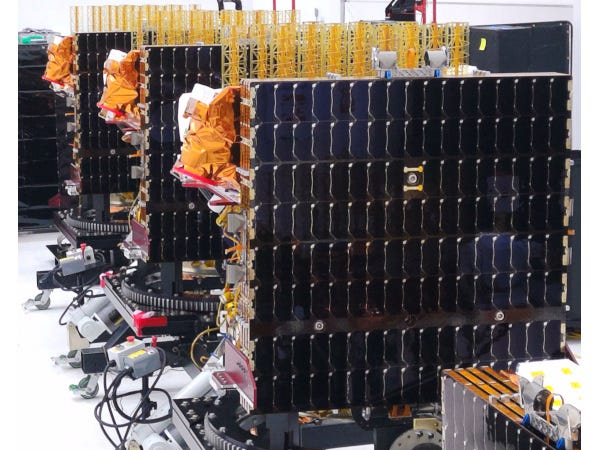
More than 20 tactical communications satellites built by York Space Systems have begun shipment to the launch site for a dedicated Falcon 9 mission planned for this summer.
“Shipping a second production lot for this important tactical communications mission demonstrates the repeatability and maturity of York’s production model.”
Melanie Preisser, York Space Systems
The shipment marks completion of York’s second production lot under the Tranche 1 Transport Layer contract — the second time the Denver-based company has delivered a full batch of operational national security spacecraft for the Proliferated Warfighter Space Architecture (PWSA). The PWSA is a U.S. Space Force program designed to provide resilient, tactical communications for U.S. and allied military forces through a proliferated constellation of satellites in low Earth orbit.
The more than 20 satellites in this second lot will fill the complete payload of a dedicated Falcon 9. That rocket is the second Falcon 9 launched exclusively for York under the program. No launch date or launch facility has been announced.
“Shipping a second production lot for this important tactical communications mission demonstrates the repeatability and maturity of York’s production model,” said Melanie Preisser, vice president and General Manager of York Space Systems. “We have shown that operational national security space capabilities can be built and fielded rapidly, affordably, and at the scale that the USG demands.”
York was the first Tranche 1 performer to ship and launch satellites from its initial production lot. All spacecraft from that first batch were confirmed operational within hours of launch separation, the company said. The constellation has since passed additional on-orbit milestones as it moves through early operations. Combined, the two production lots represent more than 40 York-built spacecraft delivered under the contract.
York says it completed both lots at half the cost of competitors. The company did not identify those competitors or provide an independent cost comparison in its announcement.
The PWSA’s Transport Layer is the communications tier of the architecture. It is intended to provide the secure, tactical data links that U.S. and allied forces need for operations across land, sea, air, and space domains. The Space Force is building the constellation with multiple commercial prime contractors, each under separate Tranche 1 contracts. York says it has now twice completed its production lot before any of its fellow Tranche 1 primes.
That sequencing matters for a program built around the premise that commercial industry can produce and field national security hardware faster and at lower cost than traditional defense contractors. Whether the other Tranche 1 performers will contest York’s timeline claim has not been addressed publicly.
York Space Systems went public on the New York Stock Exchange under the ticker YSS. The company is headquartered in Denver, Colorado, and describes itself as a national defense and commercial prime contractor.
“Most importantly, these spacecraft will provide operational capability to the warfighter, supporting the enduring need for resilient tactical communications and infrastructure needed for modern military operations,” Preisser said.
The first lot of York satellites has been providing operational support to U.S. and allied forces since completing early operations. The second lot is intended to expand that coverage once the Falcon 9 delivers the spacecraft to orbit this summer.
The Proliferated Warfighter Space Architecture draws its name from the strategy of fielding so many satellites that no adversary could neutralize the network by targeting individual spacecraft. The Transport Layer is one of several tiers in that architecture, alongside sensing and data transport functions handled by other contractors and programs.
York’s back-to-back production completions come as the Space Force continues to press commercial industry to demonstrate the sustained production rates needed to maintain and grow the constellation over time. The program’s operational value depends not on any single launch, but on the ability of prime contractors to repeatedly replenish the on-orbit fleet as satellites age or are lost.
The summer launch, once completed, will mark York’s second contribution to the on-orbit layer of the PWSA — and the second test of whether the company’s satellites can replicate the rapid health confirmation seen after the first mission.