

Satellites Market worth $46.79 Billion by 2031: Report
The Small Satellites Segment Is Expected to Register the Highest CAGR of 23.8 Percent

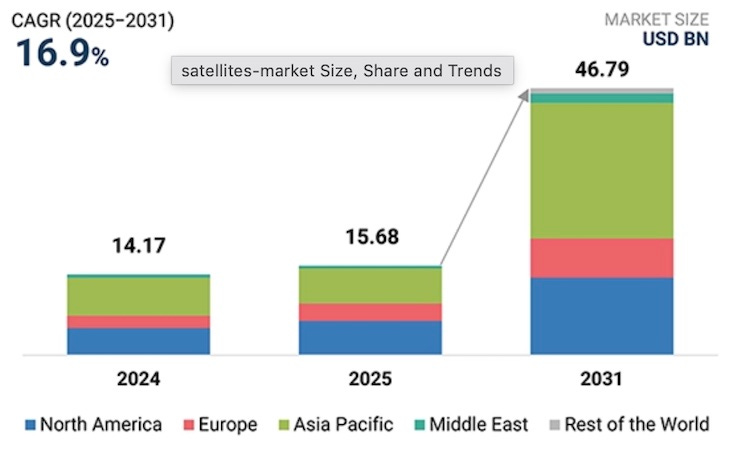
The global satellites industry is growing due to increased reliance on space-based services for disaster response, climate monitoring, and early warning systems, according to a new report from MarketsandMarkets. The market is projected to reach $46.79 billion by 2031, up from $15.68 billion in 2025, with a CAGR of 16.9%.
Satellites are also being used more for precise timing and synchronization in financial networks, power grids, and telecom infrastructure, which creates steady demand. Spending on space situational awareness is increasing as operators aim to track objects and reduce collision risks, leading to new satellite launches. Additionally, longer satellite lifespans and in-orbit servicing plans are encouraging operators to invest in higher-value, more capable satellites.
By customer type, commercial is expected to be the largest segment during the forecast period. This is driven by increased involvement of private satellite operators, telecom companies, and data service providers investing in space infrastructure. Many commercial players are launching satellites to support broadband, enterprise connections, media delivery, and data analytics. As the market shifts from government-led programs to revenue-based business models, satellite fleets are expanding more rapidly, and older satellites are being replaced sooner.
By application, communication satellites are expected to record the fastest growth during the forecast period. This is driven by higher demand for high-capacity data links to support 5G backhaul, cloud services, and remote areas. More aviation, maritime, and mobile platforms are transitioning to satellite-based connectivity, which is boosting the momentum. During emergencies and network failures, satellites are viewed as a reliable option, increasing dependence on satellite communications systems.
The Middle East is expected to be the second-fastest-growing region during the forecast period. The Middle East is expected to be the second-fastest-growing region during the forecast period. This is mainly due to increased government spending on national space programs and digital infrastructure. Countries in the region are launching satellites for secure communication, Earth observation, and monitoring needs. There is also a greater focus on smart cities, oil and gas asset monitoring, and border security, which is driving the demand for satellites. Strong funding support and partnerships with global satellite manufacturers are helping accelerate growth across the region.
SpaceX, Lockheed Martin Corporation, Airbus, Northrop Grumman, and Thales Alenia Space are the major players among satellite companies. These companies have strong distribution networks across North America, Europe, Asia Pacific, the Middle East, and the rest of the world.