

Satellite Emissions Firm Joins EU Program to Track Ship Pollution from Space
GHGSat Brings LNG Vessel Monitoring Capability to 10-Nation Horizon Europe Consortium

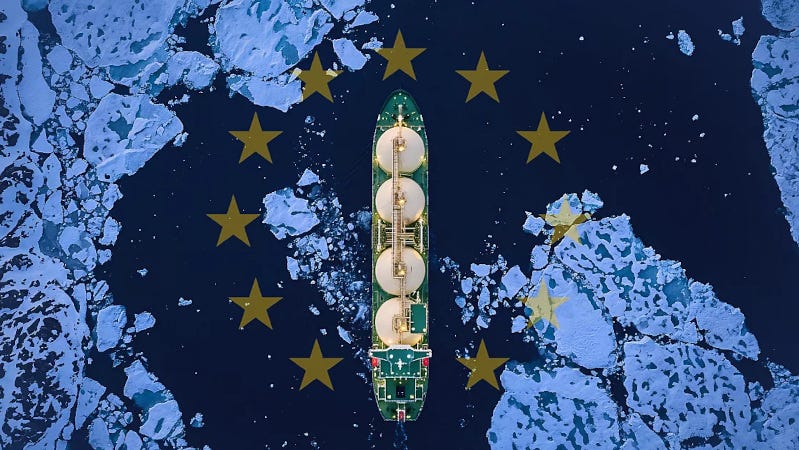
A Canadian satellite emissions company has joined a European Union-funded project to expand space-based detection of maritime pollution, with a focus on liquefied natural gas vessel emissions in EU and Arctic-adjacent waters.
“POSEIDON demonstrates how international collaboration can create global value and strengthen partnerships for important environmental topics.”
Marte Indregard, KSAT
GHGSat is one of 10 partners in POSEIDON — Pollution Observation from Space: Environmental Imagery for Detections in the Oceans & Nearshore — a three-year initiative funded under the EU’s Horizon Europe research and innovation program with a budget of approximately 5 million euros (approximately $5.5 million USD). The project is led and coordinated by Kongsberg Satellite Services (KSAT) of Norway.
The POSEIDON consortium draws partners from Norway, Canada, the Maldives, the Netherlands, Germany, South Korea and Greece, combining private sector, public sector and research institutions across earth observation, in-situ measurement, communications and regulatory coordination.
Using optical and radar-based satellite technology, POSEIDON will improve services for detecting oil spills — including in sea ice — and for monitoring chemicals, sewage, garbage and ship-sourced emissions. The project carries EU Horizon Europe grant agreement No. 101296478.
GHGSat operates a fleet of 16 satellites dedicated to methane emissions identification — the largest such constellation in the world. Its proprietary Wide-Angle Fabry-Pérot imaging spectrometer can detect methane plumes down to approximately 25 square meters, roughly half the size of an Olympic swimming pool, and can pinpoint sources to individual pieces of industrial equipment. In 2025, GHGSat detected more than 20,000 emissions events exceeding the super-emitter threshold of 100 kilograms per hour.
Within POSEIDON, GHGSat’s role centers on the LNG sector. As European governments lean on LNG to shore up energy supply chains, the company is positioned as the consortium’s primary capability for detecting and quantifying gas emissions from LNG vessels.
“Joining POSEIDON reflects our conviction that the world’s most urgent environmental challenges require the world’s most advanced monitoring capabilities,” said Stephane Germain, CEO of GHGSat. “We are proud to bring GHGSat’s precise emissions intelligence to this multinational effort and to demonstrate how Canadian innovation can help protect Europe’s oceans and secure its energy future.”
GHGSat’s technology has been independently validated by NASA and the European Space Agency. The company monitors millions of industrial facilities annually at a daily revisit frequency it says is unmatched by any government or commercial system. Beyond methane, it also monitors carbon dioxide and is expanding its sensing capabilities across industrial greenhouse gas sources.
KSAT President and CEO Marte Indregard said the project underscores the value of cross-border cooperation on environmental surveillance. “POSEIDON demonstrates how international collaboration can create global value and strengthen partnerships for important environmental topics,” Indregard said. “KSAT is proud to lead its first EC Horizon Europe project and to have brought together a strong global consortium to address these challenges.”
Charlotte Bishop, KSAT Director of Emerging Products and Services, said vessel traffic growth is intensifying the monitoring challenge. “With increased vessel traffic to meet rising transport demands, this places pressure on the environment, and as such maritime pollution becomes an increasing challenge that needs to be better understood,” Bishop said.
POSEIDON is scheduled to run three years from award.