

Satellite Earth Observation Market on Track to Nearly Double by 2032
Growing Applications in Climate Monitoring, Defense, and Agriculture Drive Projected 6.6% Annual Growth

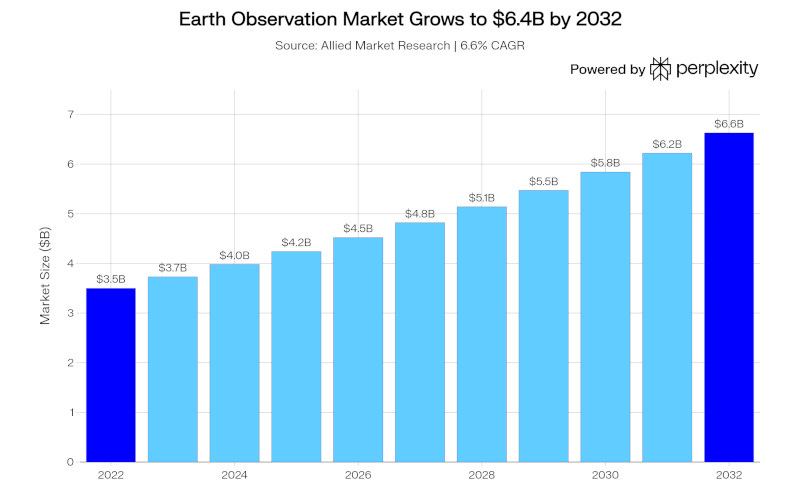
The global satellite-based earth observation market is forecast to grow from $3.5 billion in 2022 to $6.4 billion by 2032, driven by rising demand for high-resolution imagery, advances in satellite sensor technology, and expanding government investment in space-based data programs, according to a new analysis from Allied Market Research.
The report projects a compound annual growth rate of 6.6% over the forecast period, with North America — led by the United States — identified as a dominant regional market. Key drivers include the increasing use of earth observation data across agriculture, urban planning, disaster management, and climate monitoring, as well as growing procurement activity by government intelligence and scientific agencies.
Federal agencies are playing a significant and expanding role in stimulating the commercial earth observation sector. In October 2023, NASA significantly expanded its Commercial Smallsat Data Acquisition (CSDA) Program, awarding contracts to seven companies for earth observation data and services, with a maximum combined value of $476 million over five years.
Spire Global has been among the program’s beneficiaries. In August 2023, the company received a $6.5 million, 12-month CSDA contract renewal — a $500,000 increase over its previous award — to deliver satellite constellation data to NASA. In January 2024, Spire Global secured a separate $9.4 million contract from NOAA to provide radio occultation data used for weather forecasting, space weather modeling, and climate research.
The National Geospatial-Intelligence Agency (NGA) launched a program called “Luno” in February 2024 to expand its use of commercial satellite imagery and analytics, scaling up its prior Economic Indicator Monitoring initiative from a $29 million, five-year budget to an estimated $290 million — a tenfold increase signaling a broad shift in how intelligence agencies integrate commercial earth observation.
Technology and Service Trends
Observation-as-a-service and advanced geospatial analytics are identified as the primary growth areas within the market. Major players such as Airbus and Maxar Technologies have moved toward subscription and on-demand imagery models, as well as AI-assisted analytics services including land cover classification, infrastructure monitoring, and change detection.
Climate change monitoring is also emerging as a significant market driver. In September 2023, Chinese aerospace officials cited greenhouse gas monitoring and environmental change tracking as priorities for future earth observation satellite programs — a priority echoed globally as demand grows for continuous, high-resolution monitoring of emissions and ecosystem changes.
Headwinds and Competition
The market faces structural challenges, including increasing competition from alternative earth observation platforms such as aerial drones and high-altitude balloons, which can be deployed for certain monitoring applications at lower cost and with greater operational flexibility than orbital systems. A shortage of trained personnel with expertise in satellite data processing and geospatial analytics is also cited as a constraint on market growth.
Key Players
The report identifies a broad competitive landscape including Airbus SE, Boeing, Israel Aerospace Industries Ltd., Lockheed Martin Corporation, Mitsubishi Electric Corporation, Planet Labs PBC, L3Harris Technologies, Inc., SkyWatch Space Applications Inc., Raytheon Technologies Corporation, Thales Group, Maxar Technologies, BlackSky, Capella Space, and ICEYE.