

Satellite Communication Service and Equipment Market Projected to Reach $86.92 Billion by 2030
LEO Constellation Growth, Broadband Demand, and Secure Communications Drive 17.3% Annual Expansion

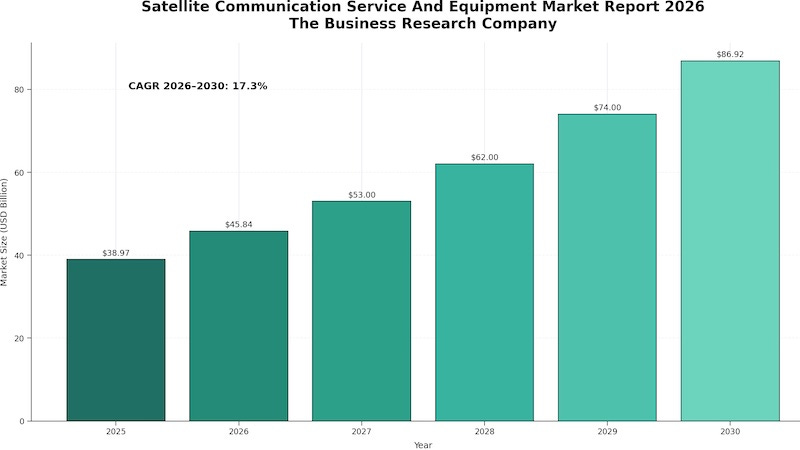
The global satellite communication service and equipment market is forecast to reach $86.92 billion by 2030, expanding at a compound annual growth rate of 17.3%, according to a new market report from The Business Research Company.
The growth trajectory is attributed to the accelerating deployment of next-generation satellite networks, rising worldwide demand for broadband coverage, and expanding connectivity requirements for commercial aircraft and maritime vessels. Increasing emphasis on secure satellite communications and growing investment in space-based infrastructure are also cited as key drivers across the forecast period.
Key market trends expected to shape the sector through 2030 include the rapid build-out of low-Earth orbit satellite constellations, surging demand for high-throughput satellite connectivity, wider adoption of multi-band communication systems, the expansion of mobile satellite services, and an intensified focus on secure satellite data transmission. Taken together, these forces reflect a structural shift in how governments, militaries, and commercial operators approach global connectivity.
The companies operating at the center of this market span defense primes, satellite fleet operators, and specialized equipment manufacturers. Key players identified in the report include Raytheon Technologies Corporation, Lockheed Martin Corporation, Airbus SE, Thales SA, L3Harris Technologies Inc., SES S.A., Eutelsat Communications S.A., Intelsat S.A., ViaSat Inc., Gilat Satellite Networks Ltd., Comtech Telecommunications Corp., Iridium Communications Inc., EchoStar Corporation, Global Invacom Group Limited, Avanti Communications Group plc, Asia Satellite Telecommunications Company Limited, Sky Perfect JSAT Holdings Inc., China Satellite Communications Co. Ltd., Tata Communications Limited, Bharti Airtel Limited, and SpaceX.
A significant transaction reshaping the competitive landscape came in May 2023, when California-based internet service provider Viasat Inc. acquired UK-based Inmarsat Global Limited for an undisclosed sum. The acquisition was designed to strengthen Viasat’s capabilities across the speed, flexibility, reliability, coverage, and security of its satellite communication products and services. Inmarsat specializes in satellite voice and data services, and the combination broadens Viasat’s reach in the commercial satellite communications arena.
Innovation is advancing on the hardware side as well. In January 2024, India-based telecommunications firm Sasken Technologies Limited launched an LTE-enabled satellite broadband device designed to support emergency and critical communications. The device integrates LTE (Long-Term Evolution) cellular network speeds with the broad coverage offered by satellite connectivity, providing reliable communication during natural disasters such as tsunamis and other disruptions to ground-based infrastructure. The product marks a notable step toward integrating standard 3GPP cellular protocols over satellite infrastructure — a convergence of mobile broadband and satellite communication frameworks.
The report segments the market by type into satellite communication services and satellite communication equipment. Service subcategories include Fixed Satellite Services, Mobile Satellite Services, Broadband Satellite Services, Broadcasting Satellite Services, and Satellite Communication Network Services. Equipment subcategories cover ground station equipment, satellite terminals, antennas, amplifiers, transceivers, and satellite modems.
By frequency band, the market spans C Band; L and S Band; X Band; Ka Band; Ku Band; Very High Frequency and Ultra High Frequency bands; Extremely High Frequency and Super High Frequency bands; and multi-band systems. By application, the market divides into government and military use, civil satellite communications, commercial applications, and other uses. The segmentation reflects the breadth of demand across both public-sector and private-sector customers globally.
The full report, including a complimentary sample, is available from The Business Research Company.