

Satellite Communication Market Could See Double-Digit Growth Through 2031
CAGR of 13 Percent Projected by Global Market Insights Inc.

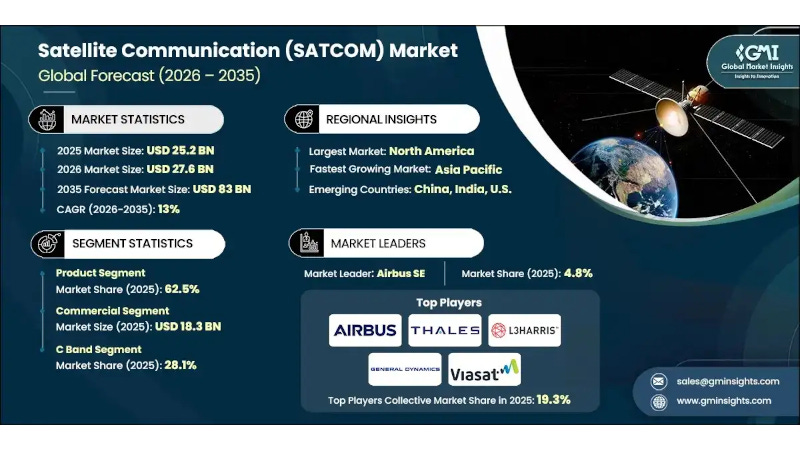
The global satellite communication market, which was valued at $25.2 billion in 2025. The market is expected to grow from $27.6 billion in 2026 to $47.6 billion in 2031 & $83 billion in 2035, at a CAGR of 13% during the forecast period according to the latest report published by Global Market Insights Inc.
The expansion of demand for internet connectivity, development of small satellite constellations to enhance communications, demand for remote area connectivity, increased demand for IoT & M2M Connectivity, and integration of 5G with existing infrastructure and new technologies are several ways that propel satellite communications market growth.
The growing demand for reliable internet depends upon satellite communications expanding into underserved areas. Programs Like NTIA’s Internet for all projects (USD 50 Billion) highlight the need for equitable access to broadband. For example, in rural areas, over 72% of tribal broadband connectivity program funds were awarded to rural areas, which is why satellite communications is important to provide high-speed communications to areas where terrestrial infrastructure is not available. Satellite communications expand the digital divide, allowing remote education, and allowing income growth through remote work by growing the economy.
As the IoT and M2M market continues to grow rapidly, many new communication hardware devices are being developed in all areas of communications. Because of this rapid growth, satellite communications networks now have an ever-increasing demand to provide real-time, secure data transmission across various industries including but not limited to logistics, agriculture, and smart cities. According to the IoT M2M Council, the satellite-enabled IoT market reached USD 1.8 billion in 2024 and is projected to grow to USD 5.7 billion by the year 2030, representing a compound annual growth rate (CAGR) of 21.3%. By 2030, the growth of the satellite-enabled internet of things (IoT) will be driven by the growing dependence on satellites for meeting the massive amount of data required by connected devices.
Between 2022 and 2024, the market witnessed considerable growth, increasing from USD 20 billion in 2022 to USD 23.1 billion in 2024. With satellite communications (SATCOM) rapidly evolving into a multi-orbit solution, combining GEO, MEO, LEO to provide the most flexible, high-performance connectivity for sectors such as government, military, and aviation, manufacturers have developed new technologies such as open architecture terminals and adaptive modems which provide a means of cross orbital switching with maximized bandwidth efficiency. In February 2023, SES, ThinKom, and Hughes showcased their multi-orbit service capabilities for Aeronautical missions using ThinKom’s Ka2517 terminals, SES networks, and Hughes’ HM400 Modems to enable seamless transitions between satellites.
The analysts found that the rapid expansion of satellite constellations is a key trend in the SATCOM market, as demand for worldwide high-speed broadband is a key factor driving this growth. As indicated in the 2022 U.S. GAO report, there are approximately 5,500 satellites currently in orbit (as of 2022) and this number could potentially increase to 58,000 more by 2030, with large-scale LEO satellite constellations (like Starlink) being the primary driver of that growth. Satellite networks are being transformed by these developments and have improved access, decreased latency, and provided lower-cost connectivity to some of the most remote areas on the planet.
The integration of satellite networks with 5G technology is a growing trend in the SATCOM market, especially in remote locations. As estimated by GSMA Intelligence, the number of 5G connections worldwide has been increasing rapidly; the current number of global connections is approximately 1.6 billion and this number is expected to grow to approximately 5.5 billion by 2030. By integrating satellite networks into the creation of 5G networks, companies able to provide faster working speeds, minimize latency, and increase the amount of available coverage, which help in spur growth within segments of their businesses including IoT (Internet of Things), smart cities, and self-driving (autonomous) vehicles and create an ongoing demand for saturation solutions.
The SATCOM industry is rapidly developing new advanced technology in satellite communications and is focused on providing government and defense customers with secure, reliable, high-capacity, resilient connections. As such, this is driving the evolution of global entries and developing global reliable satellite systems and advanced user terminals that allow users to process and transmit more data securely and efficiently and that can also be used in conjunction with existing terrestrial networks. For example, in February 2023, Inmarsat Government partnered with Cobham Satcom to manufacture SAILOR XTR terminals to support the U.S. Navy’s military sealift command operations by providing fast and secure worldwide communication capabilities, as well as being designed to provide adaptable and mobile satellite communications capabilities in response to the increased requirement for both significance and needs servicemen.