

Satellite Bus Maker Raises $200M, Valuation Nearly Doubles to $2.3B
Funding Round to Expand Los Angeles Manufacturing Campus and Advance Defense Programs

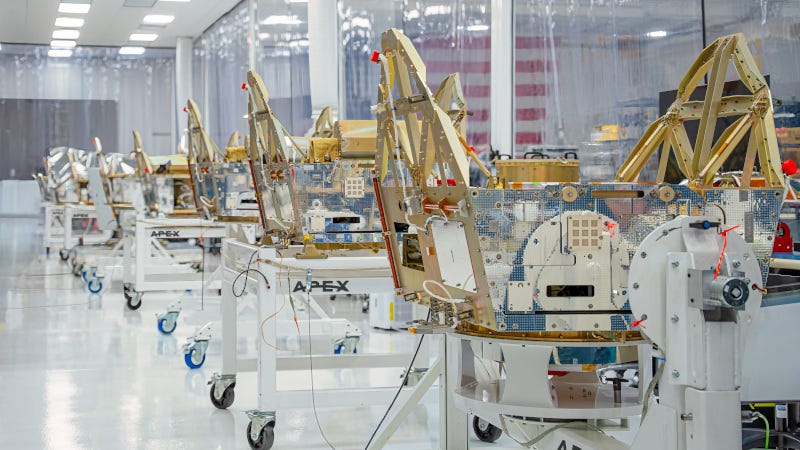
Los Angeles satellite bus manufacturer Apex has closed a $200 million funding round that nearly doubles its valuation to $2.3 billion, less than a year after first crossing the $1 billion mark.
“Proliferation is the name of the game these days, and it’s only possible with suppliers like Apex that can actually execute on their model to build satellites at an industrial scale.”
Ian Cinnamon, Apex
Glade Brook Capital Partners led the round, with Washington Harbour Partners co-leading. New and existing investors also participated. The announcement was made June 5, 2026.
The funding comes as demand for proliferated low Earth orbit constellations — both commercial and national security — continues to stretch the production capacity of spacecraft manufacturers. Apex was founded in 2022 specifically to address that bottleneck by building satellite bus platforms ahead of customer orders, rather than on a bespoke, contract-by-contract basis.
“This raise is all about scaling the business to meet the demand Max and I highlighted when we founded Apex, which has continued to grow in the subsequent years,” said Ian Cinnamon, CEO and Co-Founder of Apex. “Proliferation is the name of the game these days, and it’s only possible with suppliers like Apex that can actually execute on their model to build satellites at an industrial scale.”
Apex will use the new capital to expand its Factory One manufacturing campus in Los Angeles, adding 30,000 square feet of floor space. The facility is currently capable of producing more than 200 satellites per year at peak capacity. The company’s headcount has more than doubled in the past year to over 350 employees.
The company also announced the appointment of Michael Kopet as Chief Financial Officer. Kopet joins from Axon, where he served as Vice President of Finance.
The round drew in investors who pointed to Apex’s manufacturing model as the attraction. “Space is undergoing a fundamental transition from bespoke programs to scalable, proliferated infrastructure,” said Paul Hudson, Founder and Chief Investment Officer at Glade Brook Capital Partners. “Apex has built exactly the kind of business needed to support that shift.”
Washington Harbour Partners’ co-lead position reflects a similar read on the market. “We believe Apex is defining a new category within the aerospace and defense industry,” said Mina Faltas, Founder and Chief Investment Officer at Washington Harbour Partners. “The company’s productized approach to spacecraft manufacturing, combined with its speed, commitment to reliability, and growing production capacity, positions Apex to become a foundational partner for the next generation of proliferated constellations and resilient space architectures.”
Apex’s three satellite platforms — Aries, Nova, and Comet — are designed for missions in both LEO and geostationary orbit, with payload capacity reaching up to 6,614 pounds on the recently announced Mini configuration of the Comet platform. Customer missions in the pipeline cover remote sensing, communications, in-space power generation, and proliferated national security architectures.
On the defense side, Apex is collaborating with Northrop Grumman on space-based interceptor capabilities for the U.S. Space Force under the broader Golden Dome for America initiative. The work centers on Orbital Magazines — spacecraft designed to host and support space-based interceptors.
Project Shadow, the satellite platform hosting America’s first commercially led on-orbit space-based interceptor demonstration, remains on track for a summer 2026 launch. The mission is designed to validate core technologies underlying the Orbital Magazine architecture.
Later this year, a handful of Apex satellites are also scheduled to reach orbit, adding to flight heritage the company built from its first Aries satellite, which launched two years ago and continues to operate in LEO.