

SatComm Market Projected to Top $391.45 Billion by 2040
Reflects Accelerating Demand for Broadband Connectivity in Underserved Regions, According to Roots Analysis

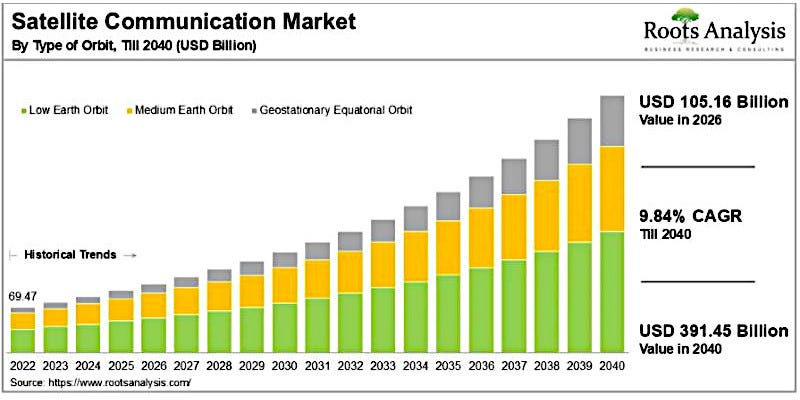
The global satellite communication market, valued at $94.81 billion in 2025, will reach $105.16 billion in 2026 and expand to $391.45 billion by 2040, advancing at a CAGR of 9.84% over the forecast period. According to a new report from Roots Analysis, the growth reflects accelerating demand for broadband connectivity in underserved regions, large-scale low earth orbit constellation deployments, and rising defense investment in secure satellite networks worldwide.
Satellite communication integrates ground infrastructure with space-based relay systems to deliver high-speed data transmission, voice, video, and broadband services across geographies where terrestrial networks cannot reach reliably. It is no longer a niche technology; it is now foundational to global connectivity strategies across defense, aviation, maritime, agriculture, and consumer broadband.
Three macro forces are converging to drive this market forward. First, LEO constellations from operators including SpaceX Starlink, Amazon Kuiper, and Eutelsat OneWeb are extending low-latency broadband to remote populations at scale. Second, governments from the United States to India are committing multi-billion-dollar investments to secure autonomous satellite capabilities. Third, the direct-to-device segment is pulling major technology companies, including Apple, AT&T, and Google, into the market as investors and ecosystem partners.
Recent developments illustrate the pace of change. In November 2025, Eutelsat Group expanded LEO satellite connectivity in Angola through a partnership with MSTelcom. Saudi Telecom Company announced direct-to-device satellite mobile services in partnership with AST SpaceMobile to extend coverage across the Middle East. Vodafone simultaneously launched a space-land mobile broadband research hub in Malaga to develop integrated 5G and satellite solutions. These are not exploratory pilots; they are commercial deployments signaling that the satellite communication industry has entered its scaling phase.
Key Growth Drivers
LEO Constellation Expansion for Global Broadband Access - SpaceX has deployed over 8,000 active Starlink satellites as of late 2025, achieving 146 total missions in a single year. Amazon launched its Project Kuiper constellation with 27 satellites in April 2025 and has completed three additional launches since. These programs are bringing satellite internet services to populations and enterprises previously excluded from high-speed connectivity, and the pace of deployment shows no sign of slowing.
Rising Defense and Military Investment - Military modernization and network-centric warfare requirements are generating sustained demand for secure, high-bandwidth satellite communication systems. The United States Space Force’s Commercial Satellite Communications Office allocated USD 2.3 billion in commercial SATCOM contracts in January 2025, prioritizing LEO broadband services. India announced plans to launch 52 dedicated defense satellites by 2029 at a program value of approximately 26,968 crore, covering LEO, MEO, and GEO orbits for real-time intelligence and surveillance.
5G and Non-Terrestrial Network Integration - 3GPP standardization of 5G non-terrestrial networks enables satellite operators to extend broadband, voice, and video through the same interfaces used by mobile networks. In February 2025, Ericsson and its partners successfully demonstrated portable 5G private network systems connected to LEO satellites, validating seamless handoffs between mobile and satellite access for disaster response and remote operations.
Direct-to-Device Consumer Services - Smartphones are connecting directly to satellite constellations without ground towers, creating a new revenue layer for both satellite operators and handset manufacturers. AST SpaceMobile, backed by AT&T, Google, and Vodafone, is building mobile-native satellite connectivity. In May 2025, AccelerComm closed a USD 15 million funding round to accelerate 5G satellite technology deployment for direct-to-device communications, with Lockheed Martin’s regenerative 5G NTN satellite payload as a target platform.
Government Programs for Digital Sovereignty - The European Commission awarded a grant to the IRIS2 consortium in December 2024 to deploy a secure satellite constellation, with Deutsche Telekom and Orange among the partners. This builds on the EU’s Gigabit Society framework and reflects a broader pattern of governments seeking satellite infrastructure independence rather than reliance on foreign commercial providers.
North America commands 38.64% of the global satellite communication market and is the clear leader by revenue, while Asia Pacific is the fastest-growing region through 2040, the report finds.