

Russia’s Titanium Grip
Mapping Which Space Primes Remain Exposed to VSMPO-AVISMA Four Years into Sanctions

What This Means:
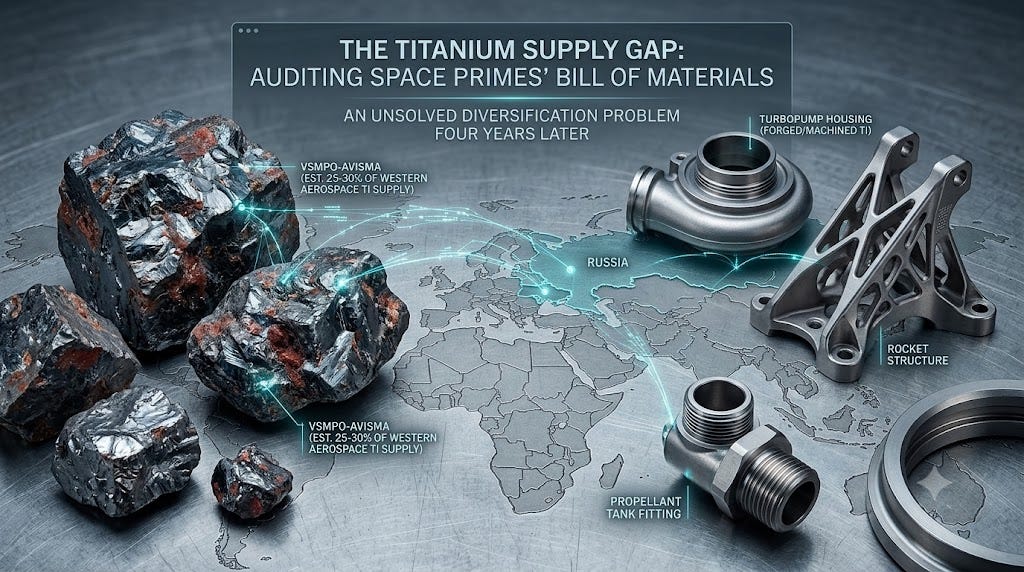
VSMPO-AVISMA, the Russian metals producer, still accounted for an estimated 25 to 30 percent of the titanium used in Western aerospace manufacturing, based on the most recent available trade estimates. Four years after Russia’s invasion of Ukraine, the diversification effort remains incomplete for the forged and machined titanium that goes into rocket structures, propellant tanks, and turbopump housings. Boeing cut direct purchases in 2022, but the alloy still moves through European mills and pre-war supply agreements. The United States government has not placed VSMPO-AVISMA itself on the Specially Designated Nationals list, which means the company remains legally reachable by Western buyers today. Program managers and executives at space primes, and at the structural-titanium subcontractors who serve them, should audit their bill of materials for VSMPO-linked alloy now, before a Treasury designation, an export restriction, or a Kremlin policy shift forces a mid-program requalification under schedule pressure.
The Decision You Cannot Outsource to Your Supplier
If you run procurement for a rocket structures program, you already know titanium is not a commodity you swap out on short notice. A change in alloy source means a change in melt chemistry, a change in forging supplier, and a new qualification cycle that can run 12 to 24 months for a flight-critical part. That is the timeline your program has to work with if the titanium behind your pressure vessels, your ISOgrid airframe panels, or your turbopump housings turns out to trace back to a Russian mill that the United States or the European Union decides, on a Tuesday, to sanction directly.
That is not a hypothetical. It is the exact position Boeing and Airbus found themselves in in March 2022, and the position much of the launch vehicle and satellite structures industry has spent four years trying, unevenly, to work its way out of. The question for space primes in 2026 is not whether the Ukraine war reshaped the titanium market. It did. The question is whether your specific program still carries exposure that your procurement organization has not fully mapped, because the header risk (Russia, sanctions, titanium) got covered by the trade press in 2022 and then largely disappeared from the trade press, even though the underlying exposure did not disappear from the supply chain.
The Signal
VSMPO-AVISMA is one of the two or three largest titanium producers in the world and has historically supplied a disproportionate share of aerospace-grade titanium sponge, ingot, and mill products to Western manufacturers. Boeing issued an official statement in March 2022 confirming it had suspended purchases of titanium from Russian sources following the invasion of Ukraine, a direct, named action from a Class 1 company disclosure. Airbus, which drew a larger share of its titanium from VSMPO-AVISMA than Boeing did, moved more slowly, continuing to honor existing contracts before announcing a phased diversification of its titanium supply base.
The signal that matters for space primes specifically, as distinct from commercial aviation, is this: the U.S. government has had four years to add VSMPO-AVISMA to the Office of Foreign Assets Control (OFAC) Specially Designated Nationals and Blocked Persons List under the authority of Executive Order 14024, the April 2021 order blocking property tied to harmful foreign activities of the Russian government, and it has not done so. That is not an oversight. It likely reflects a policy tension that the U.S. Government Accountability Office (GAO) has flagged in its public reporting on defense industrial base risk, though the specific report citation could not be independently verified for this piece and should be treated as directional rather than confirmed: the American and European aerospace industrial base remains materially dependent on Russian titanium feedstock, and a full sanctions cutoff would create a supply shock for defense and space production lines faster than domestic capacity could absorb it. GAO’s 2023 review of defense supply chain risk flagged titanium sourcing specifically as an area where the Department of Defense (DoD) lacked full visibility into how deep Russian-origin material had penetrated the subcontractor base, a finding that functions as a key risk indicator for this analysis, though the underlying report should be independently confirmed by readers before being relied on as audited fact.
In practical terms, that means the titanium exposure did not get closed by sanctions. It got closed, partially, by individual company decisions, and those decisions were made unevenly across the industry and are not fully disclosed at the program level.
