

Rocketdyne Reborn
What PE Ownership of RL10 Infrastructure Means for National Security Launch Customers

What This Means
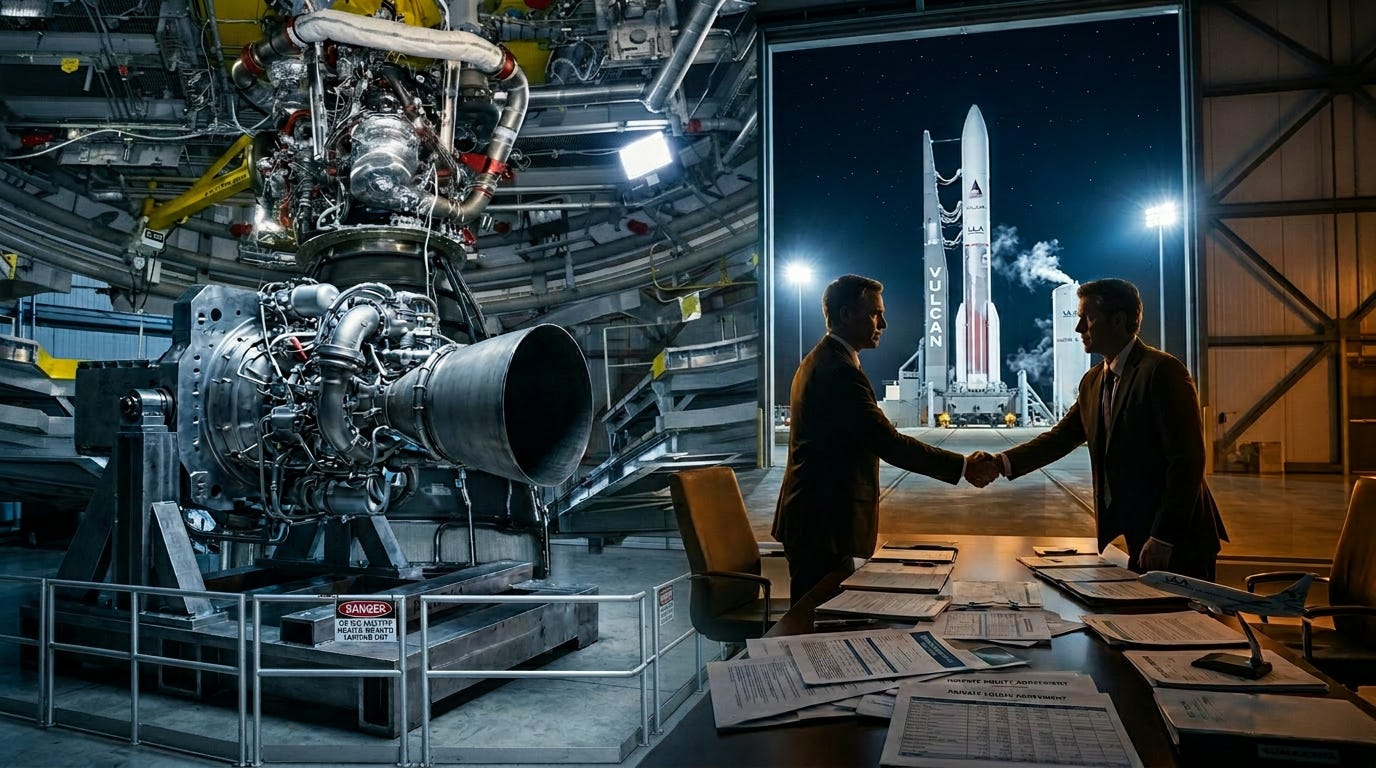
AE Industrial Partners’ $845 million majority carve-out of Rocketdyne’s upper-stage propulsion assets from L3Harris Technologies puts a private equity firm’s return horizon in direct tension with the multi-decade infrastructure commitments that national security launch programs require. The RL10 engine powers the upper stages of United Launch Alliance’s (ULA) Vulcan Centaur, which carries the most demanding National Security Space Launch (NSSL) Phase 3 Lane 2 missions, including National Reconnaissance Office (NRO) and Global Positioning System (GPS) payloads. Policy professionals and investors with exposure to the national security launch supply chain need to understand what happens to that infrastructure when the owner’s incentives are structured around an exit, not perpetual stewardship.
The Deal That Restarted a Name
For more than sixty years, Rocketdyne was a fixture of the American launch stack. The name passed through Aerojet, then into L3Harris when it acquired the Aerojet Rocketdyne propulsion assets in 2023. Now it is passing again — this time to AE Industrial Partners (AEI), a Boca Raton-based private investment firm that describes itself as focused on technologies “critical to aerospace and national and economic security.”
The transaction, announced January 4, 2026, gives AEI a 60 percent controlling stake in the carve-out, with L3Harris retaining approximately 40 percent. The deal is valued at $845 million and is expected to close in the second half of 2026, pending regulatory approval. Notably, L3Harris’ RS-25 engine business — the main engines for NASA’s Space Launch System (SLS) — is explicitly excluded from the transaction. What AEI does control is the RL10 upper-stage engine, in-space propulsion systems, nuclear power assets for exploration missions, and launch avionics.
Kirk Konert, Managing Partner at AEI, framed the acquisition in confident terms: “By taking the historic engine — the RL10 — and applying modern manufacturing discipline, we will honor its design while revolutionizing the production line.” The intent to modernize is credible. AEI’s stated focus on additive manufacturing scale-up and production-line efficiency for the RL10 reflects genuine backlogs in current supply. The question for policy professionals and government procurement offices is not whether AEI intends to deliver. It is whether PE ownership, with its inherent return-period constraints, is structurally compatible with the decades-long supply commitments that NSSL customers require.
Why the RL10 Is Not a Replaceable Part
Upper-stage engines are not commodity components. Konert himself acknowledged as much: “Upper-stage engines are tightly integrated into vehicle architectures, so we do not expect wholesale engine swaps by current operators.” That architectural lock-in is precisely what makes this ownership transition consequential for national security customers.
The RL10 currently powers the Centaur V upper stage on ULA’s Vulcan Centaur. Vulcan Centaur holds the NSSL Phase 3 Lane 2 contract for the most risk-intolerant national security missions — the NRO, GPS Block III, and Wideband Global SATCOM (WGS) satellites that define U.S. space-based intelligence and communications architecture. NASA has also formally selected Vulcan Centaur’s Centaur V upper stage as the replacement for the SLS Interim Cryogenic Propulsion Stage (ICPS) beginning with Artemis IV, through a sole-source procurement award signed March 6, 2026, by NASA Senior Procurement Executive Marvin Horne — deepening the RL10’s role in civil deep-space access alongside its national security mission load.
There is no near-term alternative. Blue Origin’s BE-3U engine is designed for its own New Glenn vehicle and is not qualified for ULA’s Centaur V stack. Qualifying any alternative engine for the Centaur V configuration would require a new certification campaign estimated at 24 to 36 months of testing and integration validation — a timeline that eliminates any practical “swap” option within the NSSL Phase 3 delivery window. SpaceX uses its own Merlin Vacuum or Raptor Vacuum engines internally and does not offer them to third-party integrators. The RL10’s LH2/LOX performance envelope, 465.5 seconds of specific impulse in its ICPS variant, remains unmatched among operationally certified upper-stage engines available to third-party operators. A supply disruption at Rocketdyne does not trigger a procurement detour. It triggers a launch manifest failure.
The next sections map the RL10 supply chain vulnerability, the DoW equity investment contrast, the PE exit timing problem against NSSL Phase 3 and Phase 4 schedules, and the specific decision questions for program offices and investors. Full analysis for subscribers.
