

Robotic Arm Prototype Delivered to European Space Agency for Lunar Cargo Lander
Manipulator Designed to Load and Unload Cargo, Tools on ESA’s Argonaut Lander

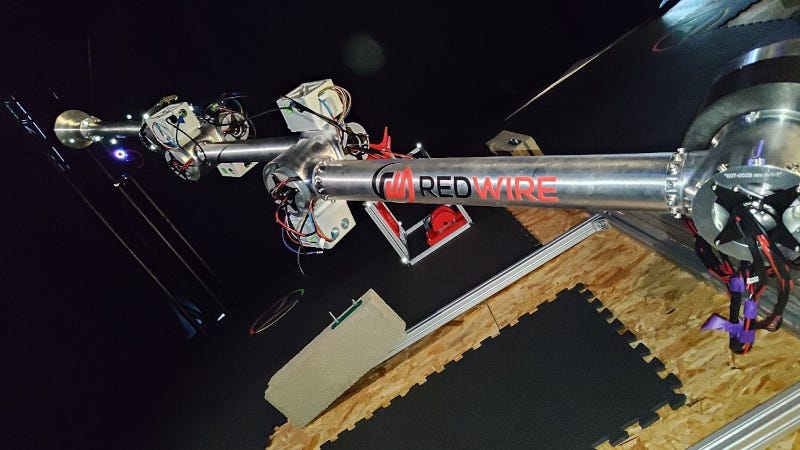
A robotic arm prototype built to support cargo operations on the European Space Agency’s planned lunar lander has been successfully developed, tested, and delivered by Redwire, marking a key milestone in Europe’s effort to establish a sustained presence on the Moon.
The manipulator, known as MANUS — Manipulator for Argonaut Payload Needs and Unloading Support — was developed by Redwire’s Luxembourg-based team in collaboration with Added Value Solutions, with support from ESA. The project recently completed several milestones, including preliminary design and performance assessment, before the prototype was formally handed over to the agency.
Prior to delivery, the MANUS Breadboard Model underwent a comprehensive test campaign to verify the functionality and performance of the manipulator and its tool-changer subsystems, and to demonstrate operational scenarios aligned with system requirements. All planned operations were executed successfully, confirming overall system readiness.
Functional testing validated safe and reliable mechanical performance, demonstrating strong joint-space accuracy and stable interaction among subsystems. Operations included payload handling, end-effector actuation with wireless data and power transfer, range extender manipulation, and automatic deployment.
MANUS is designed to support the loading and unloading of equipment and cargo from ESA’s Argonaut lander, a vehicle intended to deliver between 3,300 and 3,970 pounds of cargo, infrastructure, and scientific instruments to the lunar surface. The manipulator is designed to facilitate transfers to a rover, directly onto the lunar surface, or to an astronaut. It could also function as a connector for rovers to transfer power and charge batteries, and as a tool for scooping lunar regolith.
The Argonaut program is central to ESA’s strategy to establish an enduring European presence on the Moon and ensure Europe remains an active participant in global space exploration efforts.