

RAVEN Shuttle, NEST Depot Comprise Orbit Fab In-Space Refueling Network
New Architecture Targets 2030 Deployment to Enable On-Orbit Fuel Distribution

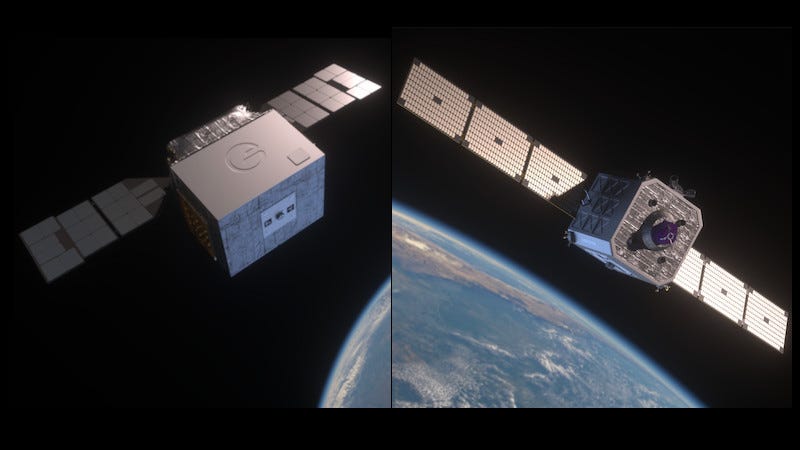
A new two-part in-space refueling architecture designed to deliver propellant directly to satellites across multiple orbital regimes has been unveiled by Orbit Fab. The Lafayette, Colorado-based company introduced RAVEN, a mobile refueling shuttle, and NEST, an on-orbit fuel depot, as the latest expansion of its growing in-space fuel logistics network — which the company markets as “Gas Stations in Space.”
“RAVEN and NEST are a major step toward making on-orbit refueling routine.”
Peter Shaper, Orbit Fab
Together, RAVEN and NEST are designed to position propellant in orbit and deliver it to spacecraft when and where it is needed, enabling more maneuverable, responsive and sustained satellite operations across a range of commercial and government missions. First deployments of the new architecture are targeted for 2030.
The unveiling builds on Orbit Fab’s existing refueling ecosystem, which centers on its Rapidly Attachable Fuel Transfer Interface, or RAFTI — a standardized docking and transfer port that spacecraft manufacturers can integrate before launch. More than 100 commercial spacecraft have already been fitted with the RAFTI port, which is priced at $30,000 per unit and supports a range of fuel types, spacecraft sizes and propulsion systems.
In the new architecture, RAVEN shuttles are intended to ferry propellant from NEST depots to RAFTI-equipped spacecraft in orbit. The system is designed to be scalable, enabling dynamic space operations across a distributed network of orbital fuel nodes. Orbit Fab uses in-house software called UMPIRE to model satellite clusters and determine optimal placement of shuttles and depots.
“This is about building the logistics backbone for dynamic operations in space,” said Peter Shaper, CEO of Orbit Fab. “RAVEN and NEST are a major step toward making on-orbit refueling routine, unlocking the maneuverability, endurance, and operational flexibility that will define strategic advantage in space.
The announcement comes at a pivotal moment for the company. In March 2026, Orbit Fab closed a $20 million Series B funding round as it enters what executives described as a new growth chapter. The company has also secured a landmark $20 million contract from the U.S. Department of Defense for its first commercial fuel sale — delivering 100 kilograms of hydrazine in geostationary orbit.
Orbit Fab has also expanded its international footprint. The company is working with Airbus Defence and Space on a feasibility study for integrating RAFTI into future Airbus geostationary satellites, under a project funded by the UK Space Agency and the European Space Agency’s RADICAL program. Additionally, Orbit Fab received €750,000 (≈$882,450) from ESA to collaborate with telecommunications primes on refueling geostationary orbit satellites, and was awarded a $3.8 million contract from the UK Space Agency and ESA to lead a European consortium on next-generation satellite refueling technology under the ASTRAL program.
A first in-orbit refueling demonstration mission is scheduled to launch in 2026, with a second planned for 2028 under the ASTRAL initiative — the latter aiming to validate the RAFTI port and the company’s GRASP docking interface using xenon propellant. The company has also announced that its first fuel depot is set to launch on the same rocket as Astroscale’s LEXI servicer in June 2026, with Orbit Fab contracted to supply up to 2,200 pounds of xenon in GEO.
Separately, Payload’s State of ISAM 2026 report identified three missions scheduled for in-space servicing, assembly and manufacturing in 2027, with Orbit Fab’s on-orbit refueling technology cited as a key driver. The report highlighted the sector’s transition from early-stage concepts to operational capabilities.
Orbit Fab was founded on the premise that making spacecraft refuelable fundamentally changes the economics and longevity of satellite operations. With RAVEN and NEST, the company is scaling that vision from individual refueling events to a persistent, network-based fuel delivery infrastructure in orbit.