


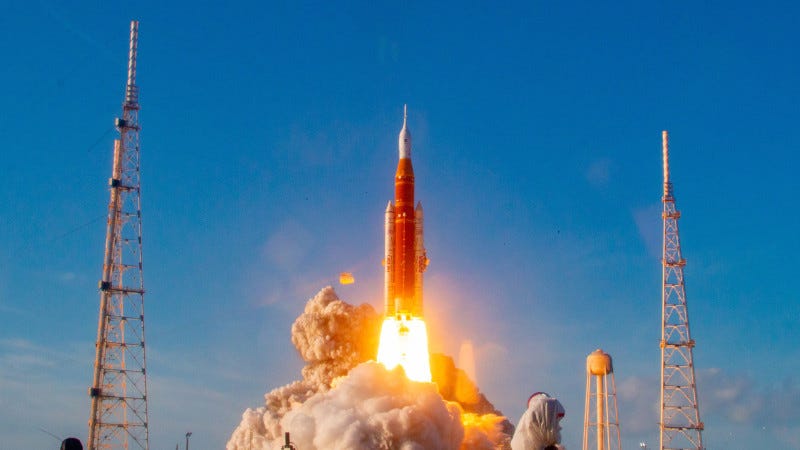
A sprawling network of aerospace and defense contractors, stretching from a New Orleans assembly floor to a semiconductor lab in Tokyo, powered NASA’s Artemis II mission off the launch pad Tuesday evening, sending four astronauts moonward for the first time in more than half a century.
“Artemis II marks a new era in human space exploration. We congratulate NASA and all our teammates on achieving liftoff.”
Christopher Kubasik, L3Harris
The Space Launch System rocket lifted off at 6:35 p.m. ET, carrying NASA astronauts Reid Wiseman, Victor Glover and Christina Koch, and Canadian Space Agency astronaut Jeremy Hansen aboard the Orion spacecraft, named ‘Integrity’ by its crew. The mission is the first crewed test flight of the Artemis program.
The Lift: Boeing and L3Harris
The SLS core stage, built by Boeing, stands 212 feet tall and includes a 196,000-gallon liquid oxygen tank and a 537,000-gallon liquid hydrogen tank. Four RS-25 engines at its base generate a combined 2.2 million pounds of thrust. Boeing manufactures the core stage at NASA’s Michoud Assembly Facility in New Orleans, drawing on suppliers in more than 38 states.
“Our focus has been on prioritizing the quality of the vehicle and the safety of the crew as they begin their journey. This rocket is designed to withstand incredible forces while speeding through the atmosphere, and it performed exactly as intended,” said John Shannon, vice president, Boeing’s Exploration Systems business. “I want to extend my heartfelt thanks to our dedicated team and partners for their hard work in making this part of the mission a success.”
Those RS-25 engines, however, were not Boeing’s alone to deliver. L3Harris Technologies supplied the RS-25 engines for the SLS core stage, the RL10 engine for the Interim Cryogenic Propulsion Stage, and the Orion Main Engine for the translunar injection burn — the critical firing that sends the spacecraft on its path around the moon. The Melbourne, Fla.-based defense company contributed more than 100 separate elements to the mission in all, including in-space thrusters for course corrections, 40 advanced avionics systems for precision control and monitoring of the launch vehicle, and the Orion audio system for continuous astronaut communications.
Eight and a half minutes after liftoff, the Boeing-built core stage completed its mission and separated from the upper stage, enabling Orion to continue its journey toward the Moon.
“Artemis II marks a new era in human space exploration,” said Christopher Kubasik, chairman and chief executive of L3Harris. “We congratulate NASA and all our teammates on achieving liftoff.”
The Pointy End: Lockheed Martin
Orion was built by Lockheed Martin and features new systems designed to keep humans safe in deep space, including environmental control and life support, updated crew displays and controls, audio communications with an experimental laser link to mission control in Houston, and a fully functional Launch Abort System.
During the 10-day mission, the crew will complete two orbits around Earth before traveling nearly 5,000 miles beyond the far side of the Moon — almost 250,000 miles from Earth — on a free-return trajectory. On April 10, Orion is scheduled to re-enter Earth’s atmosphere at 30 times the speed of sound before splashing down in the Pacific Ocean off the coast of San Diego.
Eyes on the Mission: Redwire
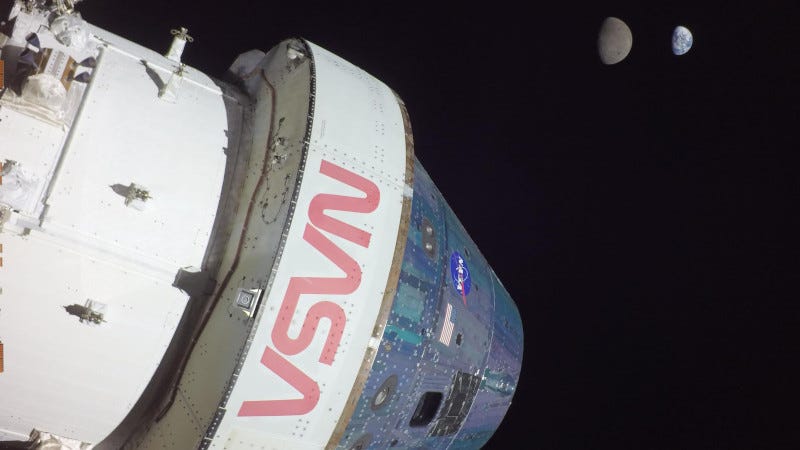
Jacksonville, Fla.-based Redwire Corporation supplied the Orion Camera System under contract with Lockheed Martin, with its scope covering Artemis missions I through V. The system comprises 11 internal and external inspection and navigation cameras, including wireless cameras mounted on each of Orion’s four solar arrays to allow in-flight inspection of the entire spacecraft.
An Optical Navigation Camera provides high-resolution imagery to the spacecraft’s machine vision algorithm to determine Orion’s position and velocity relative to Earth, while other cameras capture 4K video and 12-megapixel still images of key mission events such as separation, jettison and deployment.
“You may have heard the phrase, ‘the camera is the mission,’ which certainly still resonates today. I am so proud that Redwire is providing its trusted and flight-proven imaging and navigation technology for Artemis II, which will play a vital role in this historic endeavor” said Mike Gold, President of Redwire Space. “We can’t all be astronauts, but through the amazing imagery that our cameras will capture, the whole world can be a part of the extraordinary journey of discovery that is Artemis II.”
Redwire also provided four redundant Coarse Sun Sensor assemblies for Orion’s European Service Module through a contract with Airbus, feeding data to the Solar Array Drive Electronics to orient the module’s solar panels.
The Electronics: Renesas
Deep within the spacecraft’s avionics, components from a Japanese semiconductor company are keeping the systems running. Renesas Electronics Corporation’s radiation-hardened integrated circuits — sold under the Intersil brand — are embedded across multiple subsystems in both the Orion capsule and the SLS rocket, helping regulate and distribute power, maintain signal integrity and support onboard computing. The specialized chips are engineered to operate reliably under the elevated radiation levels and extreme temperatures of human spaceflight.
The Intersil brand traces its space heritage back more than six decades to the founding of Radiation Inc. in 1950, and its products have flown on virtually every satellite, shuttle launch and deep-space mission since.
“Human space flight missions leave no margin for failure,” said Chris Stephens, vice president of the HiRel Business Division at Renesas.
The mission will test Orion’s systems and generate critical data on spacecraft performance and human health in deep space, laying the groundwork for future crewed lunar landings. For the constellation of prime contractors and suppliers whose work converged on Launch Complex 39B Tuesday evening, Artemis II is both a milestone and a down payment — Boeing is already building core stages for Artemis III through V at Michoud and Kennedy, and L3Harris, Redwire and Renesas are contracted to support those missions as well.