

Precision Nanomedicine to Target the Most Challenging Tumors
ISS National Lab-Enabled Research Supports Next-Gen Chemotherapy and Immunotherapy Development

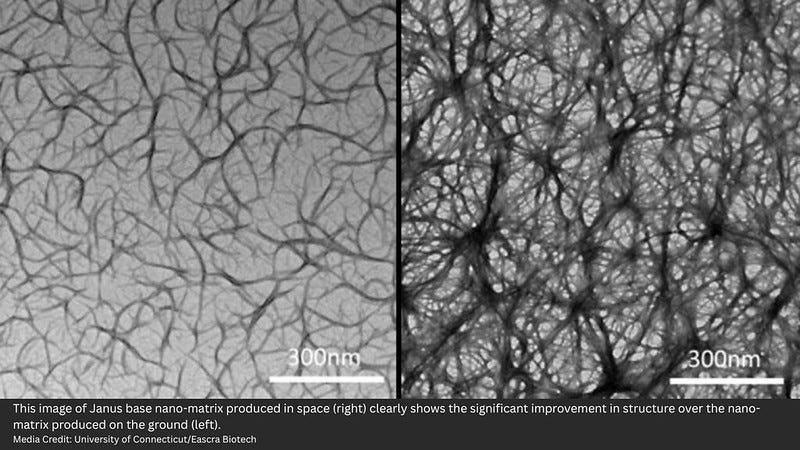
Research to advance the next generation of targeted cancer treatments through the development of Janus base nanomaterials (JBNs) is being conducted by Eascra Biotech aboard the International Space Station. JBNs are engineered from synthetic DNA-inspired molecules that self‑assemble into nanotubes that can be loaded with a therapeutic.
“Microgravity research has given us a clearer path toward optimizing this technology for real‑world cancer treatment.”
Mari Anne Snow, Eascra Biotech
Previous research sponsored by the ISS National Lab demonstrated that JBNs manufactured in microgravity form more uniform and durable structures than those produced on Earth, resulting in improved therapeutic performance. Building on these findings, Eascra is now advancing two commercial cancer therapies: a JBN‑based chemotherapy and a JBN‑based immunotherapy.
Designed to precisely target solid tumors, JBNs enable direct drug delivery into some of the most difficult‑to‑treat cancers, including triple‑negative breast cancer, high‑grade ovarian cancer, and select bone cancers. By mimicking natural DNA, JBNs evade immune detection, allowing treatments to remain concentrated at tumor sites longer—potentially improving treatment effectiveness while reducing harmful side effects. JBNs are also stable at room temperature, so JBN-based therapeutics do not need to be refrigerated, making them much easier to ship and store.
“Microgravity research has given us a clearer path toward optimizing this technology for real‑world cancer treatment,” said Mari Anne Snow, CEO and co-founder of Eascra Biotech. “These findings bring us closer to delivering more precise and effective therapies for patients with aggressive and drug‑resistant tumors.”
The research is scheduled to launch no sooner than April 9, 2026, on NASA’s Northrop Grumman Commercial Resupply Services 24 mission from Cape Canaveral Space Force Station. The mission will carry more than 10 ISS National Lab-sponsored investigations to the ISS.
These projects span a wide range of scientific disciplines and could help improve heart disease modeling, enable real‑time environmental surveillance for land and water management, and advance understanding of microbial adaptation to extreme environments.