


WHAT THIS MEANS
Portal Space Systems’ $50M Series A is not a propulsion story. It is a market-structure story. For the first time, solar thermal propulsion (STP), a technology validated at National Aeronautics and Space Administration (NASA) and Air Force Research Laboratory (AFRL) programs but never commercialized, has attracted institutional capital at scale, with Booz Allen Ventures sitting at the table alongside commercial investors. That combination sends a clear signal: maneuverability is moving from a nice-to-have to a mission-critical capability. Investors with exposure to the in-space propulsion sector and program managers sourcing spacecraft for multi-orbit operations should map their options before this supply tier consolidates around a short list of qualified vendors.
Every propulsion architecture makes a bet. Chemical systems bet on raw energy density. Electric propulsion bets on efficiency, accepting low thrust as the price of that efficiency. Solar thermal propulsion bets on a third thing: the ability to have it both ways.
Portal Space Systems, a Bothell, Washington-based spacecraft manufacturer founded in 2021 by Jeff Thornburg, a former SpaceX engineer who helped develop the Merlin engine program, closed a $50 million Series A in April 2026, valuing the company at $250 million. The round was led by Geodesic Capital and Mach33, with participation from Booz Allen Ventures, ARK Invest, AlleyCorp, and FUSE. It follows a $17.5 million seed round, one of the largest publicly disclosed seed financings in the sector at the time, announced in 2025.
The numbers matter less than the investor mix. Booz Allen Ventures does not back science projects. It backs technologies where a named defense customer has a defined operational need and a credible path to procurement. Its presence in this round is a procurement signal that no press release can replicate.
The Physics Argument
To understand why this raise matters, start with what STP actually does and why no one has commercialized it before.
Conventional chemical thrusters burn fuel to generate thrust. They deliver high specific impulse (Isp) in a narrow window, after which the propellant is gone. Electric propulsion, ion thrusters, Hall-effect thrusters, converts solar energy to electricity to accelerate propellant, achieving far higher Isp but at thrust levels that are, for most mission architectures, too low for rapid orbital changes. The tradeoff has defined mission architecture for decades: fast and fuel-hungry, or efficient and slow.
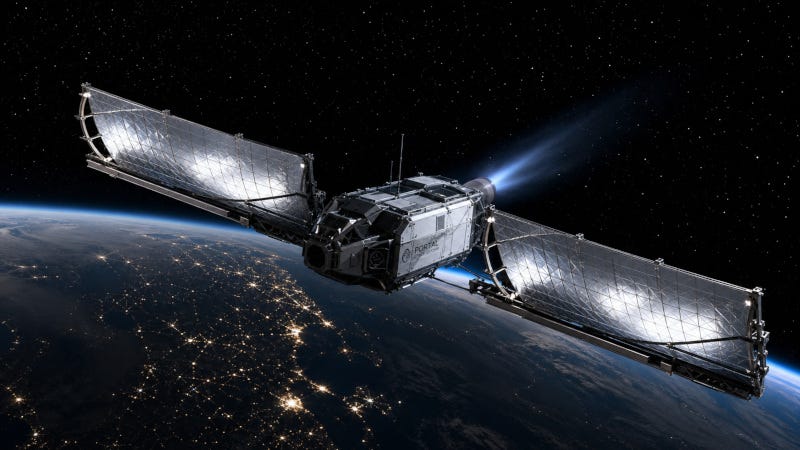
Solar thermal propulsion cuts through that tradeoff. Instead of converting sunlight to electricity and then to thrust, Portal’s system concentrates sunlight directly to heat ammonia-based propellant to temperatures that chemical combustion cannot reach. The result, per Portal’s own data and independent assessments, is specific impulse approaching nuclear thermal performance levels, without a reactor and without the regulatory burden that comes with one. Portal’s Supernova spacecraft is designed to deliver up to 6 km/s of delta-v across orbital regimes from low Earth orbit (LEO) to cislunar space.
Orbital maneuvers that currently take weeks or months using conventional propulsion can be executed in hours or days. For a Defense Department customer watching an adversarial satellite make an unannounced approach, “hours or days” is not a performance specification. It is a strategic capability.
Why Now, and Why Commercial
NASA and the AFRL have had STP on the drawing board since the 1960s. The question is not whether the physics works. It is why the physics could not be commercialized until now.
The answer sits in three converging manufacturing capabilities. Additive manufacturing now produces the complex internal geometries, heat exchangers, thruster cores, fluid channels, that STP demands but that traditional machining cannot economically produce. Advanced materials science has extended the thermal performance envelope for components operating at the temperature extremes the system requires. Precision optics manufacturing has driven down the cost of the deployable concentrators that focus sunlight onto the propellant feed.
Portal’s 3D-printed heat exchanger thruster, designated Flare, sits at the center of that convergence. In September 2025, Portal became the first commercial company to successfully test an STP system at operational temperatures inside a vacuum chamber, a milestone that no other commercial entity had reached before. That test validated the core technology powering Supernova, and it is the proof point that converted the $17.5 million seed into a $50 million Series A.
The supply chain implications of additive manufacturing’s role here are not trivial. Portal’s production model depends on additive manufacturing (AM) vendors capable of working with advanced thermal materials to tolerances that legacy aerospace manufacturing does not routinely hold. That sub-tier is small, it is not yet mapped in any public procurement database, and it will carry outsized program risk as Portal scales from 40 employees to a target of 100 by year-end 2026 and toward a CEO-stated goal of four spacecraft per month by end of 2027, a target that has not been verified against confirmed facility capacity or supplier commitments.
The following sections are available to Journal of Space Commerce paid subscribers. They include the full Supply Chain Map, Defense Procurement Signal analysis, competitive landscape breakdown, and all Decision Questions.
