


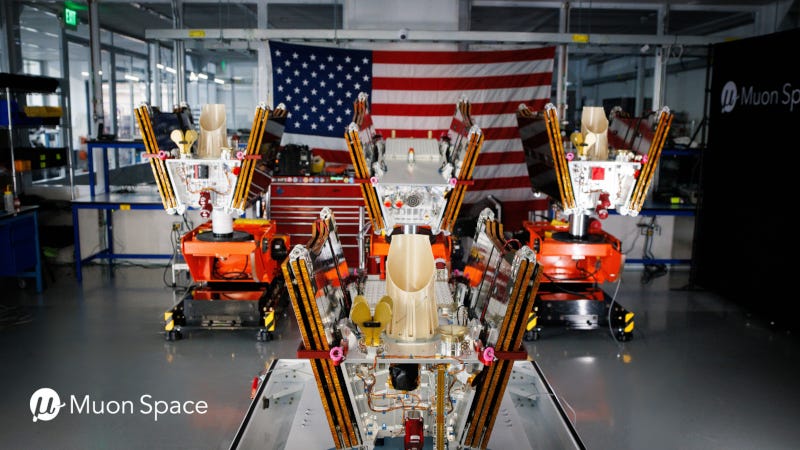
A new phase of operational scale, driven by a growing portfolio of government and commercial customers, an accelerating launch cadence, and increasing demand for its end-to-end, mission-optimized systems, is being anticipated by Muon Space.
“Customers are no longer asking for satellites – they’re asking for operational outcomes. They want high-performance missions delivered in months, not years.”
Jonny Dyer, Muon Space.
The company positions itself as “the Mission Foundry for high-performance satellite constellations”. Over the past year, Muon has continued to expand its government and commercial customer portfolio while scaling the organization to support increased demand. In 2025, the company secured major government contracts supporting missile warning and tracking and dual-use environmental monitoring, while successfully launching new commercial satellites and advancing multiple operational constellations. During the same period, Muon more than doubled its employee base and delivered over 100% year-over-year growth for the second consecutive year.
Building on this foundation, Muon is supporting multiple defense and civil customers, with additional announcements expected at a later date. The company has also secured several new commercial awards for 2026 spanning hyperspectral imaging, high-resolution thermal infrared sensing, BLE (Bluetooth Low Energy) detection, and high-quality weather data, with initial announcements expected in the near term and additional commercial milestones planned in the months ahead. Together, these programs reflect Muon’s transition to repeatable, operational deployment at constellation scale.
“Customers are no longer asking for satellites – they’re asking for operational outcomes,” said Jonny Dyer, CEO of Muon Space. “They want high-performance missions delivered in months, not years, with tight integration across spacecraft, sensors, and operations. That’s what the Mission Foundry delivers.”
The Mission Foundry: Where Missions Are Forged, Not Assembled
The Mission Foundry is Muon’s industrial approach to constellation development: spacecraft platforms, payloads, mission operations, and data processing integrated from first simulation to on-orbit operations. Customer constellations are designed, launched, and enter operation faster, more affordably, and with higher performance and reliability than traditional approaches allow.
The Foundry draws on Muon’s Halo technology stack, M-class and XL-class spacecraft platforms, in-house propulsion, and deep expertise in advanced sensor design. These building blocks serve missions across defense, civil, and commercial domains – maritime intelligence, wildfire detection, logistics, agriculture – without forcing customers into one-size-fits-all architectures.
Launch Cadence Accelerates
Muon is entering a period of sustained deployment, with an expanding launch manifest driven by growing government and commercial demand. In 2025, the company completed its third and fourth mission launches, setting the stage for higher operational tempo in 2026 and beyond. Upcoming programs span hyperspectral mapping, radio frequency (RF) sensing, thermal infrared sensing, weather and atmospheric intelligence, and other mission areas where rapid deployment and performance are critical.
Over the next 20 months, Muon has 20 satellites manifested for launch, underscoring the company’s shift from discrete missions to sustained, operational cadence across multiple constellations. Notably, many of these contracts were secured in the second half of 2025 alone, demonstrating the rapid acceleration of Muon’s market traction and momentum.
Near-term missions include deployments for customers such as SNC, supporting its next-generation Vindlér 2.0 constellation for RF collection and analytics functionality. The first three Vindlér satellites are scheduled to launch in Q1 2026. Three FireSats for Earth Fire Alliance will launch in mid 2026, expanding the constellation to significantly lower revisit times and enhance early wildfire detection and monitoring.
With additional missions already under contract and others in advanced stages of development, Muon expects its launch cadence to continue accelerating as more programs transition from demonstration to full operational deployment.